HOOK
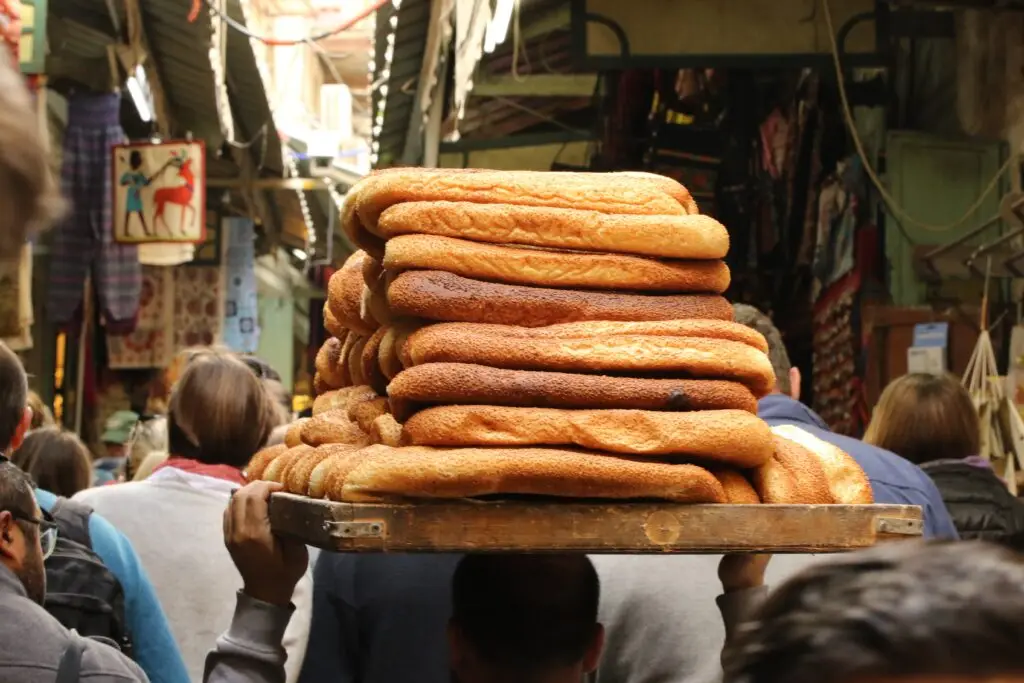
Egypt bought bread twice.
Not as a metaphor. In the first five months of 2026, the government paid its own farmers a premium price to hand over a record domestic wheat harvest — 4.6 million tons — and, in the same stretch of months, imported more foreign wheat than it ever had before: 7.1 million tons, up 65 percent from the year prior (Enterprise, 2026).
A country does not usually buy the same loaf twice. It does so only when it has stopped trusting the ship that was supposed to bring the next one.
The two currents behind that decision are easy to confuse but worth separating. One is the Strait of Hormuz — twenty-one miles wide at its narrowest, the corridor for up to 30 percent of the world’s traded fertilizer (FAO, 2026) — where tanker traffic has collapsed by more than 90 percent since February 2026 (CFR, 2026), driving the price of nitrogen an ocean away from any Egyptian field. The other is the Black Sea, the route Egypt’s own wheat actually sails, where the same season of regional escalation stretched freight rates and insurance premiums thin enough that Cairo, Amman, and Tunis all began buying earlier than usual (Enterprise, 2026). Different water. Same fear.
HISTORICAL CASE
A Ship That Sailed Before Washington Understood the Wind
Nations have panicked over grain before, though rarely with such good manners.
In the summer of 1972, the Soviet Union’s wheat harvest failed — winterkill followed by drought across the European USSR, a shortfall Moscow could not conceal from its own population much longer (Wikipedia, 2026). Rather than announce the crisis, Soviet trade representatives moved quietly through half a dozen American grain-trading houses and, inside three months, bought up nearly a quarter of the entire United States wheat crop (Wikipedia, 2026). They did it on favorable terms, too: a freshly signed $750 million line of credit, plus an export-subsidy structure that let them lock in fixed prices while the market around them had not yet noticed what was moving.
Washington found out roughly the way a farmer finds out his well has run dry — not from a report, but from the silence afterward. There was no real-time export monitoring system in 1972; Congress only mandated one the following year, after the fact, once the damage had already been priced into every loaf in the country (UPI, 2026). By the time officials reconstructed the pattern, American farmers who had sold early — before the scale of the Soviet buying became public — had unknowingly handed a windfall to the handful of grain conglomerates who brokered the deals, while everyone downstream absorbed the shock at the register. Wheat that sold for $1.68 a bushel in July 1972 was trading above $3.00 by the following spring, and global food prices climbed roughly 50 percent through 1973 (UPI, 2026; Daily Reckoning, 2026).
History calls the episode the Great Grain Robbery. The more useful word for it, though, is asymmetry. One party already knew its hunger was coming. The other did not learn it was being bought out from under itself until the shelves told the story.
Fifty-four years apart, the two governments failed — or passed — the same test in opposite directions. Washington in 1972 did not see the purchase coming until the silos were already lighter. Cairo in 2026 saw the same kind of shortage coming from a hundred miles away, and bought early anyway — not because it lacked information, but because, for once, the information was too clear to ignore.
BIBLICAL LENS
The Granary Egypt Already Knew How to Build
Egypt had lived a version of this story once before, long before Chicago had a grain exchange or Moscow had trade representatives — and the man who ran it for them left behind the oldest known blueprint for surviving a famine no one else saw coming.
“And Joseph gathered corn as the sand of the sea, very much, until he left numbering; for it was without number. … And the seven years of dearth began to come, according as Joseph had said: and the dearth was in all lands; but in all the land of Egypt there was bread.” (Genesis 41:49, 41:54, KJV)
What is easy to miss in that verse is how undramatic the actual mechanism was. Joseph performed no miracle of multiplication. He performed a miracle of foresight, converted into granaries — a network of city storehouses, built during seven years of surplus so ordinary that most of Egypt had likely stopped thinking about famine by year five.
“And in all lands famine prevailed; but in the land of Egypt there was bread. When all the land of Egypt was famished, the people cried to Pharaoh for bread.” (Genesis 41:54–55, RSV)
The text is careful to note that the famine was not local. It was regional — “in all lands” — which meant that by the time the crisis was visible to Egypt’s neighbors, the window for building storage had already closed for everyone who had not started early. Joseph’s advantage was never information Pharaoh’s other advisors lacked. It was a willingness to treat a good year as a warning rather than a reward.
Scripture is notably restrained about what this foresight was ultimately for. The surplus was not hoarded against foreigners. It was sold to them.
“And all countries came into Egypt to Joseph for to buy corn; because that the famine was so sore in all lands.” (Genesis 41:57, KJV)
Scripture does not require that every catastrophe be interpreted as divine judgment; it does, however, insist that societies eventually reveal the moral conditions under which they have chosen to live.
PATTERN INSIGHT
Fear and Wisdom Look Identical on a Balance Sheet
The instinct to stockpile is not, in itself, righteous. Fear can fill a granary as efficiently as wisdom can — the two look identical on a balance sheet, and only time reveals which one was actually operating. What separated Joseph’s storehouses from mere accumulation was never the accumulation itself. It was the third act, the one that costs more than storage: the doors opened, the grain sold back into a starving world rather than withheld from it.
That is the test the current numbers have not yet answered. Egypt is not only a buyer of fertilizer; it is a producer of it. When Egyptian urea rose 28 percent in a single week, the shock did not stay offshore — it moved straight into the cost of growing the record domestic harvest Cairo was simultaneously trying to bank (FAO, 2026). Egypt’s cereal import dependency ratio sat at 43 percent before this year’s disruption even began — lower than Tunisia’s striking 87 percent, but high enough that roughly 70 million people depend, directly, on wheat that must clear a chokepoint the government does not control (OECD, 2026). FAO’s chief economist has warned that nitrogen fertilizer follows a nonlinear yield curve — meaning a modest cutback by cash-strapped farmers today can produce a wildly disproportionate collapse in the harvest six to nine months from now (CFR, 2026). The damage, in other words, is not visible in the month it happens. It arrives later, as a loaf that costs more, or simply is not there.
Sudan offers the sharper edge of that same arithmetic. Local wheat prices there have climbed to more than $550 a ton — roughly 180 percent above 2021 levels — in a country with none of Egypt’s fiscal room to buy its way out twice (WFP, 2026). Two neighbors, one chokepoint, and only one of them able to afford the anxiety.
CLOSING
Two Granaries, One Door
Egypt’s decision to buy the same loaf twice was not a miracle and it was not folly. It was the ordinary, unglamorous arithmetic of a country that has learned, through repetition, that the lane it depends on can close without asking permission — and that the only defensible answer to that vulnerability is a granary, not prayer alone.
Joseph understood something modern risk models still struggle to price correctly: a surplus year is not evidence that the danger has passed. It is simply the last year in which building the storehouse is still cheap. Cairo, watching tanker traffic through Hormuz vanish by more than 90 percent in a matter of days, seems to have understood the same thing at a speed that would have been unthinkable in 1972, when an entire nation’s reserves could quietly change hands before anyone noticed the ship had already sailed.
What Joseph’s example leaves unresolved — for Egypt, and for every import-dependent nation now recalculating its exposure to a single strait or a single sea lane — is not whether the granary gets built. It is what happens at the door once it does: whether it opens outward, toward the neighbor whose own storehouse stands empty, or stays sealed against everyone but the household that filled it.
1. Torero, M., in “Fertilizer, Food, and the Fragility of Global Agriculture.” Council on Foreign Relations, June 3, 2026.
2. Wikipedia contributors, “1973 United States–Soviet Union wheat deal,” accessed 2026.
3. UPI Archives, “The great Soviet grain robbery — 10 years later,” originally published July 30, 1982.
4. Food and Agriculture Organization of the United Nations, “Agrifood policy highlights,” April 2026.
5. OECD, “Policies for the Future of Farming and Food in Egypt,” OECD Agriculture and Food Policy Reviews, 2026.
6. World Food Programme, “Worsening food crisis looming in Sudan,” 2026.
7. Enterprise, “Egypt is breaking records on both wheat procurement and imports,” June 2026.