In the week ending September 20, federal surveyors rated 89 percent of Texas topsoil as short or very short of moisture, with Oklahoma close behind at 82 percent (USDA, 2026). Within days, showers were crossing the southern Plains, while farther north a pocket stretching from southeast Minnesota into northeast Iowa had taken on more than seven inches, enough to leave harvest crews idling at the edges of sodden fields (AgWeb, 2026).
A grower in Texas and a grower in Iowa spent that week doing the same thing: standing at a fence line, looking up. Neither could summon a single drop, and neither could turn one away.
Ordinary people have always known this posture, and the ancients wrote it down first. In the previous installment, we examined why Israel split into two kingdoms, how Rehoboam’s refusal to listen turned one nation into two rivals. Within two generations of that fracture, a man from the hills of Gilead walked into the northern king’s court and announced that the sky would close.
Elijah’s story is usually told as a duel of fire. I think it reads better as a story about weather, and about what a body and a soul do once the weather finally answers.
A Nation That Bet on the Forecast
The wish to command the sky was never peculiar to ancient kings.
In the 1870s and 1880s, as settlers pushed onto the Great Plains, land promoters spread a pleasing idea: that plowing and planting would themselves draw rain. The slogan, remembered as “rain follows the plow,” gained credibility from a run of unusually wet seasons and from the confidence of the men selling the land. The historian Donald Worster later traced how that confidence hardened into an entire regional economy (Worster, 1979).
Half a century on, the prairie sod had been stripped for wheat, and the drought of the 1930s arrived. The topsoil that once held the region together rose into the sky as dust. What failed was more than a forecast. A whole culture had staked its livelihood on a story about rain that no one had the standing to promise.
Ahab’s Israel made a different kind of wager on the sky. Ahab married Jezebel, daughter of the Sidonian king (1 Kings 16:31), and Baal worship gained powerful royal patronage. The Ugaritic texts, our best window into Canaanite belief, portray Baal as a storm god who rides the clouds and sends the rains. The two wagers differ in almost every particular. What they share is a structure: a people’s livelihood resting on an answer to the question of who sends the rain.
When Elijah announced a drought, then, he was doing more than predicting weather. He was contesting who held jurisdiction over it.
Three Scenes, Falling in Volume
1 Kings 17:1 (paraphrased). Elijah told Ahab that, as surely as the Lord lives, the God before whom he stood, there would be neither dew nor rain in the coming years except at his word.
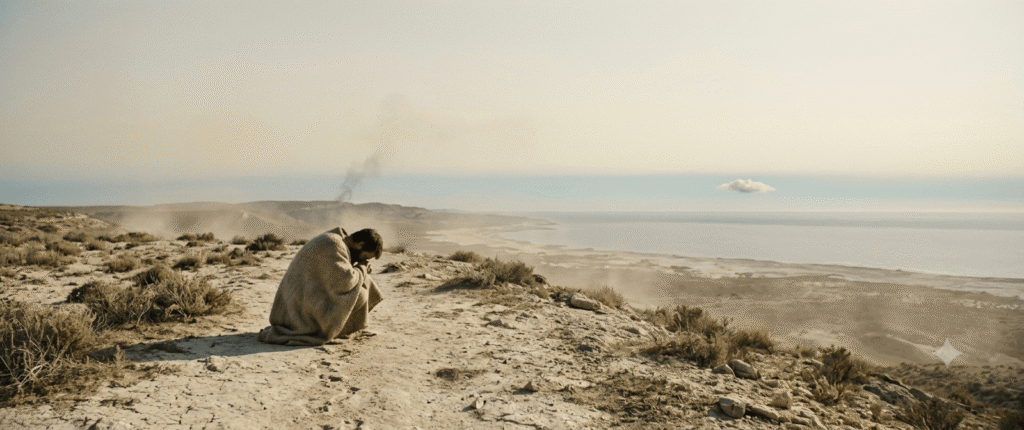
1 Kings 18:42–44 (paraphrased). While Elijah bowed to the ground with his face between his knees, his servant went to look toward the sea. Six times he came back with nothing to report. On the seventh, he saw a cloud no larger than a man’s hand, rising in the distance.
1 Kings 19:11–12 (paraphrased). A wind split the mountains, then an earthquake came, then a fire, yet the Lord was in none of them. After the fire came a sound so faint it was nearly silence.
Nothing in these chapters obliges a reader to treat every dry season as a verdict from heaven, though they do suggest that a people’s settled habits tend to stand exposed once the water stops.
Set side by side, the three scenes share a strange feature. The story begins with an oath, passes through a cloud the size of a hand, and ends in something barely audible. Its volume falls as it climbs.
The fire on Carmel is real, and the text credits it to the Lord (18:38). But at Horeb the narrator is careful to say that the Lord was not in the wind, the earthquake, or the fire. The loudest moments of that mountain are exactly where the story declines to place God’s presence.
The Arithmetic of the Mountain
The numbers in these chapters are unusually precise. Four hundred and fifty prophets of Baal are summoned to Carmel (1 Kings 18:19–22), and the summons names four hundred prophets of Asherah beside them. Against that, Elijah says, stands one man. After the fire and the rain, that man runs ahead of Ahab’s chariot to the entrance of Jezreel (18:46).
Then Jezebel sends word that she will take his life (19:2). Soon afterward he is in Beersheba, a town that belongs to Judah, where he leaves his servant and goes another day’s journey into the wilderness. He sits down under a broom tree and asks to die (19:3–4). Later he walks forty days to Horeb (19:8).
The text sets these facts side by side and declines to explain the gap. It offers no diagnosis, only sequence: victory, threat, flight, collapse.
The man who outran a chariot could not outrun his exhaustion. Here the pattern turns. We tend to assume the cost of a crisis ends when the crisis does, but Elijah’s collapse begins at the height of his success, before the rain has dried on the ground. The week’s weather offers a quieter parallel. Too little rain had stressed pastures across the southern Plains, and too much had stalled harvests in the Corn Belt. Either way the farmer paid.
The first thing God offers the prophet under the broom tree is neither argument nor correction. It is bread and water and sleep, twice over, with the acknowledgment that the road ahead is too much for him (19:5–8). Only afterward does the question come, What are you doing here, Elijah?, and it comes twice, because the first answer carries the same complaint as the second (19:9–14). In it Elijah describes himself as the last faithful man in Israel.
Elijah’s private arithmetic was wrong. Earlier in the same story, the palace steward Obadiah had hidden a hundred prophets in caves and fed them bread and water (18:4), so the prophet was less alone than he believed. The answer Elijah received was not another spectacle, but a quiet correction: seven thousand had not bowed to Baal (19:18). It is worth noticing what the text withholds. Elijah is neither scolded for despair nor praised for endurance, and before the chapter closes a successor is named (19:16), so the burden will no longer be carried by one man.
Abraham Joshua Heschel argued that the prophets were not detached messengers. In his account they carried the divine concern as a felt weight, a shared passion for the people they addressed (Heschel, 1962). Read that way, Elijah’s exhaustion need not be treated simply as a failure of faith. It can also be read as the cost of carrying a people’s crisis for too long. For anyone whose work is also a calling, the passage offers an unhurried recognition that such a cost is real and is not always visible from the outside.
The cloud may be the most telling detail of all. Vindication does not announce itself in the story. It begins as a smudge on the horizon that a servant must be sent to look for seven times, while the prophet himself waits bowed to the ground with his face between his knees (18:42–44). It is hard to read that posture and not sense that something was already being spent.
The Bill Comes Due After the Rain
We usually picture relief as the final scene: the drought breaks, the field greens, the story ends. Elijah’s chapters suggest that relief is often where the account is finally presented, once adrenaline has run out and the work that held everything up can be set down.
The two growers from the opening are still looking at the sky. It is the same sky over both fields, and one grower is waiting for water while the other is waiting for it to leave. Each is carrying something the forecast never mentioned.
The text does not prescribe a cure in triumphant terms. It offers bread, sleep, a question asked patiently twice, and a correction delivered in a whisper. The whole story descends in volume, from oath to cloud to silence, and the recovery happens at its quietest end. Whatever we make of the fire on Carmel, the story keeps its real weight for the quiet room afterward.
A drought can end in an afternoon. What it cost a person tends to arrive later, unannounced, in a place with no audience.
- Abraham J. Heschel, The Prophets (New York: Harper & Row, 1962), on prophetic pathos.
- Donald Worster, Dust Bowl: The Southern Plains in the 1930s (Oxford University Press, 1979).
- USDA agricultural weather summaries, as cited in the September 25, 2026 farm weather report; AgWeb, “Ring of Fire Pattern Fuels Historic September Rain,” September 2026.