HOOK
He Bought It Knowing It Would Not Be Enough
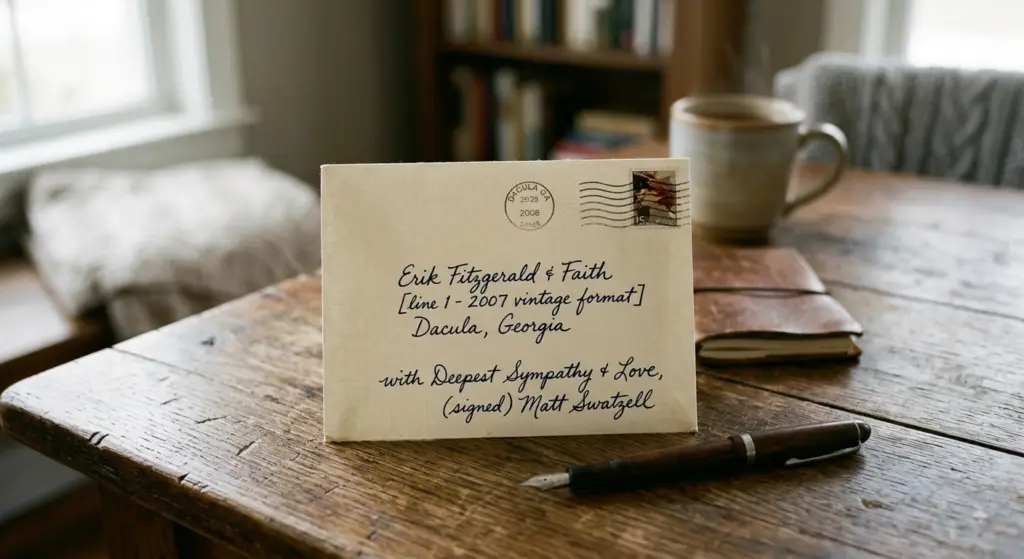
Two years after the accident, Matt Swatzell walked into a grocery store and bought a sympathy card. He didn’t buy it for a stranger’s funeral, and he didn’t buy it out of obligation. He bought it because he didn’t know what else to do with what he was carrying, and a card seemed like a start.
He had not spoken to the man he was buying it for. Not once, not in two years — not during the investigation, not in the courtroom, not after. He knew the man only as a name on legal paperwork: Erik Fitzgerald, husband of the woman who had died in the crash Swatzell caused.
The card could not undo anything. It could not return June Fitzgerald to her husband, or the child she was carrying, or the version of Faith Fitzgerald who would have grown up with both parents in the house. Swatzell knew this. He bought it anyway.
That’s the detail worth sitting with before the rest of the story explains itself: a grown man, standing in a checkout line, holding a piece of paper he already knew was insufficient.
The accident happened on Oct. 2, 2006, outside Dacula, Georgia. Swatzell, twenty years old and a rookie firefighter-paramedic, was driving home after a twenty-four-hour shift when he drifted across the center line for three or four seconds, as NBC’s TODAY reported in a 2026 interview with both men. In the oncoming car was June Fitzgerald, thirty, seven months pregnant, her nineteen-month-old daughter Faith buckled in the back seat. June and the unborn child did not survive. Faith did.
At the hospital that night, a grief counselor told Erik Fitzgerald, a pastor, that his wife was gone. He walked into his daughter’s room, and she climbed into his lap and fell asleep. He has said, since, that he was grateful for that — for the several minutes he didn’t have to perform being okay.
In a different room of the same hospital, a police officer was telling Swatzell what he’d done.
In the previous installment, we examined what it costs a person to carry grief without asking anyone to help carry it. This story begins in that same private register — a husband alone with news no one else can absorb for him, a young man alone with a fact he cannot undo. But it doesn’t stay there. It becomes, eventually, a story about what two men chose to do next, separately, without speaking to each other for two years.
HISTORICAL CASE
The Right to Punish
Prosecutors approached Fitzgerald, as they often do in cases like this, to ask what he wanted them to pursue. His input was not a formality; a victim’s family’s wishes routinely shape what a prosecutor argues for, even where the law leaves final discretion to a judge. Fitzgerald could have asked for the maximum the system allowed.
In the United States, this was never fully Fitzgerald’s decision to make. It is the State, not the grieving spouse, that formally brings a criminal charge, and a prosecutor’s obligation runs to the public rather than to any one family. What Fitzgerald had was narrower than authority — an invitation to be heard by a system that didn’t owe him the floor. Declining to ask for the maximum was not simple generosity. It was one man using the single point of leverage the law allowed him to keep the machinery of prosecution from running all the way to its harshest setting.
He has said he remembered a line from a sermon — that tragedy hands a person the option of grace or vengeance — and that he chose, deliberately, the one that asked more of him. Swatzell was sentenced to community service and a fine.
South Africa’s Truth and Reconciliation Commission, convened in 1996 under Archbishop Desmond Tutu, asked a related but much larger question: whether a nation could survive an atrocity like apartheid without making punishment the only available language for addressing it. Perpetrators who gave full public testimony of their crimes could receive amnesty, as Tutu described in his 1999 memoir, No Future Without Forgiveness. Its legacy remains contested — historians and survivors still disagree about whether it delivered justice or simply deferred it — but it permanently complicated the assumption that justice after mass harm has to mean prison.
The comparison has a limit worth stating plainly: the TRC traded testimony for amnesty inside a negotiated political settlement. Fitzgerald received no such trade. Nothing was owed to him for choosing grace, and nothing was promised to him in return.
Fitzgerald’s decision was not a national commission. It was smaller, and in some ways more exposed: one grieving man, alone, deciding what he would do with the legal standing he’d been given to ask for more suffering. No hearing, no historical precedent, no one to share the weight of the decision with him.
BIBLICAL LENS
What Forgiveness Is Not
The word “forgiveness” gets used loosely enough that it’s worth being careful with it here.
Forgiving Swatzell did not mean Fitzgerald decided the crash didn’t matter, or that June’s death required no accounting. It did not restore his marriage, return his unborn child, or give Faith back the childhood she would have had. Forgiveness, justice, reconciliation, and healing are four different things, and this story is interesting precisely because they didn’t all arrive together, or at the same pace, or completely.
Scripture treats forgiveness less as a feeling than as a decision — one a person can make before they feel anything resembling peace, sometimes long before.
“Vengeance is mine; I will repay, saith the Lord.” — Romans 12:19
Paul isn’t telling the Roman church that the wrong doesn’t matter, or that justice is beside the point. He’s narrower than that. He is asking them to give up their claim to be the one who settles it. Fitzgerald didn’t have to decide the crash was a small thing. He had to decide he would not make himself its final judge.
The same movement shows up earlier, and more starkly, in Genesis. Joseph — sold by his own brothers, imprisoned on a lie, risen finally to power in Egypt — meets those same brothers years later, starving, standing in front of him without knowing who he’s become.
“Be not grieved, nor angry with yourselves, that ye sold me hither.” — Genesis 45:5
He doesn’t claim the betrayal didn’t happen. He refuses to let it be the only thing that gets to happen next. Forgiveness, read this way, is not the rewriting of the past. It is a refusal to let the past become the sole author of the future — the same moral movement, appearing again in a much smaller courtroom thousands of years later.
The philosopher Hannah Arendt, writing decades after watching a European civilization collapse into genocide, arrived at something close to this from an entirely different direction. In The Human Condition, she described forgiveness as the only available answer to what she called the predicament of irreversibility — the plain fact that an action, once done, can never be undone.¹ Forgiveness doesn’t erase the deed, in her account. It’s what allows the person who suffered it to act again, rather than remaining permanently defined by what was done to them. Arendt wasn’t writing about scripture. She was describing, in a different vocabulary, roughly the same maneuver Joseph makes.
There is a quieter text worth setting alongside these two. When Job’s friends first arrive, before any of them says a word about God or justice or why any of it happened —
“They sat down with him upon the ground seven days and seven nights, and none spake a word unto him.” — Job 2:13
Before scripture teaches anyone what to say to a person in loss, it shows them how to sit beside one. Whatever moved Swatzell to buy a card he couldn’t write two sentences into — that same instinct, unglamorous and mostly wordless, is closer to what these texts are describing than any tidy account of forgiveness is.
PATTERN INSIGHT
The Evidence for Sitting Across the Table
Restorative approaches to justice — processes built around direct contact between the harmed and the person who caused the harm, rather than punishment alone — have accumulated enough research now to be evaluated on more than sentiment.
In a landmark 2007 review, criminologists Lawrence Sherman and Heather Strang examined thirty-six direct comparisons between restorative conferencing and conventional criminal processing across the UK and abroad.² The findings do not offer a clean case for grace. In at least two tests each, restorative conferencing substantially reduced repeat offending — for some offenders, not all. Victims who took part reported fewer post-traumatic stress symptoms and less desire for violent revenge against the person who’d harmed them, along with higher overall satisfaction with how their case was handled, than victims routed through standard prosecution.
The evidence doesn’t prove that forgiveness heals people. It suggests something more modest: when an offender is made to sit across from the specific human cost of what they did, something happens that a courtroom, working from a distance, rarely produces on its own.
Swatzell didn’t get that face-to-face reckoning in court. He and Fitzgerald never spoke during the proceedings. He got it two years later, in a grocery store parking lot, holding a card, when a grieving father he barely knew started walking toward his truck instead of away from it.
“He was just bawling,” Fitzgerald has said of that first meeting. “So I just walked up and I just hugged him.” Two years of guilt came out of Swatzell all at once. He has said it was the greatest relief he has ever felt — hearing, finally, that he was forgiven.
But Swatzell has also said something else, something the tidier version of this story tends to leave out: that he isn’t sure, even now, whether he’s forgiven himself. Fitzgerald extended something Swatzell has not yet been able to extend inward. Forgiveness, given this way, behaves less like a settlement than like a gift — freely extended, but never something the receiving side is guaranteed to be able to accept, even from himself. That gap may be the most honest part of this story.
CLOSING
What the Card Could Not Do
Fitzgerald has since remarried and had another child, born on the same due date as the baby he and June had been expecting. He does not claim to know what the coincidence means. He only knows what it means to him.
Swatzell, now thirty-two, has children of his own. Faith is twelve. The two families spend time together, especially around holidays — not because the story resolved into something clean, but because the next generation has grown up alongside it rather than outside it.
Swatzell has said, plainly, that this isn’t a story with a tidy ending. It isn’t. What forgiveness gave these two families was not an undoing of October 2, 2006. It was a way to keep living near the wound instead of around it.
That was not why it mattered.
¹ Hannah Arendt, The Human Condition (University of Chicago Press, 1958).
² Lawrence W. Sherman & Heather Strang, Restorative Justice: The Evidence (Smith Institute, 2007).
New essays every week. Delivered quietly.