The Watchtower Files
What the Doorbell Camera Saw
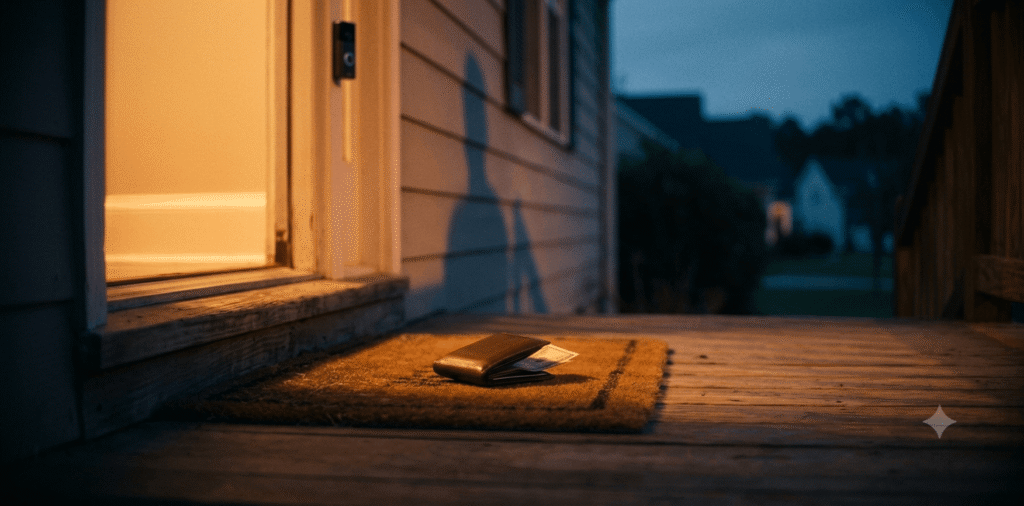
A Ring camera outside a house in McDonough, Georgia, recorded twelve unremarkable seconds — and missed the part that actually mattered.
What the lens caught was ordinary enough: a young man in a T-shirt that read Smile, standing on a stranger’s porch, holding out a wallet. The shirt wasn’t chosen for the occasion — it was just what he’d put on that morning — but it makes an accidental kind of argument anyway: a stranger’s cheerful slogan on the outside, and underneath it, a decision nobody had asked him to make.
Tyrese Smith had lost that wallet less than an hour earlier — fifty dollars in cash, every card still in its slot. Nothing in it would have made headlines on its own. But it was exactly the kind of ordinary loss that turns an afternoon into a scramble: canceled cards, replacement fees, the small tax an honest mistake charges an ordinary life. That was the whole size of what was at stake, and it was still enough of a test.
The man on the porch didn’t leave a note. He found an address tucked inside the wallet, drove across town, rang the bell once, and left before anyone could properly thank him.
Smith didn’t even know his name. He posted the doorbell image to a local Facebook group, hoping someone would recognize the stranger. The answer came from the man’s own father, scrolling the same group — recognizing his son in the frame before Cameron had said a word about it at home (Crosswalk.com, 2026).
The Envelope in the Shopping Cart
Fourteen years earlier, on the other side of the country, a different Walmart parking lot produced a similar test — with a much larger number attached.
In October 2012, Bismark Mensah was collecting shopping carts outside a Walmart in Federal Way, Washington, a part-time job that paid just over nine dollars an hour. Mensah, who had immigrated from Ghana earlier that year, was used to finding stray items left behind in carts — keys, cards, the occasional wallet. This time it was a white envelope, its window thick with cash: twenty thousand dollars, meant for a couple’s down payment on a house, left behind when it slipped from a purse (Seattle Times, 2013).
Mensah didn’t hand it to customer service and let the matter end there. He ran through the parking lot after the couple’s car and caught them before they pulled away. Asked afterward whether he’d been tempted, even briefly, he gave an answer shorter than the moment deserved: “My conscience wouldn’t allow it” (Seattle Times, 2013). Walmart later gave him a national honor for it — a plaque, a promotion — but that came after the choice, not because of it.
No one was filming that parking lot either. It’s a detail worth pausing on, because a different piece on this site once traced how a lie only has to match what someone is already prepared to believe — Xerxes fell for a story about a weak, divided enemy because it was the story he already wanted to be true. Mensah’s refusal runs on the same mechanism, aimed the other way: the size of the money never had a false story about himself to work with, because he’d already decided who he was going to be.
Two men, a decade apart, in the same retail chain’s parking lots, made the same unremarkable-sounding choice.
There was no audience.
That is the entire point.
The Small Things That Tell the Truth
“Whoever can be trusted with very little can also be trusted with much, and whoever is dishonest with very little will also be dishonest with much.” — Luke 16:10
“The integrity of the upright guides them, but the unfaithfulness of the treacherous destroys them.” — Proverbs 11:3
Zacchaeus’s declaration in Luke 19 — that he would repay four times what he’d taken — wasn’t required by any authority standing over him. Nothing in the text suggests anyone would have known if he’d simply kept collecting what he’d overcharged. His public declaration reads like the outward form of a change that had already happened somewhere less visible.
Scripture isn’t asking anyone to diagnose a soul from a single afternoon, or to read one returned wallet as proof of a devout heart — a moment like that rarely carries that kind of verdict. What it does ask is narrower, and harder to escape: that the small, unsupervised choices are where character eventually tells the truth about itself, whether or not the choice ever needed telling.
When the Data Ran Backward
For decades, the working assumption in behavioral economics ran the other direction: the more valuable a lost item, the less likely a stranger is to return it. Temptation was assumed to scale with the prize.
In 2019, a team of economists tested that assumption directly. Across 355 cities in 40 countries, they “lost” more than 17,000 wallets — some empty, some holding a small amount of cash, some holding considerably more — and tracked how often each one made its way back to its owner. The result ran backward from what most people predicted, including the professional economists surveyed beforehand. Wallets containing more money were more likely to be returned, not less: reporting rates climbed from roughly 40 percent for an empty wallet to more than 70 percent for one holding real cash (Cohn et al., Science, 2019).1
The researchers proposed that one force behind the pattern was less about weighing costs and benefits than about what psychologists studying dishonesty sometimes call self-concept maintenance — the discomfort of acting in a way that would force a person to revise what they already believe about themselves. Cohn and his colleagues describe their own version of it more plainly: an aversion to viewing oneself as a thief, one that grew rather than shrank as the money on the table grew larger. That is their reading of the data, not scripture’s. But it lands in roughly the place Proverbs assumed without needing a field experiment across forty countries: character isn’t manufactured in the moments everyone is watching. It surfaces first in the ones no one is measuring.
The Decision the Camera Missed
The decision itself — to walk toward an address instead of away from it — happened somewhere between the checkout line and Cameron’s car, in the part of the story no camera caught. By the time the Ring doorbell picked him up, the choice was already finished. All the footage shows is a stranger in a Smile shirt, waiting to hand back something that was never going to be missed if he’d simply kept walking.
The same was true in a Federal Way parking lot fourteen years earlier — a decision to treat someone else’s twenty thousand dollars as something he was only holding, not something that had quietly become his because no one was there to stop him. This blog has made a version of that same argument before, about a much smaller room offered in a much larger crisis: that what belongs to someone else, however briefly it passes through our hands, tends to ask more of us than it ever asks of the person waiting on it — and that the decision to honor that claim is usually made before there’s any proof it will be worth making.
The camera recorded the gesture. It missed the decision.
1. Alain Cohn, Michel André Maréchal, David Tannenbaum, and Christian Lukas Zünd, “Civic Honesty Around the Globe,” Science 365, no. 6448 (2019): 70–73.
New essays every week. Delivered quietly.