WAITING & TRUST
A Boarding Pass to a Stranger’s Country
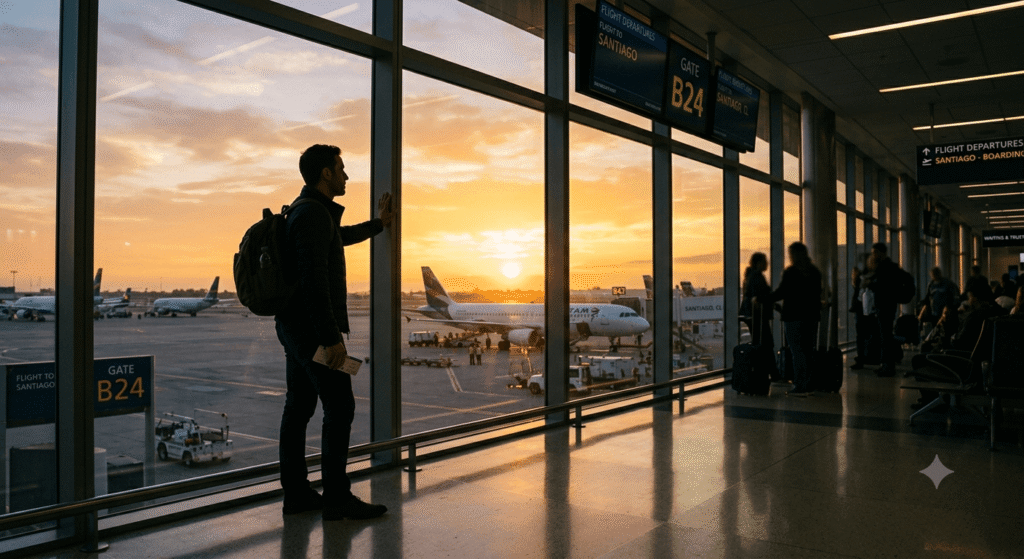
On the morning of February 13, 2026, a thirty-six-year-old data analyst named Kyle Adler stood in a Miami airport terminal, checking a flight to a country he had never visited, to meet a woman he had never met.
He was not going on vacation. He was going to find out whether the story he had been told about his own beginning was true — and, without quite framing it this way, to prove that he had not stopped asking the question long enough to let it close.
For thirty-six years, Adler had understood himself as a Chicago-suburb kid, adopted at nine months old by a couple named Mike and Connie Adler. He has said, since the reunion, that he does not believe his parents knew the circumstances of his adoption, and that however they raised him, they did it out of love rather than malice (AP, 2026). But that love had one boundary neither of them crossed while they were alive: neither had supported his decision to search for his birth mother, and neither lived to see the day he found her.
He landed in Santiago the next day. Waiting for him was Ana Maria Navarrete, who had been nineteen years old and working night shifts at a fish shop in the coastal town of Coronel when her son was taken from her more than three decades earlier.
“It’s been so eye-opening to see who my people are,” Adler said, describing the reunion (AP, 2026).
He did not have to choose between the family that raised him and the woman who gave birth to him. But reunion did not make the question of who his people are simpler. It only gave him a second, equally real answer to sit beside the first one.
The Question That Wasn’t Allowed
To understand why Navarrete spent over three decades not knowing whether her son was alive, it helps to understand what she was up against.
Between the early 1970s and the late 1990s, Chile went through a period in which infants — disproportionately the children of poor, young, and single mothers — were funneled out of hospitals and into international adoption pipelines. Mothers were frequently told their babies had died shortly after birth. Paperwork was falsified. Files were sealed. The children were sent, legally on paper, to families across the United States and Europe who had no reason to suspect anything was wrong.
Estimates of the total scale vary by source and by decade, which is itself worth naming rather than smoothing over. A Chilean judicial inquiry opened in 2018 has examined the circumstances of roughly eight thousand overseas adoptions between 1970 and 1999. Chile’s legislature and independent researchers, drawing on a wider window of years, put the fuller number closer to twenty thousand. These are not two competing claims; they are two different lenses on the same unfinished investigation.
The moral failure here was never adoption itself. Loving, legitimate adoption is not what this essay is describing. What is being described is a system that manufactured adoptions through deception and the deliberate destruction of informed consent — a distinction worth holding onto, for the sake of every family, adoptive or biological, this story touches.
What makes that system hard to file away as a single villain’s crime is exactly what makes it worth pausing on. A 2025 criminal case out of the city of San Fernando named the network plainly: health officials, a Catholic priest, attorneys, social workers, and a sitting family court judge, allegedly delivering stolen infants to foreign couples for fees reported as high as $50,000. The disturbing part was not only that individual people did wrong. It was that responsibility could be distributed across so many procedural roles that no single person appeared to own the whole act.
That is why DNA databases and nonprofits built by former adoptees — organizations with names like Nos Buscamos and Connecting Roots — have spent the last decade doing something no government office was designed to do: reopening files that were built to stay shut.
What the Text Already Knew
Long before DNA testing existed, two of the oldest stories most of Watchman Insight’s readers know were already circling this exact shape.
In Luke’s account, a father sees his son “while he was still a long way off” — the detail worth sitting with is not the son’s return but the father’s watching: someone who had kept scanning that horizon for longer than made obvious sense, on the strength of a hope he apparently never fully set down. It is closer to Navarrete’s thirty years at a fish shop in Coronel than to anything Adler did by boarding a plane. When the son does arrive, the father does not lead with an accounting of what was lost. He says the boy “was dead, and is alive again; he was lost, and is found” (Luke 15:24).
Older still is Joseph — sold by his own brothers as a boy, rising to power in a foreign country under circumstances that have nothing to do with the family that lost him. When he finally reveals himself, it is not to accuse. It is simply: “I am Joseph your brother, whom ye sold into Egypt” (Genesis 45:4). The wrong his brothers did him is not undone by what he becomes afterward, and the text does not pretend it is; Joseph’s rise restores a relationship, not the years, and not the crime.
Scripture does not explain the Chile case, and it would be dishonest to claim it does. What it offers instead is another language for thinking about it — one older than DNA testing, that has always understood there to be a difference between a family severed and a family erased. Even the psalmist’s quieter promise, that “when my father and my mother forsake me, then the Lord will take me up” (Psalm 27:10), belongs to that same vocabulary: not an explanation, but a place to stand while the explanation is still missing.
Scripture does not ask us to treat every long separation as a lesson written in advance; it does ask us to notice what a person quietly protects, or fails to protect, across the years — because that, more than any single reunion, reveals the terms two people, or a whole system, chose to live by.
The pattern here is narrower than “everything works out.” It is that a searching parent, a hidden child, and a return that reframes rather than erases the years in between is not a new story. It only has new paperwork.
The Numbers Behind the Reunion
Adler and Navarrete’s story is easy to read as a single, complete headline. It is more honest to read it as one resolved case inside a mostly unresolved pattern — and the two tracks, restoration and reckoning, are worth separating instead of collapsing into one another.
Reunion is not justice. Justice is not reunion. A family can need both, on different timelines, without either one canceling out the need for the other.
On the reckoning side: in June 2025, a Santiago Court of Appeals judge filed Chile’s first criminal charges in this scandal, issuing arrest warrants against five people tied to the San Fernando network. It was, by multiple accounts, the first time in the country’s history anyone had been formally charged over the decades-long practice — and it covered two children, out of a case count still estimated in the thousands. The gap between those two numbers is not a footnote. It is the story’s second half.
On the restoration side: the nonprofit Nos Buscamos alone has facilitated more than 450 reunions over the past decade. That is a real number, and a small one, set against twenty thousand estimated cases. Most of the mothers who were told their babies had died are still, as far as the public record shows, only told that.
That asymmetry matters for anyone drawn to this story mainly for its ending. Not every missing child is found. Not every mother receives a phone call, a DNA match, or a boarding pass. A theology of waiting that only makes sense to the people who eventually got their reunion is not yet a theology of waiting — it is a theology of luck with religious language attached.
Which is where hope has to be defined more carefully than the word usually allows. Hope, in Navarrete’s thirty-six years, was not a prediction that her son was alive. She had no way to know that. Hope was something smaller and harder to sustain: the refusal to treat what she could not see as though it had already stopped mattering.
A Boarding Pass, Read Differently
Go back to the terminal in Miami, to a man checking a flight to a country he’d never visited.
At the time, it may have felt like a ticket to an ending — the flight, the arrival, the embrace waiting on the other side. It was actually something narrower and, in its way, more durable: proof that someone had finally decided the question was worth crossing an ocean to ask.
The waiting itself was never the empty part of the story. What it actually was, for thirty-six years, was Navarrete declining to accept the only account she had been given — that her son was gone — without a single piece of evidence that refusing to accept it would ever change anything.
Scripture leaves us with a harder possibility than a happy ending: that the years between leaving and return are not empty simply because we cannot see, from here, what they are becoming. Waiting is not certainty about how the story ends. It is what a person does with a life while the ending stays hidden.
A Note on Sources: The reunion described above is drawn from Associated Press reporting (Vanessa A. Alvarez, May 28, 2026). The estimate of roughly twenty thousand irregular Chilean adoptions comes from a 2025 peer-reviewed account in Critical Debates in Humanities, Science and Global Justice, cross-referenced against the narrower figure of eight thousand cases examined under Chile’s 2018 judicial inquiry. The June 2025 criminal charges against five people tied to the San Fernando network are reported by CNN and ABC13. The figure of more than 450 completed reunions belongs to the nonprofit Nos Buscamos, via Euronews/AP reporting from 2023.
New essays every week. Delivered quietly.