The Grandmother Who Signed Nothing
She took the two children in the same week the county called — a dish towel still over one shoulder, a stack of school forms with someone else’s name on them, and nothing else with her name attached to any of it. No license. No home study. What she offered instead was simpler: she was already, unmistakably, theirs.
Kinship care is a broader category than most people realize — a relative can take responsibility for a child formally, through the child-welfare system, or informally, through nothing more than a decision made at a kitchen table — and in fiscal year 2024, well over a hundred thousand American children in foster care were living with a relative rather than a stranger.1 Most of those homes, researchers found, were never formally licensed at all.
The gap is not hidden. Legislators in West Virginia spent part of this year arguing over how quickly the state could get money to relatives who had already taken children in, sometimes years earlier, on nothing but their own initiative.2 As of this winter, only a couple dozen states and tribal jurisdictions nationwide had formally rewritten their federal child-welfare plans to treat kinship homes differently from stranger foster care. Across most of the country, an aunt or grandfather who steps in still does so largely on the strength of blood alone, well ahead of whatever paperwork eventually arrives.
The relative usually acts before the law has a category ready for what she is doing. She does not wait for a license to decide a child belongs to her.
Long before any of this had a federal acronym, a story in the Hebrew Bible ends at a city gate, in front of ten witnesses, with exactly this kind of decision — and, for once, a law hurrying to catch up to it.
The Law That Both Broke Families and Was Asked to Mend Them
The clearest historical case of a family redeeming what the law had not yet protected is not a gentle one, and it is worth sitting with the discomfort rather than smoothing past it.
The Thirteenth Amendment freed roughly four million people, but freedom did not arrive evenly. Across the former Confederacy, state legislatures passed apprenticeship laws letting courts bind Black children to white households “to learn a trade,” often on the claim that a parent was unfit — a judgment made, in many cases, by the same local authorities who had spent the previous years enforcing slavery itself. Courts justified the practice under parens patriae, the doctrine that the state may act as a child’s ultimate parent when it deems a family unfit — a legal principle built for protection, repurposed here to bind children to households that differed from their own recent bondage in little but name. Historian Mary Frances Berry’s archival findings, tracing individual court cases across the postwar South, document children legally re-bound to households connected to their own former enslavement, sometimes within the same season freedom was declared.3
Here is the part worth not simplifying: the same legal system doing this was also, eventually, the system parents turned to in order to undo it. Petitions, testimony, and court appearances — filed by mothers, grandmothers, uncles, often without a lawyer — became the mechanism that pried some children loose again. Law, in this period, was not simply slow to protect families. It had actively separated them, and then, imperfectly, became the only lever available to put them back together. That double function does not resolve into a tidy moral. It is closer to the truth than either half alone.
What finally changed, generations later — the Bureau’s guardianship authority, later civil rights statutes, today’s child-welfare codes that name kinship placement as a preferred category rather than an afterthought — arrived long after families had already been doing, case by case, the work the law eventually got around to naming. Legal recognition, again and again, was the last thing to change hands, not the first.
What Happened at the Gate
Ruth’s earlier chapters end with a field and a harvest. Her final two end with something closer to a legal proceeding, and the book spends more verses on its exact mechanics than on almost anything else in the story.
It is worth pausing on Ruth herself before the transaction absorbs her. She is not simply “a relative” waiting to be redeemed; she is a Moabite widow with no legal standing in Israel at all, who chose, earlier in the story, to attach herself to a people and a God that owed her nothing. Ruth complicates what kinship even means. She belongs to Naomi’s family by decision more than by blood, which makes the redemption that follows a story about belonging that is claimed as much as it is inherited.
Naomi sends Ruth to the threshing floor at night to uncover Boaz’s feet and lie down — a request whose precise social meaning scholars still debate, but whose narrative function is clear enough: Ruth is asking Boaz to act as go’el, kinsman-redeemer, for her family. Boaz does not treat this as forward. He treats it as a claim requiring process.
“There is a kinsman nearer than I.” (Ruth 3:12, paraphrased)
Custom requires Boaz to offer a closer relative first right of refusal, in public, before witnesses. The next morning he sits at the gate, a public place where legal and civic matters were conducted, and waits.
The narrator does not dignify this nearer kinsman with a name. The Hebrew text calls him only peloni almoni — roughly “so-and-so” — the ancient equivalent of a redacted name in a court transcript. He is not a villain. He agrees to redeem the land, and only withdraws once Boaz clarifies that the arrangement includes marrying Ruth and raising an heir who would inherit in another man’s name, not his own.
“I cannot redeem it for myself, lest I mar mine own inheritance.” (Ruth 4:6, paraphrased)
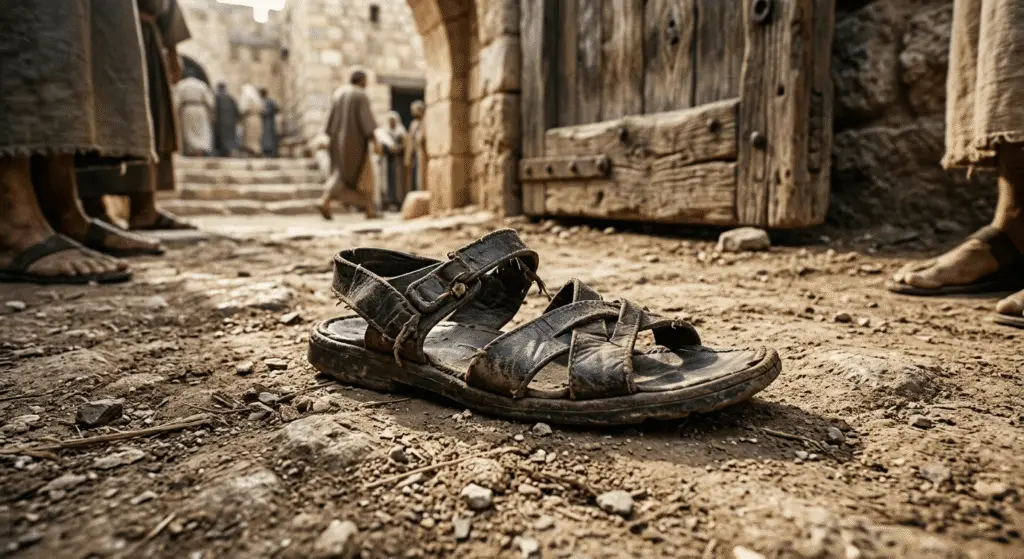
He is not punished for the calculation. The text simply lets it stand — a man who had already done the arithmetic on what family loyalty was going to cost him, and decided the number was too high. He removes his sandal and hands it over. The gesture carried real legal weight: surrendering a sandal was a recognized way of publicly relinquishing a right of purchase, done before elders so the transfer could never later be disputed — a physical object standing in for a claim no document yet existed to record.
The text portrays Boaz as willing to take on a costly obligation the nearer kinsman declines — not because the law demanded that particular outcome, but because he chose to absorb it. The son born to Ruth and Boaz is Obed, father of Jesse, father of David. A private decision, transacted in public precisely so it could not later be erased, becomes the ancestry of Israel’s greatest king.
What a Law Can and Cannot Manufacture
Ancient Israelite law anticipated that families would sometimes fail — through death, debt, or displacement — in ways no institution could fully prevent on its own. What it could not anticipate in advance was which relative would actually step forward, or what it would specifically cost him. The law set the frame at the gate. It did not, and could not, make Boaz walk through it.
That gap has not closed in three millennia; it has only changed shape. What does a society owe the people who step forward before its own systems are ready for them? Federal policy increasingly names kinship placement as the preferred outcome for a child who cannot stay with a parent.4 What it cannot yet guarantee, in most of the country, is that the relative who takes on that placement will be paid, licensed, or supported anywhere near what a stranger foster parent receives for identical work.
None of this makes the informal path automatically the right one. Kinship is not automatically safety. Blood is not automatically virtue. A relative can be exactly the wrong person to trust with a child, and an institution’s slowness is not proof of its irrelevance. Bureaucracy, meanwhile, has its own honest function: a home study and a monthly check exist because good intentions are not always enough, and because someone, somewhere, has to ask the harder question a family member may be too close to ask. A good system does not ask its laws to manufacture love. It asks its laws to recognize, protect, and sustain the people who have already chosen to carry its cost.
The sandal at the gate was never the mechanism of redemption. It was the record of one — proof, after the fact, of a decision that had already been made, probably somewhere between the threshing floor and sunrise, that this family’s survival was now Boaz’s to carry.
What the Elders Witnessed
Ruth does not end by praising family loyalty over legal machinery. It ends by watching the two meet — a private act of redemption walking, deliberately, into the most public institution the town had, until ten elders could witness it and a genealogy could record it. Boaz did not avoid the gate. He went looking for it the very next morning, as if he already understood how easily an unrecorded redemption disappears.
That is the piece worth setting beside every quieter version of it since — a grandmother taking two children on a phone call, a dish towel still over her shoulder and someone else’s name still on the school forms; parents arguing kinship in a postwar southern courtroom; an aunt raising a niece in a home the state has not yet licensed. In each case, someone acted before the paperwork existed to describe what they were doing. In each case, whether the paperwork ever caught up mattered anyway.
Obed’s name survives four generations later, in a shepherd boy anointed in a field, because someone once thought to write down what had happened at that gate.
The redemption is what a family decides to do before anyone is watching. The genealogy is what survives because, eventually, someone made sure they were.
1. U.S. Department of Health and Human Services, Office of the Assistant Secretary for Planning and Evaluation, States Increasingly Promote Kinship Care, though Significant Opportunity Remains for Improving Licensing, Definitions, and Reach, Issue Brief, March 2026.
2. Mountain State Spotlight, “Relatives Who Take Care of Foster Kids Could Get Financial Support From the State More Quickly,” February 12, 2026.
3. Mary Frances Berry, Slavery After Slavery: Revealing the Legacy of Forced Child Apprenticeships on Black Families, from Emancipation to the Present (Beacon Press, 2025).
4. U.S. Department of Health and Human Services, Office of the Assistant Secretary for Planning and Evaluation, States Increasingly Promote Kinship Care, though Significant Opportunity Remains for Improving Licensing, Definitions, and Reach, Issue Brief, March 2026 (as of February 2026, only 24 jurisdictions — 19 states and five Tribes — had amended their Title IV-E plans to adopt separate kinship licensing standards).
New essays every week. Delivered quietly.