Across the vast horizon of human history, the name Persia has never merely denoted a geographical entity; rather, it has stood as a civilizational arena where brilliance and brutality, order and upheaval, have continuously converged. To juxtapose the reign of Cyrus the Great — who, some 2,500 years ago, inaugurated the Achaemenid vision of imperial unity — with the devastating military confrontations unfolding around the Strait of Hormuz in 2026 is to invite a profound meditation on the nature of power and the fragile architecture of lasting peace.
Cyrus the Great: The Triumph of Humanity Forged Through Tolerance
The campaigns of Cyrus the Great were never merely instruments of territorial ambition. They constituted, in their deepest essence, a civilizational choice — a deliberate reordering of the political and moral landscape of his age, and the manifestation of one extraordinary man’s determination to redirect the currents of history through justice and magnanimity. He was a conqueror who did not annihilate the cultures of the conquered; a ruler who did not impose ideological uniformity upon those he governed.
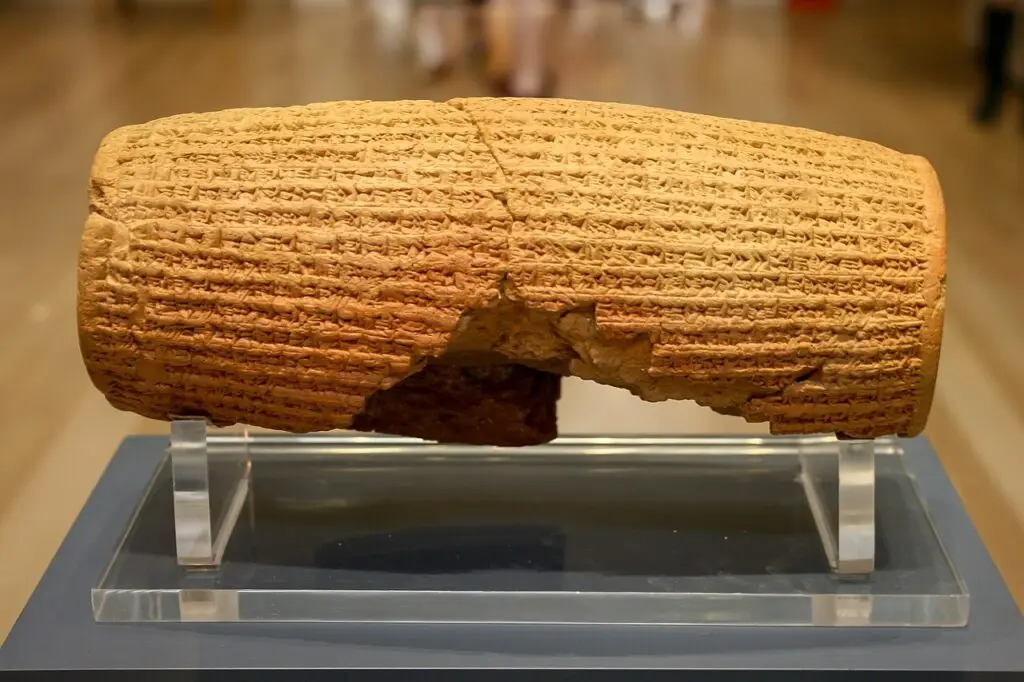
His liberation of the Jewish people following the conquest of Babylon, and his steadfast commitment to preserving their religious autonomy, stand as enduring testimony to a mode of governance rooted in respect rather than subjugation — an ethos immortalized in the Cyrus Cylinder, revered to this day as one of humanity’s earliest articulations of universal rights.
His legacy endures not because he defeated his adversaries, but because he transformed them into willing stakeholders within a broader imperial order. For Cyrus, war was not an instrument of destruction but a mechanism of integration. His authority rested not on coercive force, but on something far more profound — psychological legitimacy, a form of power that secured allegiance by inspiring trust rather than fear. As Herodotus attests, his life speaks to an enduring truth: that the truly powerful are not those who subdue their enemies, but those who move them to willing allegiance.
Iran in 2026: The Collision of Technological Advancement and Moral Regression
The conflict unfolding today across Iran and the surrounding waters stands in stark and sobering contrast, laying bare the darkest dimensions of modern civilization. The escalation of hostilities — defined by the Trump administration’s Operation Project Freedom — a naval escort mission through the Strait of Hormuz — and Iran’s retaliatory deployment of drone warfare — illustrates a paradigm in which precision technology coexists with indiscriminate destabilization. The spirit of tolerance that once characterized the age of Cyrus has vanished entirely, supplanted by a rhetoric of negation in which adversaries are no longer engaged, but existentially denied.
Modern warfare, mediated through drones, hypersonic missiles, and economic strangulation, has become increasingly impersonal — yet paradoxically more destructive. The military escalation between the United States and Iran, which intensified sharply in early 2026, has spawned a vicious cycle of dehumanizing rhetoric and cascading hatred, holding global energy security and regional stability hostage to an increasingly ruinous war of attrition. Where the wars of antiquity gave birth to new political orders and expanded the horizons of civilization, the conflicts of today dismantle existing structures and yield nothing but fragmentation, uncertainty, and prolonged instability.
The Unsparing Question History Demands
The most profound and melancholy paradox that emerges from juxtaposing the reign of Cyrus with the crises of our time is this: humanity has advanced immeasurably in its technological capacities, yet has demonstrably regressed in what might be called the moral grammar of conflict resolution. Where Cyrus forged unity through the acknowledgment of difference, modern leadership increasingly gravitates toward division through its rejection — driving civilization not toward order, but toward mutual destruction.
The resolution of the current turmoil surrounding Iran will not be secured through superior weaponry, strategic deterrence, or technological dominance alone. It will depend, rather, upon the recovery of a more enduring wisdom — the principle of tolerance, the pursuit of dignified victory, and the recognition that true power lies in integration rather than annihilation; in the restoration, from the depths of humanity’s collective memory, of that ancient light buried in the dust of Pasargadae two and a half millennia ago.
As Arnold Toynbee observed, history does not simply repeat itself — it is reshaped by those who either remember, or forget, the lessons it offers. In this sense, the legacy of ancient Persia remains not a relic of the past, but a mirror held up to the present, asking whether humanity is still capable of learning from its own inheritance.
Sources
- British Museum: The Cyrus Cylinder — Ancient Persian Records on Human Rights
- Herodotus: The Histories — Historical Accounts of Cyrus the Great
- International Institute for Strategic Studies (IISS): Middle East Report 2026: The Collapse of Deterrence
- Arnold Toynbee: A Study of History — Historical Patterns and Civilizational Responses