The Watchtower Files
History Remembers the Walk. It Rarely Remembers the Person Waiting.
I keep returning to one detail the famous photographs cannot show.
On the morning of November 14, 1960, federal marshals drove a six-year-old girl and her mother five blocks to an elementary school in New Orleans. Crowds had gathered at the entrance. As she later remembered it, Ruby Bridges took the shouting for something like Mardi Gras (Bridges Hall, 1999).
We know those five blocks well. They have been painted, photographed, and taught to schoolchildren for generations.
What the pictures do not show is that she did not reach a classroom that day. The building was in chaos, parents were marching in to remove their children, and Ruby spent the entire first day in the principal’s office. Lessons did not begin until the second morning, and the person waiting for her then was a teacher whose name most Americans could not give you.
History
A Court Order Is Only Paper Until Someone Opens the Door
A federal court had ordered Louisiana to desegregate its schools. New Orleans responded by creating entrance exams for Black children, and Ruby was among six who passed. She was the only one of them to enter William Frantz Elementary, and once inside she was the only Black child in the building.
An order can declare a principle. It cannot stand at the front of a room. When Ruby arrived, white parents withdrew their children, and many of the school’s teachers refused to teach while a Black child was enrolled. One teacher was willing to teach her: Barbara Henry, a young white teacher from Boston, new to the school.
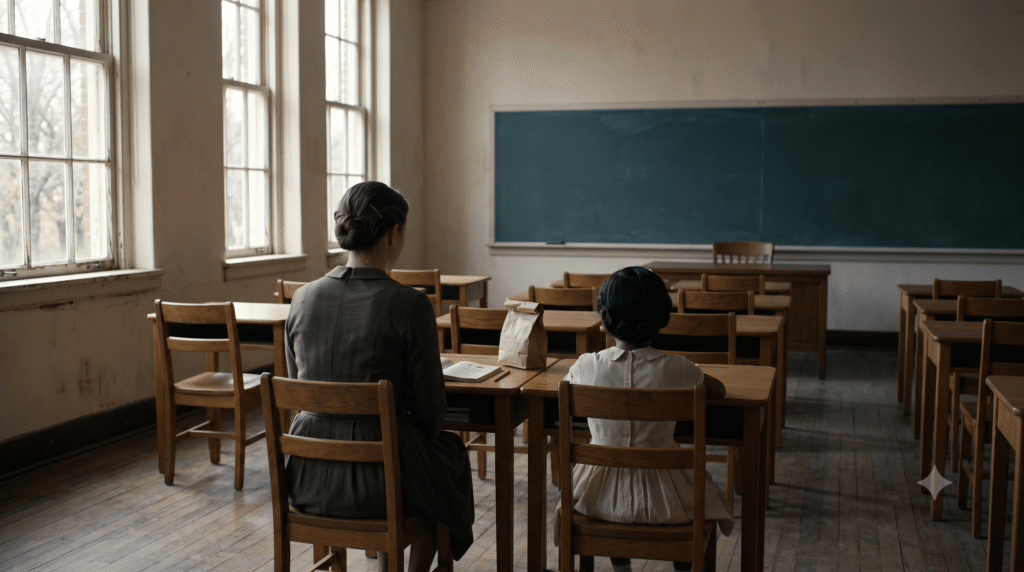
Accounts of that year describe the two of them at two desks, side by side, in an otherwise empty classroom. Outside, the marshals urged Ruby to keep her eyes forward so that she would not have to read the signs. Inside, the room became something like a refuge.
She ate her lunch there, because she was kept out of the cafeteria and off the playground. By the National Park Service’s account, she did not miss a day of school (National Park Service, 2020).
Ruby was six, and the decision to enter that building was not hers alone. Her mother, Lucille, had not finished elementary school herself and wanted her daughter to have the education she never had (Associated Press, 2020). She pressed the decision over her husband’s initial reluctance.
The price came quickly. Abon Bridges lost his job, grocery stores refused to sell to Lucille, and Ruby’s grandparents were evicted from the farm where they had sharecropped for a quarter-century (National Park Service, 2020). Henry’s year in that room was one strand of a larger story, and most of its cost fell on the Bridges family.
The long stretch between an announced policy and an ordinary day is where most social change either holds or quietly fails. In that stretch, a policy is carried out one teacher, one morning at a time.
Scripture
Presence Is the Oldest Unit of Faithfulness
Scripture often measures faithfulness in a unit that looks small on the page. In the book of Ruth, a young widow is given every reasonable excuse to turn back from a country that is not her own. We have walked with Ruth here before, into Boaz’s field, where the question was what a community leaves within reach before anyone has to ask. Her story opens earlier than that field, with a vow.
“…whither thou goest, I will go.” (Ruth 1:16, KJV)
Henry was also an outsider in that building, a transplant from Boston. The comparison goes no further than that. Ruth was bound to Naomi by family and by loss, and Henry was bound to a six-year-old by a job she could have refused, as many of her colleagues did. The pattern here is a shared one: two people who chose not to leave someone alone in a place that wanted to be rid of her.
The prophet Isaiah speaks of danger in a similar register, and his words belong to God’s promise to Israel, not to a teacher.
“When thou passest through the waters, I will be with thee.” (Isaiah 43:2, KJV)
I offer the verse as a lens for what presence in hardship can mean, and not as a claim that Henry fulfilled it.
Paul’s instruction is the most active of the three, and it describes work.
“Bear ye one another’s burdens, and so fulfil the law of Christ.” (Galatians 6:2, KJV)
In Henry’s case, bearing the burden took the form of teaching. A child that age had reading to learn, sums to master, and a school day to survive, and someone had to sit down and do those things with her.
Nothing I have found shows Henry describing her year in scriptural terms, and I will not put those words in her mouth.
A hardship, in Scripture, is not automatically a verdict, and a kindness is not automatically a reward. What the text keeps returning to is quieter: what a community, through its daily choices, shows it is willing to live with, and whom it permits to be left alone in the room.
Pattern
One Teacher, One Pupil, One Year
Set the facts of that school year in a column and they read like an attendance sheet. One teacher agreed. One child enrolled. One year passed, and Ruby did not miss a day of it.
Figures like these tempt us toward the word heroism, which has a way of turning a person into a statue. A statue does not have to show up the next morning.
Heroism is a moment, and what Henry offered was a routine. Ruby would later say the person who greeted her every morning, through all of that year, was her teacher.
In these passages, faithfulness looks less like a rescue than like a staying. Ruth does not remove Naomi’s grief, and the promise in Isaiah does not remove the river. Henry did not end the crowd outside or change the city’s mind. Ruby and her family had walked into that building by their own choice, at great cost, and Henry’s work was to make sure the child was taught once she was in it.
We have also met, on this site, a king who decided in a single hour, with his army dissolving around him, to take up a role that was never his (The Sacrifice He Should Not Have Offered). Henry’s hour carried a comparable pressure and the opposite shape.
Many of the teachers around her put down the work that was theirs to do, and she kept hold of it. She did not have to seize anything that belonged to someone else. She only had to refuse to drop what was already hers.
The record is quiet about the end of that year. Henry’s contract was not renewed, and she and her husband returned to Boston. These are two facts, set side by side, and I have found no source that ties them together by cause.
Ruby began second grade with a classroom full of other children and no Mrs. Henry in it. Years later she would describe that year as harder than the first, because her closest friend was gone.
The two women lost touch for decades. They were reunited on television in 1996, thirty-five years after the first morning at the second desk (National Braille Press, 2013). More than six decades on, they remain close. A late reunion does not pay off the earlier faithfulness, and I would resist reading it that way. Henry’s staying already counted on the days she did it.
Closing
The Work That Lasts Is Usually Done Beside Someone
In the previous installment, we examined The Folded Bill, where a farmer’s unsigned gift protected a neighbor’s dignity and left a mark on a small community’s moral memory. That story is about what a person can give from a pocket. Barbara Henry’s is about what a person can give from a day. Both kept someone from standing alone in public, and both were offered without a banner.
A community shows what it will accept through the people it leaves alone in a room. The responsibility in 1960 was spread across a school board, a faculty that refused to teach, and parents who pulled their children out. It was also met, in one room, by a single teacher who did the opposite.
That is the detail the photographs could not hold. Behind the walk, the marshals, and the crowd, there was a classroom with two people in it who showed up each morning.
The five blocks became history. The second desk is where it was lived.
Notes & Sources
- Ruby Bridges Hall, Through My Eyes (New York: Scholastic, 1999). Mardi Gras recollection.
- Robert Coles, The Story of Ruby Bridges (New York: Scholastic, 1995).
- National Park Service, “Ruby Bridges” (2020).
- Encyclopaedia Britannica, “Ruby Bridges.”
- Biography.com, “Ruby Bridges.”
- Associated Press, “Lucille Bridges, mother of activist Ruby Bridges, dies at 86” (2020).
- TODAY, “Ruby Bridges’ new children’s book is love letter to her 1st grade teacher” (2025).
- National Braille Press, “Ruby Bridges and Her Teacher Reunite Because of a Print-Braille Book” (2013).
- Scripture quotations are from the King James Version (public domain).
New essays every week. Delivered quietly.