Section I
The Measure Before the Ground Is Broken
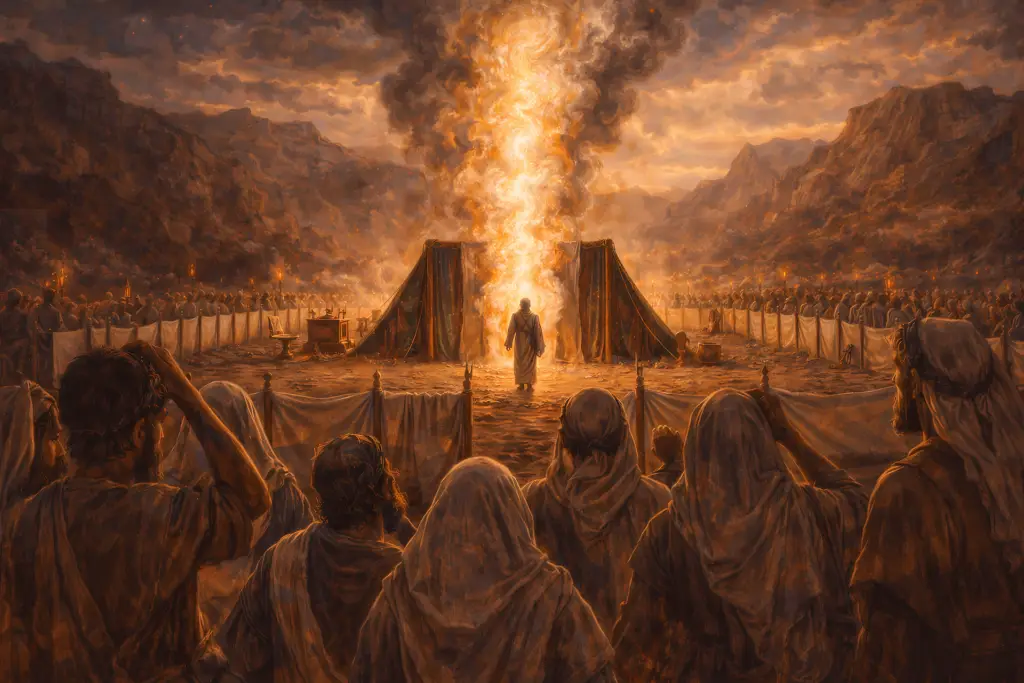
This is what caught me when I first read this passage. The law had just descended on the mountain. Smoke, thunder, the sound of a trumpet sustaining past the point where human breath could hold it. The people had not yet camped long enough to wear grooves into the ground. And then, before they could ask what comes next, the text pivots — not to march orders, not to a census, not to a political constitution — but to a blueprint.
Six chapters of it. Exact cubit counts for curtains and frames. The precise alloy ratios for rings and clasps. Which acacia wood to use, how thick the linen thread, what quality of oil for the lamp that was never to go out. No army. No territory. No flag. Just a drawing.
The world in which this drawing arrived was one that understood architecture as political language. Every great power in the ancient Near East announced itself through what it built. Egypt’s temples were not merely sacred — they were arguments. Royal architecture functioned as a public argument that political authority enjoyed divine sanction. The ziggurat of Babylon, rising over the plain of Shinar, was not primarily a house of prayer; it was a declaration that Babylon had a God, and that God had certified Babylon’s position in the order of things. Stone, height, permanence — these were not aesthetic choices. They were the vocabulary of sovereignty.
In the previous installment, we examined how the law arrived — not as a gift to a throne but as a covenant with a people, in wilderness, where there was nothing yet to protect. The Day the Law Descended →
What comes next is not commentary on the law. It is the instructions for where the law will live.
Section II
What Every Empire Knew About Spaces
The ancient world was not naive about what buildings do. Temples, palaces, and ziggurats were constructed as visible systems of power — structures designed to connect divine authority, political control, and social hierarchy within the same visual field. To erect a sacred building was to make a public argument, one that could be read by anyone who stood in its shadow.
The ziggurat at Babylon, associated with King Nebuchadnezzar II, rose over ninety meters and commanded the plain for miles in every direction. The labor investment — thousands of workers, royal patronage, a construction timeline that spanned generations — was itself part of the rhetorical force. A building that required that scale of organized human effort was a standing demonstration that the state behind it was real, stable, and favored.1 The argument was architectural before it was theological.
Temple construction in Egypt reinforced an already-existing relationship between kingship, divine order, and social stability. The temples at Karnak and Luxor were not simply houses of worship — they were the physical record of a claim that had been renewed by each successive pharaoh. Destroy the temple and you did not merely eliminate a cult site; you unraveled the visible evidence that the gods had chosen this dynasty, this people, this place.
This is why the destruction of the Temple in Jerusalem in 586 BCE carried a theological meaning that reached far beyond military victory. Nebuchadnezzar’s armies were not only ending a political entity; they were — by the logic of ancient sacred architecture — declaring that the God of Israel had either failed his people or abandoned the covenant that justified their existence in that land. The stones said: your God has no house here. And therefore, you have no claim.
Exodus 25–31 functions as more than architectural instruction. Read against the political context it entered, it is a proposal about a radically different kind of sacred space — one that declines to make the arguments every surrounding civilization was making. That refusal is where the theology lives.
Section III
The Blueprint Goes to a Craftsman, Not a King
“And let them make me a sanctuary, that I may dwell in their midst. Exactly as I show you concerning the pattern of the tabernacle, and of all its furniture, so you shall make it.”
— Exodus 25:8–9 (ESV)
The word translated “pattern” here is tavnit — a term carrying the sense of an original model, a form given from above that the earthly structure must conform to. Jon Levenson, in his analysis of the Sinai traditions, observed that the correspondences between cosmic geography and temple architecture in Exodus function to depict the sanctuary as a world, and the world as a sanctuary.2 The tabernacle is not intended to house the divine so much as to map it — to create, in portable and provisional form, a structure that reflects the order God embedded in creation itself.
“See, I have called by name Bezalel the son of Uri, son of Hur, of the tribe of Judah, and I have filled him with the Spirit of God, with ability and intelligence, with knowledge and all craftsmanship.”
— Exodus 31:2–3 (ESV)
The detail that arrests attention is not the list of Bezalel’s skills. It is who Bezalel is. He is not a king. He is not a priest. He is a craftsman, recently liberated from a labor system in which his skills were deployed to build monuments for a ruler who claimed divine status. In Egypt, in Babylon, in every temple culture surrounding Israel, sacred space was built by royal decree and impressed labor, and its existence legitimized whoever commissioned it. Here, God calls the craftsman by name — independent of royal authority altogether.
“This is the contribution that you shall receive from them: gold, silver, and bronze, blue and purple and scarlet yarns and fine twined linen… olive oil for the lamps…”
— Exodus 25:3–6 (ESV)
The materials are donated, not conscripted. Unlike imperial building projects funded through taxation, tribute, or forced labor, the sanctuary is assembled from voluntary gifts. The labor is directed, not impressed. The pattern comes from above, not from a king’s ambitions. Every design decision in Exodus 25–31 is structured to ensure that what emerges is not another monument to the authority that commissioned it.
The tabernacle text encodes a different set of conditions: a God who does not need a permanent address, a sanctuary that moves with the people, and a craftsman — not a conqueror — as the first named builder of a dwelling for the divine.
Section IV
Portable Sovereignty
Biblical scholar Michael B. Hundley has argued that the Priestly source uses the terms “tabernacle” and “tent of meeting” in a complementary way — emphasizing the sacred tent’s dual function as a divine dwelling place on earth and as a site where the resident deity meets with his people. Both functions are portable. Both require movement. The structure decouples presence from territory — a proposition that cut against the foundational assumption of every surrounding empire, each of which located divine favor in a fixed place that could be held, enlarged, or destroyed. This is architecturally unusual in a world where sacred permanence was treated as the primary evidence of divine endorsement.
The scholar Victor Hurowitz, in his comparative study of ancient Near Eastern temple-building accounts, demonstrated that the Sinai blueprint follows the formal conventions of Mesopotamian divine house-building narratives — vision received, materials gathered, craftsmen appointed, structure built, deity enters.3 What Hurowitz identified as significant was not the parallel but the deviation at its center. In Mesopotamian accounts, what the god enters is always already a political structure; the temple confirms what the king has achieved. In Exodus, what the divine enters is a tent, assembled by freed slaves, in territory that belongs to no one yet. The form is borrowed. The political logic is inverted.
That inversion is what the text presses against every subsequent argument about sacred permanence. When Solomon finally builds the permanent structure — cedar from Tyre, forty thousand stalls for horses, an eight-year construction project — the text does something unexpected. It asks whether the building, for all its grandeur, can actually contain what the tabernacle was designed to hold. Solomon’s own prayer at the dedication admits it cannot: “But will God indeed dwell on the earth? Behold, heaven and the highest heaven cannot contain you; how much less this house that I have built” (1 Kings 8:27). The portable covenant and the permanent throne occupy the same tradition, but they are not the same argument.
Monumental architecture can preserve memory, but it cannot manufacture legitimacy once the moral order it symbolizes has collapsed. Nations still signal authority through what they build — capitals, monuments, court buildings — and still face the moment when the building outlasts the legitimacy it was commissioned to announce. The question the Sinai blueprint poses is not architectural. It is diagnostic: what is the structure actually for, and whose claim does it certify?
The tension runs from Exodus through the end of Kings. The blueprint from Sinai was given to a wandering people with no land. The temple will be built by a king with too much of everything. That the two belong to the same tradition is what makes the tradition worth reading.
Section V
A Tent Against Every Empire
The pattern on the mountain was shown to Moses once. The instruction was to replicate it exactly — not to improve it, not to scale it to match the empires that surrounded the wilderness. Dust, thread, acacia wood, oil. The materials of a people with no fixed address.
Bezalel built under cover. The rabbinic tradition preserves an observation that his name means b’tzel El — in the shadow of God. Not in the open air of royal triumph. Not on the elevated platform of a ziggurat. In the shelter of something he did not design and could not fully see. The first named builder of a dwelling for the divine was a craftsman working from a pattern he received, with materials his community brought, toward a structure he understood would have to travel.
The tent moved. The covenant held. And when Nebuchadnezzar finally reduced Solomon’s stones to rubble and took the people east into Babylon — into the very shadow of the empire whose architecture had always claimed to prove the gods’ favor — the covenant did not go with the smoke.
What the blueprint preserves is something that every subsequent argument about the temple — in Kings, in Jeremiah, in Ezekiel’s vision of the wheeled chariot-throne that moves — will return to: the original structure was portable because the covenant it carried was not tied to any city’s survival. The promise preceded the permanence. And when the permanence failed, the promise did not.
The measure of the blueprint was never the durability of what it produced. It was what traveled when everything else had to be dismantled and carried.
The materials came from the people.
The builder was named, not elected.
What they assembled was not a monument.
It was a sanctuary that could outlive every empire.
— Watchman
1 On the political function of monumental sacred architecture in ancient Mesopotamia, see Pongratz-Leisten, Beate, “The Mesopotamian Use of Religion to Fabricate Urban Identities,” in Redefining the Sacred: Religious Architecture and Text in the Near East and Egypt 1000 BC–AD 300, American Journal of Archaeology, 2016. The argument that ziggurat construction served simultaneously as theological declaration and political consolidation is developed in Pollock, Susan. Ancient Mesopotamia. Cambridge University Press, 1999.
2 Levenson, Jon D. Sinai and Zion: An Entry into the Jewish Bible. Harper & Row, 1985. (Levenson’s analysis of the tabernacle as a microcosm of creation — and the parallel between the seven-speech structure of the Sinai tabernacle instructions and the seven-day structure of Genesis 1 — remains foundational for any theological reading of Exodus 25–31. The phrase summarized here, that the sanctuary functions as “a world” and the world as “a sanctuary,” appears in his discussion of temple cosmology, pp. 92–95. See also his Creation and the Persistence of Evil, Princeton University Press, 1988.)
3 Hurowitz, Victor Avigdor. I Have Built You an Exalted House: Temple Building in the Bible in Light of Mesopotamian and Northwest Semitic Writings. JSOT Press, 1992. (Hurowitz’s comparative study demonstrates that the Sinai tabernacle narrative follows the formal conventions of ancient Near Eastern divine house-building accounts — a genre in which the god commissions the structure, the king gathers materials, craftsmen are appointed, and the deity enters the completed building. What makes Exodus distinctive, in Hurowitz’s reading, is that the commissioning agent is not legitimating a king but establishing a covenant community with no political structure yet in place. See also Haran, Menahem. Temples and Temple-Service in Ancient Israel. Oxford: Clarendon Press, 1978. Haran’s analysis of sanctity gradations within the tabernacle shows structural continuity with the later Jerusalem cult — a continuity that makes the political contrast between the two contexts all the sharper: the same inherited architecture, deployed first by a wandering community with no state, and later by a monarchy with every incentive to use it as one.)