Section I
A Man Ran Through the Heat of the Day, and Then He Stood His Ground
In the spring of 2024, aid convoys waited at the Rafah crossing while diplomats argued about the terms of their passage. On one side, a government insisting on the logic of military necessity. On the other, the arithmetic of hunger: the World Food Programme estimated that more than a million people in Gaza were facing catastrophic food insecurity (WFP, 2024). The arguments moved slowly. The convoys waited. The people inside waited longer.
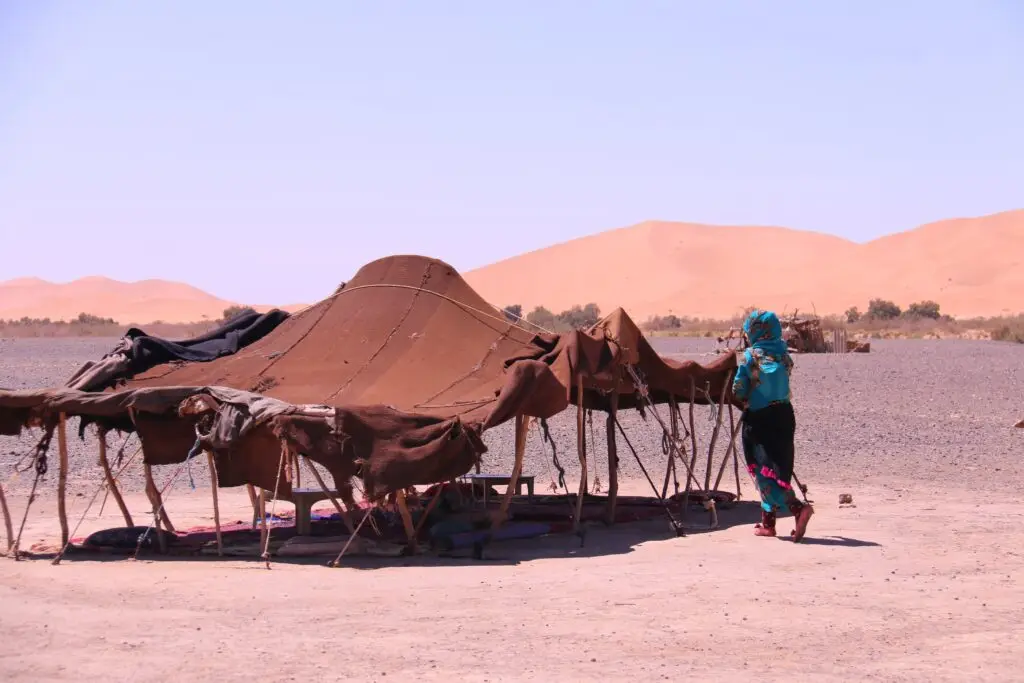
There is an older argument, conducted under a different kind of pressure, at the entrance to a tent in the heat of the day. It does not resolve the modern one. But it asks a question that the modern one has not yet found the language to ask.
In the previous installment, we examined Genesis 17 — the covenant pressed into the body, the names changed by legal authority, the promise that arrived before any biological evidence of its plausibility. Genesis 18 opens in the same household, but the register shifts. Three strangers appear on the road. The air is still. It is the hottest part of the day. A ninety-nine-year-old man rises from the tent door and runs.
What follows is among the most theologically charged chapters in the Hebrew Bible — and, for the reader who attends to it carefully, among the most demanding.
Section II
Hospitality as Political Act: From Abraham’s Tent to the Wars That Followed
The ancient Near East operated on a code of hospitality that was not merely etiquette — it was a survival structure. In a landscape of desert travel and limited infrastructure, the obligation to shelter and feed a stranger was understood as foundational to social order. Violation of that code was not rudeness; it was a breach of the framework that made human movement possible (Matthews, Manners and Customs in the Bible, 1991).
Picture the scene as the text gives it: dust on the road, shade stretched thin beneath the terebinth trees, and an old man moving faster than his age has any right to suggest. He bows. He asks the strangers not to pass by. He speaks of a morsel of bread and instructs his household to prepare a feast — a calf, fresh bread, curds, and milk. The contrast between what he promises and what he delivers is deliberate. It is the grammar of hospitality at its most generous register: offer less, give more.
The city of Sodom, whose fate dominates the second half of Genesis 18, is defined in the tradition partly by its inversion of this code. What the rabbinic tradition preserves, across multiple strands of commentary, is the argument that Sodom’s particular wickedness was not merely sexual transgression — it was the systematic destruction of the stranger. One strand of that tradition suggests that Sodom had laws prohibiting hospitality to outsiders, enforced by communal violence against anyone who dared offer shelter to a traveler (Sanhedrin 109a, Babylonian Talmud). Whether that reading is historically recoverable or is interpretive elaboration, it frames the contrast the biblical text is drawing: Abraham’s tent is the anti-Sodom. The man who runs toward the stranger is the structural opposite of the city that organizes itself against him.
The twentieth century produced its own versions of that contrast. The refugees of the Armenian Genocide moved through a landscape where the code of hospitality was selectively enforced by political calculation — where some borders opened and others closed, where the question of who deserved shelter was answered by governments rather than by any older moral framework. The displaced Palestinians of 1948, the cascading refugee flows of the Lebanese civil war, the Syrian displacement that began in 2011 and produced more than five million registered refugees by 2023 (UNHCR, 2023) — each of these crises returned, in different registers, to the question Abraham’s tent poses before it is answered: Who counts as a stranger worth running toward?
The answer a society gives to that question is not merely humanitarian policy. It is, Genesis 18 suggests, a statement about the character of the God the society claims to serve.
Section III
The God Who Stays for the Argument
The transition from hospitality to intercession in Genesis 18 is abrupt and structurally significant. The strangers have eaten. Sarah, listening at the tent door, has heard the promise that she will bear a son within a year — and laughed, quietly, to herself. Then the visitors rise to leave. Two go on ahead toward Sodom. God remains. Abraham and God stand together on the road in the afternoon light.
What happens next is one of the stranger scenes in the Hebrew Bible. God deliberates, apparently aloud, about whether to tell Abraham what is coming. The reasoning offered is significant: Abraham is the one through whom all nations will be blessed, and therefore carries a standing interest in how justice operates in the world. The disclosure is made. And Abraham begins to argue.
The argument moves in descending numbers. Fifty righteous people, if they can be found in the city, should spare it. God agrees. Forty-five. God agrees. Forty. Thirty. Twenty. Ten. Abraham pushes gently, carefully, each time prefacing his next reduction with the acknowledgment that he is dust and ashes speaking to the Lord of all. But he does not stop.
He grounds the negotiation in a premise that is as bold as anything in the Hebrew Bible:
— Genesis 18:25 (ESV)
This is not polite inquiry. It is a challenge issued to the Judge of all the earth on the basis of the Judge’s own stated character. Abraham is holding God accountable to a standard God has announced. Not as impudence — as covenant logic. If this God has defined justice, then justice is what the covenant partner has the right to invoke.
The biblical tradition consistently returns to this mode. Jeremiah, centuries later, opens one of his most anguished prayers the same way:
— Jeremiah 12:1 (ESV)
And the psalmist, in the lament tradition that runs through the Psalter:
— Psalm 13:1 (ESV)
God does not terminate any of these arguments. In Genesis 18, God listens through six rounds and agrees to each reduction. The text records no impatience, no withdrawal of presence, no correction of tone. The argument is not merely tolerated — it appears to be the mode of relationship the covenant makes available.
The hospitality Abraham offers the strangers in Genesis 18:1–8 and the intercession he offers on behalf of a city he does not live in are not two separate episodes accidentally collected in the same chapter. They are the same movement: a man who has learned to run toward what is outside himself, whether it arrives as a stranger at the tent door or as a threatened city at the far end of a road.
Section IV
Ten Righteous People and the Mathematics of a City
The negotiation ends at ten. God agrees: if ten righteous people can be found in Sodom, the city will be spared. Abraham does not push further. The text offers no explanation — whether he sensed the limit of what the city could plausibly contain, or simply ran out of courage on the dusty road back home. He turns. He walks. The text gives him no further lines.
What the tradition has consistently found in that number is not a curiosity but a weight-bearing idea. The rabbinic tradition, developing the concept across centuries of commentary, formalized the minyan — the quorum of ten adult Jews required for communal prayer — partly in conversation with this passage. What Sodom lacked, in that reading, was not merely scattered righteous individuals. It lacked the critical mass that constitutes a functioning moral community: ten people whose combined presence could anchor the social fabric against collapse.
The contemporary social science of what Robert Putnam called “social capital” — the networks of trust and reciprocity that make communities function — arrived at a parallel observation through different methods. Putnam’s longitudinal study of civic life in the United States, Bowling Alone (2000), documented the erosion of those networks across the late twentieth century and argued that communities without sufficient connective tissue became measurably worse at almost everything: public health, economic mobility, civic participation, recovery from crisis.
The question Genesis 18 asks is not whether you live in a city worth saving. It is whether you are one of the ten.
The displacement crises of the modern Middle East have produced communities of exactly this kind of testing. Zaatari refugee camp in Jordan, at its peak in 2013, housed more than 150,000 Syrians — a population larger than most American cities, organized with almost none of a city’s normal infrastructure (UNHCR, 2013). What sustained it, by the accounts of journalists and aid workers who documented it, was not primarily international supply chains. It was internal social architecture: the informal community leaders, the teachers who organized schools in tents, the women who established informal markets, the neighbors who maintained water distribution when the official systems failed. It was, in other words, the people who had decided that the community around them was worth organizing — even when no authority required it of them.
The ten, wherever they could be found.
Section V
The Intercessor Who Knew the City Would Burn
Genesis 18 ends without resolution. Abraham turns from the road and goes home. The two messengers continue toward Sodom. The text closes the chapter quietly, the way a door closes at the end of a long conversation — not with drama, but with the particular silence that follows when everything important has already been said.
What comes next is in Genesis 19, and it is not encouraging. The ten are not found. Smoke rises from the valley in the morning. The city is gone.
This is the part of the passage that resists comfortable resolution. Abraham argued well. He grounded his intercession in God’s own announced character. He negotiated patiently, in descending numbers, until the threshold seemed reasonable. And it was not enough — not because the argument failed, but because the social reality of Sodom had already crossed a line that ten righteous people could not be found to hold.
The city was not spared. But someone was carried out of it.
The text is specific about this in Genesis 19:29: “God remembered Abraham and sent Lot out of the midst of the overthrow.” The intercession did not save the city. It redirected. What could not prevent the destruction of the whole could still determine who was brought through the fire.
The aid convoys at Rafah are still waiting, their negotiations conducted by people far from the hunger they are discussing. Genesis 18 imagines another kind of negotiation: one conducted by a man standing before God on behalf of people who do not know he is speaking for them, in the long afternoon heat, on a road between a tent and a burning city.
Religious communities across the modern West find themselves in a moment with some structural resemblance to Abraham’s position outside Sodom: watching a social landscape under visible pressure, holding convictions the surrounding culture no longer shares, navigating the question of whether engagement or withdrawal is the more faithful response. Genesis 18 does not resolve that debate. It does, however, model a posture: a man who stood on the road, used the language of covenant to negotiate on behalf of people he did not personally know, in a city he did not personally inhabit.
He was not required to be neutral about what was coming. He was not required to pretend the city was well when it was not. He was required — by the logic of his covenant identity — to show up and make the argument.
The negotiation did not save Sodom. But it changed what was possible within the terms of what was coming. Abraham walked home in the dust of a road he had traveled in both directions that afternoon — toward the strangers first, then toward the Judge of all the earth, then back again toward the tent, and the silence, and whatever came next.
Some intercessions do not stop the fire. They determine who is carried through it.
Babylonian Talmud, Sanhedrin 109a. [Cited as representative of one strand of classical rabbinic interpretation; not equivalent to Scripture.]
Matthews, V. H. (1991). Manners and customs in the Bible. Hendrickson Publishers.
Putnam, R. D. (2000). Bowling alone: The collapse and revival of American community. Simon & Schuster.
Sarna, N. M. (1966). Understanding Genesis: The heritage of biblical Israel. Schocken Books.
UNHCR. (2013). Zaatari refugee camp factsheet. United Nations High Commissioner for Refugees.
UNHCR. (2023). Syria refugee crisis: Key figures. United Nations High Commissioner for Refugees. https://www.unhcr.org/syria-emergency.html
World Food Programme. (2024). Gaza emergency situation report. WFP. https://www.wfp.org/emergencies/palestine-emergency