When the Grain Never Left the Warehouse
A fertilizer bag costs three times what it did last season. That sentence sounds like an economics footnote until you follow it into a rice paddy in Myanmar’s Rakhine State, where a farmer is deciding, this week, how much less of his field to plant than he planted last year — not because the soil failed, and not because soldiers took his land, but because a war between two other countries made the inputs he needs too expensive to buy (Mizzima, 2026).
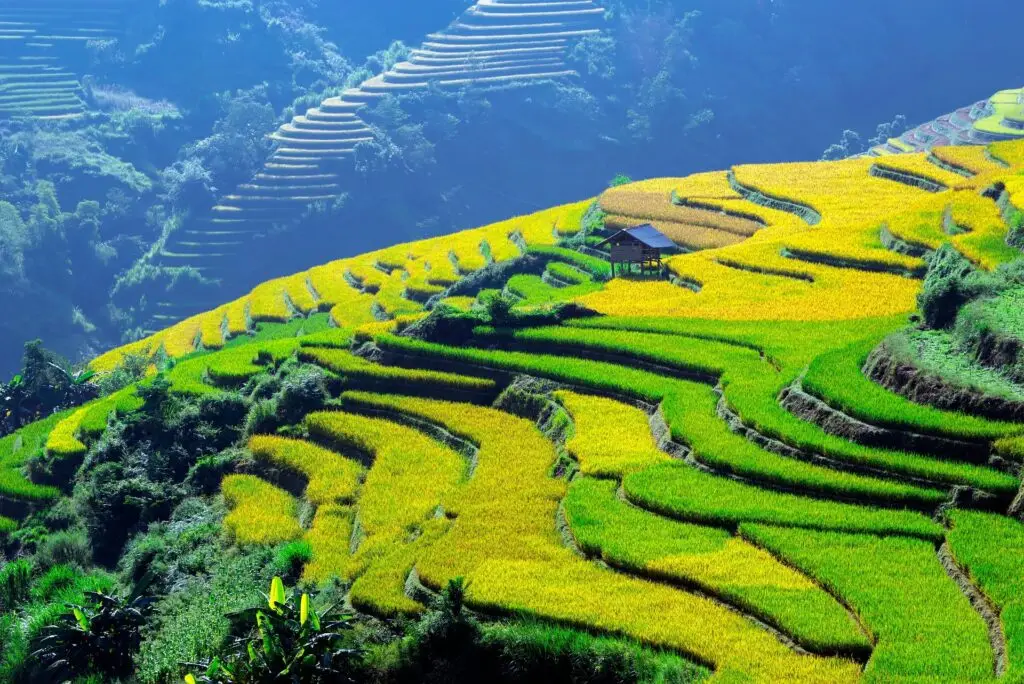
The paddy itself looks unremarkable from the road: flat, green at the edges, quiet except for the sound of water moving through an irrigation channel that has not changed its course in generations. Nothing about the field announces that its yield this year has already been shaped by a decision made somewhere else — one force among several, but a decisive one.
Myanmar has been fighting its own civil war since the 2021 coup, and that conflict remains one of the central drivers behind the 12.4 million people the World Food Programme now counts as acutely food insecure inside the country (WFP, 2026a). But in the spring of 2026, a second pressure arrived that had nothing to do with the fighting in Sagaing or Kachin. Fuel prices in Myanmar tripled within weeks. The cost of a basic food basket — rice, oil, pulses, salt — rose eighteen percent nationally, and thirty-eight percent in Magway Region alone (Mizzima, 2026). The proximate trigger was not a blockade inside Myanmar’s own borders. It was a war in the Middle East, and the fact that roughly a third of the world’s seaborne fertilizer passes through the Strait of Hormuz on its way to Asia’s fields (CNN, 2026).
A country does not need to be at war to be starved by one. WFP now estimates that the Iran conflict alone will push forty-five million additional people into acute hunger worldwide in 2026, with Asia and the Pacific absorbing the largest relative increase of any region on earth (Foreign Policy, 2026). Myanmar’s farmers are responding the only way the market allows them to: by using less fertilizer. WFP projects that a fifty-percent drop in fertilizer use could cut the country’s agricultural output by as much as fifteen percent — a shortfall that will not fully register until the 2027 harvest fails to arrive in the quantities anyone budgeted for (Mizzima, 2026). Conflict, currency instability, and repeated climate shocks were already straining Myanmar’s food system; the Hormuz disruption did not create that strain, but it decisively deepened it, arriving at the exact moment the country had the least room to absorb another shock.
None of this shows up on a map of the fighting. There is no front line running through a fertilizer depot in Naypyidaw. One of the forces now shaping this year’s rice crop is being exerted somewhere else entirely, and the people who go hungry because of it will likely never be able to name the shipping lane that did it.
That kind of distance — between a decisive pressure on a food system and the field where its consequences actually land — is not new. It has a fairly close historical precedent, one that also began with a war the hungry region was not fighting, though, as with Myanmar today, it was never the only thing at work.
A Village in Niger, and a Grain Deal Signed Somewhere Else
In the summer of 1972, the Soviet Union’s grain harvest fell short by more than seven hundred million bushels — one of the worst shortfalls in a decade. Rather than let its own population go hungry, Moscow moved to purchase American wheat through contracts negotiated quietly with private U.S. grain exporters over five weeks that July and August (Grokipedia, citing USDA and State Department records, 2026). The deal did not happen in a vacuum. It was encouraged from the American side by Agriculture Secretary Earl Butz’s policy of aggressively expanding U.S. grain exports, and by Henry Kissinger’s broader push to use trade as a lever of détente with Moscow — two Nixon-era priorities, agricultural surplus disposal and superpower diplomacy, that happened to converge on the same shipment of wheat (Grokipedia, 2026; U.S. State Department, Foreign Relations series).1 Soviet purchases that year ultimately reached roughly twenty-eight percent of the entire American wheat crop (farmdoc daily, 2019).
World wheat exports surged as the purchase pulled supply out of an already tightening market, and prices — cushioned at first by U.S. export subsidies that kept the Soviet price artificially low — kept climbing through 1973 and into 1974 (Grokipedia, 2026; USDA Economic Research Service, 2009).
That same stretch of years, the Sahel region of West Africa was living through the tail end of a drought that had already lasted the better part of a decade — a slow drying that had thinned pastureland, pushed herders further south each season, and left villages with less and less margin to absorb a bad year (Global Food Crisis Project, 2025). The drought was real, and no grain deal caused it. Decades of colonial-era agricultural policy, which had pushed many Sahelian farmers toward cash crops for export rather than subsistence grain, had already left the region with thinner local reserves than it would otherwise have had. Locust outbreaks in several seasons compounded losses the drought had already inflicted.
What the grain deal did was narrower, and in its own way more damning: it arrived at the exact moment the Sahel most needed the world’s spare grain to be cheap and available, and instead helped ensure it was neither. The Soviet purchase did not create the Sahel’s famine. It closed one of the last doors that might have softened it.
In Niger’s Tahoua region, a village called Kao had no grain stockpiled of its own and depended on relief convoys that now had to compete for supply against a global market the Soviet purchase had just tightened. Villagers waited by the roadside for trucks that came later than promised, carrying less than was needed, because the grain those trucks should have carried was already spoken for elsewhere at a price Niger’s government could not match. An estimated 350,000 people died across the Sahel in 1974 alone (World Press Photo Foundation, 2025).
The famine that killed them is remembered today, when it is remembered at all, simply as a drought — as though the weather had done this by itself. The weather did not negotiate a wheat contract in a Washington conference room in the summer of 1972. A bilateral deal shaped by farm politics and détente, agreed to by people who never met anyone in Kao and never learned their names, was one of the decisive factors that determined how much of that world’s grain a starving region could still afford two years later.
Fifty years on, the underlying mechanism is recognizable even though the commodity has changed. A shipping lane through the Strait of Hormuz, disrupted by a war between countries Myanmar has no quarrel with, is functioning today as one of the same kinds of pressure the 1972 grain deal exerted on the Sahel — not the sole cause of Myanmar’s hunger, any more than the grain deal was the sole cause of Niger’s, but a force significant enough to tip an already fragile system further than its own internal weather, conflict, and currency troubles were already tipping it.
Long before either grain contracts or shipping lanes existed, this same question — whether a famine’s decisive pressure and its casualties could be separated by a distance neither side chose — was already being treated as a matter worth writing into Scripture.
The Geography of Blame in Sacred Texts
Scripture often locates the origin of a famine’s relief, or the origin of its cause, somewhere other than where its victims actually live, treating that geographic separation as morally significant rather than incidental.
“And all countries came into Egypt to Joseph for to buy corn; because that the famine was so sore in all lands.” (Genesis 41:57)
Genesis places the famine’s remedy inside a single storehouse controlled by one government, while the people who need it arrive from every surrounding nation. The passage does not describe Egypt’s neighbors as uninvolved bystanders. It describes them as dependent on decisions — about storage, about pricing, about who is permitted to buy — made inside a country whose harvest and policy they had no part in shaping.
“And I heard a voice in the midst of the four beasts say, A measure of wheat for a penny, and three measures of barley for a penny; and see thou hurt not the oil and the wine.” (Revelation 6:6)
This is not a description of soldiers seizing grain. It is a description of a price — a market mechanism doing work that, in other famine texts, a siege or a sword does instead. The rider carries scales, not a weapon, because in this vision hunger arrives through the cost of a measure of wheat, set by forces the buyer never sees and cannot negotiate with directly. A price, unlike a sword, has no face — which may be precisely why it is the instrument this vision chooses.
“Arise, get thee to Zarephath, which belongeth to Sidon, and dwell there: behold, I have commanded a widow woman there to sustain thee.” (1 Kings 17:9)
The drought in this narrative was pronounced over Israel on account of Israel’s king, yet its consequences reached a widow in Sidon — a foreign city, outside the kingdom whose conduct had brought the famine in the first place. The widow of Zarephath did nothing to bring the drought upon herself. She simply lived within its reach, gathering the last of her flour at the very moment a stranger arrived asking her to share it.
Read together, these three passages describe a pattern that predates any modern supply chain: famine, in Scripture, is rarely confined to the place or the party most responsible for causing it. Egypt’s grain policy fed nations it never governed. The measure-of-wheat economy in Revelation prices hunger onto whoever happens to be holding the coin, regardless of where the shortage began. And a widow in Sidon was sustained — or could as easily have starved — because of a drought decreed over a kingdom that was never hers to answer for.
A Measure, Not a Motive
Economist Amartya Sen’s foundational insight into famine, developed after his study of the 1943 Bengal famine, was that starvation is rarely caused by there being too little food in the world; it is far more often caused by a collapse in who is still able to command access to the food that already exists (Sen, 1981). Sen’s term for that access was entitlement — not a moral claim, but an economic one: the sum of what a household can grow, sell, or buy with what it has. When entitlement collapses faster than food availability actually does, a famine can arrive in a country whose warehouses, statistically, are not even empty.
Myanmar’s 2026 harvest has not collapsed. Fertilizer has simply become one of the inputs many farming households can no longer command at the price the season now demands — a fertilizer bag priced not by the state of Myanmar’s own fields but by a war being fought in a strait most of those farmers could not locate on a map. That is closer to Sen’s entitlement failure than to any classical picture of famine as an empty granary.
It is also close to what Revelation’s measure-of-wheat economy seems to echo across two very different centuries: hunger delivered not by an invading army but by a price, administered by no one in particular and therefore easy to attribute to no one in particular. That anonymity may be the mechanism’s most durable feature. A sword has a hand attached to it; a price does not. Scarcity, once it moves through a global price, stops asking who is guilty and starts asking only who can still pay — and in doing so, it quietly relieves everyone along the chain of feeling responsible for the answer.
A fertilizer trader recalculating a quote upward has not committed a crime. Neither had the American and Soviet negotiators whose 1972 contract became one of several forces that tightened the market Niger depended on two years later. None of this should flatten Myanmar’s crisis, or the Sahel’s, into a single villain or a single cause. Myanmar’s hunger is being driven by internal conflict, currency instability, and repeated climate shocks as much as by any shipping lane six thousand kilometers away; the Hormuz disruption is best understood as a decisive amplifier layered onto weaknesses that were already there, not as the origin of the crisis itself.
That refusal to name a single cause is not a weakness in the pattern. It is, if anything, the pattern the Zarephath narrative already assumes. The widow’s famine had a proximate cause — a drought pronounced over a kingdom — and a deeper vulnerability that made her particular household so close to its last handful of flour before the stranger ever arrived. Scripture does not ask which factor mattered most. It asks only whether anyone with flour left was willing to share it before the jar ran dry.
What the Ledger Never Learns to Ask
The distance between a war and a harvest used to be measured in front lines and supply convoys — territory a soldier could walk, a blockade a warship could physically enforce. In Myanmar’s Rakhine State this year, that distance is measured instead in a shipping lane a farmer will never see and a fertilizer invoice he cannot renegotiate, both shaped by a conflict fought by countries whose flags do not fly anywhere near his field.
In the previous installment, this series examined Sudan’s ration cuts as a decision made by people, over a budget, dividing too little grain among too many mouths. Myanmar’s fertilizer shortage is that same decision wearing a market instead of a spreadsheet — no office, no meeting, no single person who could be asked to explain it, only a price that rose because a war elsewhere made one strait more dangerous to cross than it was the season before.
The widow of Zarephath never learned why the rain had stopped over a kingdom that was not hers. She only knew that her flour was running out, one handful nearer the bottom of the jar each morning she measured it. Myanmar’s farmers know more of the mechanism than she did — a war, a strait, an invoice, each one nameable — and still find that naming the cause changes nothing about the number printed on the bag.
1. Figures on the scale of the 1972 Soviet grain purchase — including the roughly seven-hundred-million-bushel Soviet harvest shortfall, the subsidy structure that initially held the Soviet purchase price near $1.69 per bushel, and Secretary Butz’s role in encouraging the sale — are drawn from State Department historical records and retrospective economic analyses of the 1972–74 period, including the USDA Economic Research Service’s 2009 review of 1970s commodity price spikes.
WFP. (2026a). Myanmar on the Brink as Conflict Fuels Hunger. wfp.org
Mizzima. (2026). WFP warns global fuel shocks and domestic conflict worsen Myanmar food insecurity. eng.mizzima.com
CNN. (2026). ‘This is far worse’: When conflict 2,000 miles away compounds civil war at home. edition.cnn.com
Foreign Policy. (2026). Southeast Asia’s U.S.-Iran War Food Crisis. foreignpolicy.com
USDA Economic Research Service. (2009). Agricultural Commodity Price Spikes in the 1970s and 1990s. ers.usda.gov
U.S. Department of State. Foreign Relations of the United States, 1969–1976, Vol. XV — Soviet Union, June 1972–August 1974, Document 7.
World Press Photo Foundation. (2025). 1975 Photo Contest — World Press Photo of the Year. worldpressphoto.org
Sen, A. (1981). Poverty and Famines: An Essay on Entitlement and Deprivation. Oxford: Clarendon Press.