Present Day
A Harvest Fifteen Miles From a Starving Town
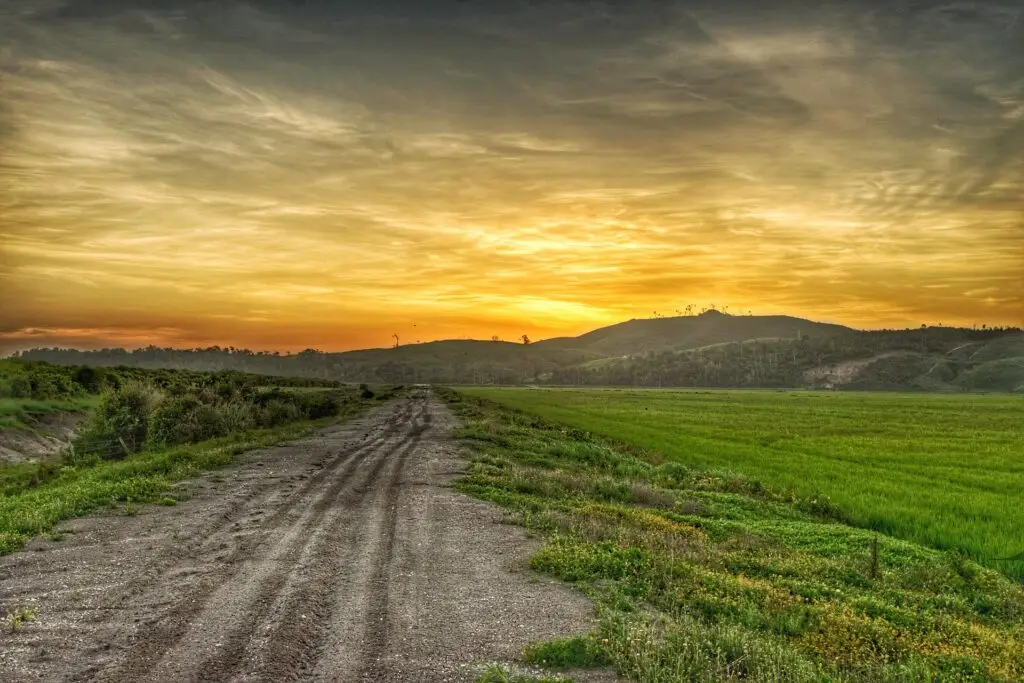
In Borno State, Nigeria, the 2026 lean season is projected to push 5.8 million people into crisis-level hunger or worse, with 15,000 people expected to reach Catastrophe conditions between June and August (WFP, 2026a). What makes Borno’s numbers different from a simple crop failure is where the food actually is: farmland surrounds the region’s displacement camps on nearly every side, but insurgent activity has made much of it unreachable for the people who once worked it (OCHA, 2026).
Government relief agencies describe a lean season “projection” as though it were weather. It is not. It is closer to an arithmetic of access — how many acres a farmer can safely walk to, how many roads a convoy can safely drive, how many days a family can wait before hunger outruns caution.
A joint FAO-WFP assessment released in June 2026 elevated northeast Nigeria into its highest-concern category for the first time, placing it alongside Sudan, South Sudan, Yemen, and Palestine as one of the world’s most severe hunger emergencies (WFP, 2026b). The insurgency driving that classification has not burned Borno’s grain stores or poisoned its wells. It has simply made the space between the field and the table too dangerous to cross.
That single fact — a harvest existing within sight of a hungry town, separated from it not by absence but by a line no one is willing to cross — turns out to be one of history’s oldest patterns, not one of its newest.
Nowhere is that pattern documented with more terrible precision than in a city that endured it for nearly nine hundred days.
Historical Case
The City That Starved Beside Its Own Warehouses
On September 8, 1941, German and Finnish forces closed the last road into Leningrad, beginning a siege that would not fully end until January 1944 (Salisbury, 1969). Roughly 872 days passed before the blockade lifted, and in that time an estimated 800,000 to 1.1 million civilians died, the overwhelming majority from starvation rather than combat (Reid, 2011).
Nine days into the siege, German incendiary bombs struck the Badayev warehouses, where a significant share of the city’s food reserves were stored. The fire that followed became, in the memory of survivors, a kind of hinge point — the moment abundance visibly became scarcity (Salisbury, 1969). What the fire did not do, contrary to a myth that persisted for decades, was destroy Leningrad’s entire food supply; the warehouses held only a fraction of what the city needed even before the blaze. The deeper failure was structural — a city of roughly three million people, cut off from resupply, rationed down to bread made partly from cellulose and dust swept from flour-mill floors (Reid, 2011).
Winter rationing by late 1941 fell to as little as 125 grams of bread per day for non-working residents — roughly the size of a deck of playing cards — and that bread was itself adulterated to stretch a shrinking stockpile across a population that could not leave.1
The region around Leningrad, and indeed much of the Soviet Union beyond the siege lines, was itself under severe wartime strain — yet grain continued to exist elsewhere within the Soviet system, even as it became inaccessible to the city (Reid, 2011). Decades later, economist Amartya Sen would give this distinction a formal analytical vocabulary, describing famine not as an absence of food but as a collapse of a population’s socially recognized claim on it (Sen, 1981). Leningrad’s siege was that collapse enacted by an army rather than a market.
The siege of Leningrad did not begin as a famine. It became one because a boundary — not a blight, not a failed harvest — decided who could eat and who could not. That distinction, between scarcity of food and scarcity of access to food, is the same fault line running beneath Borno State today, beneath a divided neighborhood in Port-au-Prince, and, in a quieter register, beneath the drought-stricken south of Madagascar.
Scripture
What Scripture Already Knew About Sieges, Storage, and Who Draws the Line
Scripture treats the siege — food existing, access denied — as a distinct category of suffering, separate from famine caused by failed rain.
“They that be slain with the sword are better than they that be slain with hunger: for these pine away, stricken through for want of the fruits of the field.” (Lamentations 4:9)
Jerusalem’s fall to Babylon in 587 BC came after a prolonged siege, and Lamentations records a starvation not caused by drought but by encirclement — a besieging army deliberately cutting the city off from its own countryside. The poet is not describing bad weather. He is describing a wall.
“And there was a great famine in Samaria: and, behold, they besieged it, until an ass’s head was sold for fourscore pieces of silver.” (2 Kings 6:25)
The siege of Samaria under Ben-Hadad of Syria produced conditions so severe that the text records mothers negotiating over their own children for food — an atrocity the narrative does not soften or explain away. What the passage insists on, without editorializing, is that this horror was manufactured by an army’s decision to encircle a city, not by a season’s failed crop.
“And that food shall be for store to the land against the seven years of famine.” (Genesis 41:36)
Joseph’s grain administration in Egypt stands as Scripture’s counter-example — proof that when governance chooses foresight over improvisation, a coming scarcity does not have to become a catastrophe. The seven years of plenty were not consumed; they were governed.
Read together, these three passages describe two different failures and one success — the siege that manufactures famine deliberately (Lamentations, 2 Kings), and the government that prevents one through foresight (Genesis). Nigeria, Haiti, and Madagascar, as it happens, sit on three different points along that same spectrum.
Pattern Insight
Three Countries, Three Different Kinds of Boundary
Borno State is the clearest modern echo of Lamentations and Samaria — a boundary of physical exclusion, drawn by an armed actor rather than a drought, separating people from a harvest that exists nearby. But it is not the only kind of boundary currently deciding who eats.
In Port-au-Prince, Haiti, that boundary has taken a second form of physical exclusion. Armed groups now control roughly half of the capital, and in neighborhoods like Cité Soleil, factions have built concrete walls dividing territory — a boundary enforced not by a foreign army but by fractured local order within a single city (WFP, 2026c). More than 5.7 million Haitians — 51 percent of the population — currently face acute food insecurity, with projections rising toward 5.9 million by mid-2026 (WFP, 2026d). Displacement has surpassed 1.3 million people, many now sheltering in schools and churchyards, three in four of them facing Crisis or Emergency levels of hunger (WFP, 2026d).
What Haiti demonstrates, in miniature, is that a siege no longer requires a foreign army or a declared war. It requires only an actor willing to control a road, a market, or a city block, and a population unable to cross it. In practical terms, this is a market breaking down from the inside: when armed groups control the roads, money in hand no longer reliably buys food, because the exchange itself has stopped functioning.
A boundary does not need a flag to starve the people on the wrong side of it.
Madagascar offers a third kind of boundary — not physical exclusion but systemic exclusion. Nothing blocks the road into southern Madagascar. What arrives too late is the help that was supposed to travel down it. Southern Madagascar has endured its driest season in roughly forty years, compounded in early 2026 by consecutive tropical cyclones, pushing 1.8 million people toward Crisis-level hunger or worse (FEWS NET, 2026). No army and no gang drew this line. The region’s early warning systems — FEWS NET among them — had already flagged the drought’s severity months in advance (FEWS NET, 2026). Humanitarian funding systems, by design, tend to release their largest resources only after a crisis is formally declared — rarely in the earlier months when a warning alone might still be enough to act on. Funding was not the only limitation; government logistics, local infrastructure, and the coordination of international aid all played a part. But funding became the bottleneck through which every other response had to pass.
This is where Joseph’s seven years of storage stop reading as ancient administrative trivia and start reading as an uncomfortable comparison. Egypt’s famine in Genesis 41 was not a surprise; it was foretold, and a government chose to govern around it. Madagascar’s drought was also foretold — by satellite data and rainfall models rather than a dream — and the response arrived late and underfunded, not because no one saw it coming, but because seeing it coming was not the same as paying for it.
Three boundaries, moving from the physical toward the systemic: an armed line around a farm, a fractured line through a neighborhood, and a delay no single actor intended to create. None of them required a failed crop. All three required only a boundary that food could not cross in time.
Closing Reflection
The Distance Between the Field and the Table
Leningrad’s siege ended in January 1944 not because the surrounding countryside suddenly produced more grain, but because an army finally withdrew and a road finally opened. The city did not lack farmland nearby for nearly nine hundred days. It lacked a passable road to it.
That is the thread running under Borno’s insurgency, Port-au-Prince’s concrete walls, and Madagascar’s underfunded early warnings, however different their causes look on the surface. In every case, the harvest was not the problem. The distance between the harvest and the table was.
In the previous installment, this series examined Ireland’s famine years, when grain and livestock left Irish ports on a regular schedule even as a quarter of the island’s population died or emigrated — a boundary drawn not by armies or gangs, but by a market and a government that treated export as more urgent than survival. Nigeria, Haiti, and Madagascar are the same lesson approached from three different directions: a line drawn by conflict, a line drawn by fractured order within a single city, and a line drawn by delay.
Joseph governed a famine before it arrived. Jerusalem and Samaria endured famines manufactured by armies who understood, with terrible clarity, that a wall does not need to touch the grain to control who eats it. Every generation redraws that same line somewhere — a border, a checkpoint, a funding cycle.
Hunger often begins long before a stomach is empty. It begins the moment access becomes a privilege instead of an expectation.
1. Bread rationing figures for the winter of 1941–42 are drawn from Anna Reid’s Leningrad: The Epic Siege of World War II, 1941–1944 (2011), which cross-references Soviet ration-card archives with survivor testimony to establish the 125-gram daily allotment for non-working “dependents” during the siege’s most severe months.
WFP. (2026a). Northeastern Nigeria Emergency Update. wfp.org
WFP/FAO. (2026b). Hunger Hotspots: June–November 2026 Outlook. wfp.org
OCHA. (2026). Nigeria: Borno, Adamawa, and Yobe States Situation Report, April 2026.
Salisbury, H. (1969). The 900 Days: The Siege of Leningrad. Harper & Row.
Reid, A. (2011). Leningrad: The Epic Siege of World War II, 1941–1944. Walker & Company.
Sen, A. (1981). Poverty and Famines: An Essay on Entitlement and Deprivation. Clarendon Press.
WFP. (2026c). Comment: Haiti Cannot Build Peace on an Empty Stomach. wfp.org
WFP. (2026d). Haiti on the Brink. wfp.org / IPC Haiti Analysis, March–June 2026.
FEWS NET. (2026). Madagascar Food Security Outlook Update, April 2026.