The Fault Line · Part 3-1
Assyria, the Lost Ten Tribes, and the Question That Outlasted the Empire
Section I
The Classroom That Never Assigned This Text
Reinhold Niebuhr once observed that history is the story of human communities discovering, at great cost, the limits of their own virtue.6 He was writing about nations. He was also, without knowing it, writing a gloss on 2 Kings 17.
In the spring of 2003, American soldiers advancing toward Baghdad crossed terrain that carried the memory of every army before them — British, Mongol, Byzantine, Roman, and further back, the armies of Tiglath-Pileser III moving through the same Tigris corridor in the eighth century before Christ. What George Friedman has called a permanent pressure zone, the meeting point of every power that ever wanted to control the route between the Mediterranean and the East, was being entered again.5 In that sense, the 2003 invasion was not an anomaly. It was an installment.
The Assyrian Empire was the first to master this corridor: not merely to conquer but to restructure. When Sargon II marched his forces into the capital of Samaria in 722 BCE, he was not executing a raid. He was performing a surgery — deliberate, documented, and designed to be permanent. The population records he left behind indicate that approximately 27,290 Israelites were deported to the upper Tigris region and replaced with transplants from Babylon, Cuthah, Avva, Hamath, and Sepharvaim (2 Kings 17:24, ESV).1 What had been the northern kingdom of Israel ceased to exist — not through massacre alone, but through administrative erasure.
In the previous installment, we examined how Solomon’s cedar trade with Hiram of Tyre built a fault line into the kingdom’s foundation — how economic dependency quietly displaced covenantal loyalty long before any empire arrived. Read Part 2-2: The Cedars of Lebanon →
Section II
The First Empire That Ran on Paperwork
What distinguished Assyria from every prior military power in the ancient Near East was not its cruelty — though its cruelty was systematic and well-documented — but its bureaucracy. Assyrian imperial expansion produced a volume of administrative records that modern archaeologists have spent two centuries excavating and cataloguing. The annals of Sargon II, recovered from his palace at Khorsabad (ancient Dur-Sharrukin), record the Samaritan campaign in meticulous terms: troop numbers, booty inventories, deportee tallies, and resettlement assignments.3
This matters because it means the fall of the northern kingdom was not a natural disaster. It was a managed event. The Assyrian deportation policy — known in Akkadian administrative texts as nasāhu, “uprooting” — was not punitive improvisation. It was standard operating procedure, refined across decades of imperial expansion, designed to accomplish two things simultaneously: eliminate the social networks that enable resistance, and populate conquered territory with peoples who had no organic loyalty to the land (Cogan & Tadmor, II Kings, 1988).1
Sargon’s annals describe the Israelite deportees being sent to “Halah, and on the Habor, the river of Gozan, and in the cities of the Medes” (2 Kings 17:6, ESV) — the upper Tigris region, far enough from Canaan to prevent coordinated return, close enough to the imperial core to be monitored. In their place came peoples from across the empire, strangers to the land’s covenantal history, strangers to its soil, strangers to the name of the God whose temple still stood in Jerusalem, ninety miles to the south.
The last king of the northern kingdom, Hoshea, had seen this coming. His response illustrates a pattern that recurs throughout the history of small states caught between great powers.
The Anatomy of a Failed Gamble
Hoshea had been paying annual tribute to Shalmaneser V — the defining transaction of a vassal kingdom, the payment that purchases survival at the cost of sovereignty. Then, calculating that Egypt’s power might counterbalance Assyria’s, he stopped paying. He sent envoys to “So, king of Egypt” — most likely Osorkon IV of the Twenty-Second Dynasty, a ruler whose actual military capacity was considerably below what Hoshea’s ambassadors appear to have believed.2
Shalmaneser V discovered the embassy. Hoshea was arrested and imprisoned. The siege of Samaria began — and lasted three years. The same grinding logic of blockade that has governed siege warfare from Jericho to Fallujah.
When Samaria finally capitulated, likely to Sargon II rather than to Shalmaneser (the annals of both kings claim credit, a textual discrepancy scholars have debated for a century), the city’s walls were dismantled, its population catalogued and redistributed, and its administrative identity as a capital erased. Sargon established an Assyrian province in its place, named Samerina, with a governor appointed from the imperial court.
The northern kingdom had existed for roughly two centuries. Hoshea’s gamble did not create the crisis; it exposed one that had been accumulating for generations.
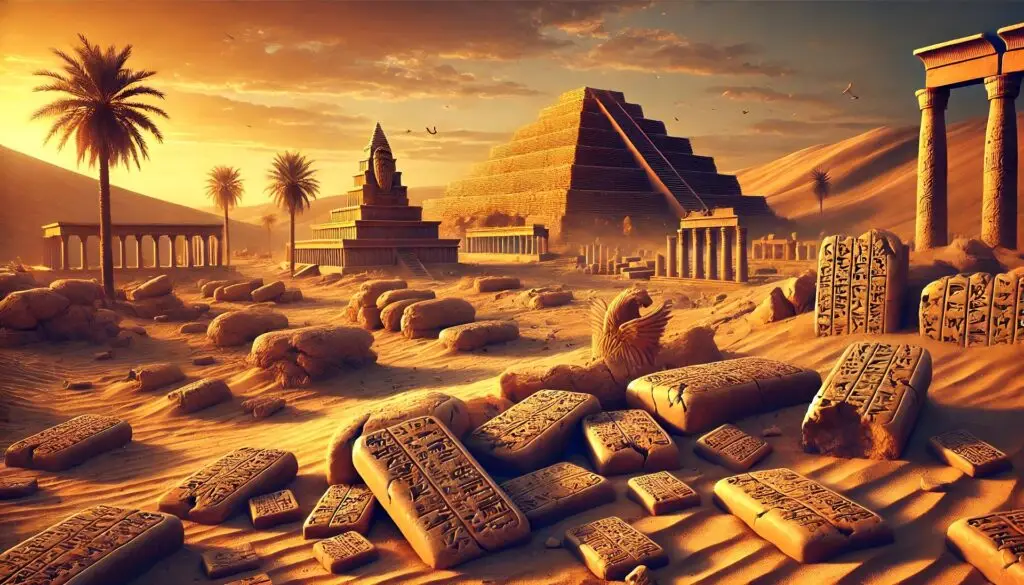
Dust. Heat. Silence. The road runs north toward Nineveh, and the people on it are walking away from everything they have known.
Section III
What 2 Kings 17 Is Actually Doing
The seventeenth chapter of 2 Kings is one of the most unusual passages in the historical literature of the ancient world. Most ancient chronicles record the fall of a city as a military event: army arrived, walls fell, king fled or died, scribes recorded the victory. The Assyrian annals do exactly this. What 2 Kings 17 does is different. It records the fall of Samaria — and then spends the following twenty verses explaining why. Not militarily. Morally.
The explanation is structured as a retrospective verdict. The narrator identifies the failure not as military miscalculation (though Hoshea’s Egyptian gambit clearly was one) but as the accumulated consequence of a two-century pattern of covenantal abandonment. The northern kingdom had been warned, the text says, by “every prophet and every seer” (2 Kings 17:13, ESV). They had been told to turn back. They had not.
Three passages frame what happened.
The first is the summary indictment of 2 Kings 17:15:
“They went after false idols and became false, and they followed the nations that were around them, concerning whom the Lord had commanded them that they should not do like them.” (2 Kings 17:15, ESV)
The Hebrew word translated “became false” is hebel — the same word used in Ecclesiastes for “vanity,” “vapor,” “breath.” You become what you worship. The kingdom had imitated the surrounding cultures so thoroughly that it had, in a meaningful sense, ceased to be itself before Sargon arrived. The empire encountered a nation already weakened by internal dissolution — and administered the paperwork for a conclusion the kingdom had been writing for itself across two centuries.
The second passage is the account of religious syncretism that followed the Assyrian resettlement, described in 2 Kings 17:29–33. The transplanted peoples — five nations, five sets of gods — brought their religious worlds with them and installed them in the high places of Samaria.
The Architecture of Syncretism — 2 Kings 17:29–31
The men of Babylon made Succoth-benoth. The men of Cuth made Nergal. The men of Hamath made Ashima. The Avvites made Nibhaz and Tartak. The Sepharvites burned their children in fire to Adrammelech and Anammelech. Five peoples, five pantheons — each installed in the high places of a land that had once heard the Shema. Not replacement. Superimposition.
The result was a system in which Yahweh was acknowledged and simultaneously reduced to one regional deity among several. The text records this without editorial fury. It simply notes what happened: “they feared the Lord but also served their own gods, after the manner of the nations from among whom they had been carried away” (2 Kings 17:33, ESV).
This is the pattern Isaiah identifies when he calls Assyria “the rod of my anger, the staff in their hands is my fury” (Isaiah 10:5, ESV). The empire is not, in the prophetic reading, the primary actor. It is the instrument of a judgment that the northern kingdom had been constructing for itself across two centuries of incremental compromise.
The third passage is Hosea 8:7, written during the final decades of the northern kingdom: “For they sow the wind, and they shall reap the whirlwind.” Hosea was not describing meteorology. He was describing the logic of consequences that accumulate beneath the surface of apparent stability — until they do not.
Section IV
The Architecture of Erasure, and What Outlasts It
The data is worth pausing on. Of the approximately 27,290 Israelites Sargon’s annals record as deported, the historical record yields no confirmed trace of a return. The ten northern tribes disappear from the historical record as identifiable tribal entities — absorbed into the administrative categories of successive empires, their regional distinctiveness dissolved across generations. What the rabbinic tradition preserves in its discussions of the “lost ten tribes” — in texts like the Talmudic tractate Sanhedrin (110b) — is not a historical account but a theological argument about whether the lost tribes have a share in the world to come.4 The historical question was apparently unanswerable even to those who lived a few centuries after the fact.
This is what successful erasure looks like. Not massacre — massacre leaves bodies, and bodies become graves, and graves become monuments. Deportation, resettlement, and the deliberate mixing of populations leaves nothing to mark.
What the Assyrian system understood, and what every subsequent empire would rediscover, is that the most durable form of conquest is not military but administrative.
Administrative empires often survive in maps long after they disappear from battlefields. When the British drew administrative boundaries in India, they did so with reference to manageable units, not to the organic communities those units disrupted. Lord Curzon’s logic and Sargon’s logic are not identical, but the mechanism is recognizable across twenty-five centuries: reshape the population, and you reshape the possible. When the British left, the borders remained — and the disruptions they encoded became the basis for partition, for the violence of 1947, for the Kashmir dispute that has not been resolved in nearly eighty years.
Sargon’s paperwork outlasted Sargon. The province of Samerina outlasted the Assyrian Empire. And what remained in the land — the mixed population practicing a syncretic religion that combined Yahweh-worship with the traditions of five other cultures — became the foundation for the community that the returning Judean exiles, two centuries later, would call Samaritans and refuse to recognize as kin. The rift that opens in Ezra 4, when the Samaritans offer to help rebuild the Jerusalem temple and are refused, is a direct consequence of what Sargon’s administrators set in motion in 722 BCE. Administrative decisions metastasize across generations.
The northern kingdom did not decide one morning to abandon its identity. It made a long series of arrangements that each seemed reasonable in isolation — political marriages, trade dependencies, high places built for foreign visitors, religious accommodations for imperial vassalage — until the identity those arrangements were supposed to protect no longer existed to protect.
Niebuhr’s insight about the irony of history is useful here. He observed that the most dangerous moment for any community is not when it is being openly attacked, but when it is succeeding — when the accommodations it has made to survive become the new normal, and the distance from original commitments becomes too gradual to notice. The northern kingdom was not crushed by a surprise. It was administered by an empire that found, on arrival, that very little remained to consolidate.
Every covenant community eventually faces a version of this question. It surfaces wherever an institution asks more of its members than they expected to give, wherever a professional environment rewards assimilation and makes distinctiveness costly, wherever the gap between what a community believes and how it operates quietly widens across decades.
The prophetic literature does not present Assyria as an anomaly. It presents Assyria as a revelation — the moment when what a society had been choosing to become was made visible, at enormous cost, in the light. The exile was not the beginning of a story about failure. It was the culmination of one.
Section V
The Province of Samerina, and Who Remains
The ruins of ancient Nineveh sit today beneath the modern Iraqi city of Mosul — the Nineveh that Nahum called a “city of blood” (Nahum 3:1, ESV), that the Babylonians and Medes dismantled in 612 BCE and left as rubble. What outlasted Nineveh was not Assyria. It was the geography Assyria had tried to master, and the question the dispersal had generated: who is a legitimate heir to the covenant when the community that held it has been scattered by a power indifferent to its existence?
That question, raised by the administrative act of 722 BCE, continued running. It runs through the Samaritan encounter in John 4, where a woman at a well asks Jesus which mountain is the correct one to worship on. It runs through every community that has tried to maintain identity under conditions hostile to that identity.
The Assyrian Empire came, restructured everything it could reach, and dissolved. What remained after Sargon’s province was reorganized and renamed and reorganized again was not a flag or an archive. It was a remnant — a minority who had carried something through the dispersal that administrative policy could not catalogue or confiscate.
Empires erase what they can measure. They cannot measure what is carried in memory, in practice, in the stubborn insistence on a name.
Footnotes
1 Cogan, Mordechai, and Hayim Tadmor. II Kings: A New Translation with Introduction and Commentary. Anchor Bible, vol. 11. Doubleday, 1988. The standard critical commentary on the deportation account in 2 Kings 17, with full analysis of Assyrian administrative terminology and parallel cuneiform sources. ↩
2 Kitchen, Kenneth A. The Third Intermediate Period in Egypt, 1100–650 BC. Aris & Phillips, 1986. Examines the identity and actual military capacity of “So, king of Egypt” in 2 Kings 17:4, generally identified with Osorkon IV of the Twenty-Second Dynasty. ↩
3 Sargon II’s annals are available in Luckenbill, Daniel David. Ancient Records of Assyria and Babylonia, vol. 2. University of Chicago Press, 1927, §§ 4–5, 55. The figure of 27,290 deportees appears in the Display Inscription from Khorsabad. ↩
4 On the “lost ten tribes” in rabbinic literature, see Sanhedrin 110b (Babylonian Talmud), where the question of their eschatological fate is debated between R. Akiva and R. Eliezer. The rabbinic tradition preserves the theological argument without resolving the historical one. ↩
5 Friedman, George. The Next 100 Years: A Forecast for the 21st Century. Doubleday, 2009, pp. 23–31. Friedman’s analysis of the Tigris-Euphrates corridor as a permanent geopolitical pressure zone; the interpretive application to the Assyrian period is the author’s own. ↩
6 Niebuhr, Reinhold. The Irony of American History. Scribner, 1952, p. 63. Niebuhr’s framing of history as the progressive exposure of human community’s moral limits underlies the interpretive arc of this essay. ↩
7 Biblical citations follow the English Standard Version (ESV) unless noted. Key passages: 2 Kings 17:6, 13, 15, 24, 29–33; Isaiah 10:5; Hosea 8:7; Nahum 3:1; Ezra 4; John 4:20.