Section I
The Eye Decides Before the Mind Does
In the spring of 2025, the consulting firm McKinsey Global Institute estimated that between 2030 and 2050, climate pressures alone could displace as many as 216 million people within their own countries — not by war or persecution, but by the slow, grinding arithmetic of where the water is, where the soil holds, and where the temperature remains livable (McKinsey Global Institute, 2021). The number is staggering. The logic beneath it is ancient.
Human beings move toward what looks survivable. They read the landscape before they read anything else.
In the previous installment, we followed Abram out of Ur — out of the ziggurat’s shadow, out of the moon god’s jurisdiction, out onto a road with no marked destination. That departure was framed as vocation: the commanded leave-taking of a man embedded in the most sophisticated city of the ancient Near East, walking away from everything that made staying make sense.
This installment stays with the same family, the same terrain, and the same question — but the answer it arrives at is almost a photographic negative. What Abram modeled in his departure, his nephew Lot immediately undoes in his choice. The separation recorded in Genesis 13 is brief on the page and long in consequence. It is also, for anyone watching the present world with any degree of attention, recognizable.
Section II
Two Men Standing on a Ridge
By Genesis 13, Abram and Lot have returned from Egypt — the same Egypt that will later enslave Abram’s descendants for four centuries — carrying more livestock, silver, and gold than the land around Bethel can sustain for two large households at once. The herdsmen begin to quarrel. The text is precise about the pressure: “the land could not support both of them dwelling together, for their possessions were so great” (Genesis 13:6, ESV). This is not a moral failing. It is a resource constraint, the kind that has driven separations, migrations, and territorial conflicts across every civilization in recorded history.
Abram responds with what the text treats as characteristic generosity. He gives Lot the first choice. In a cultural world where the patriarch’s prerogative was assumed and rarely surrendered, this is not a small gesture. “Is not the whole land before you?” Abram says in Genesis 13:9 (ESV). “Separate from me. If you take the left hand, then I will go to the right, or if you take the right hand, then I will go to the left.”
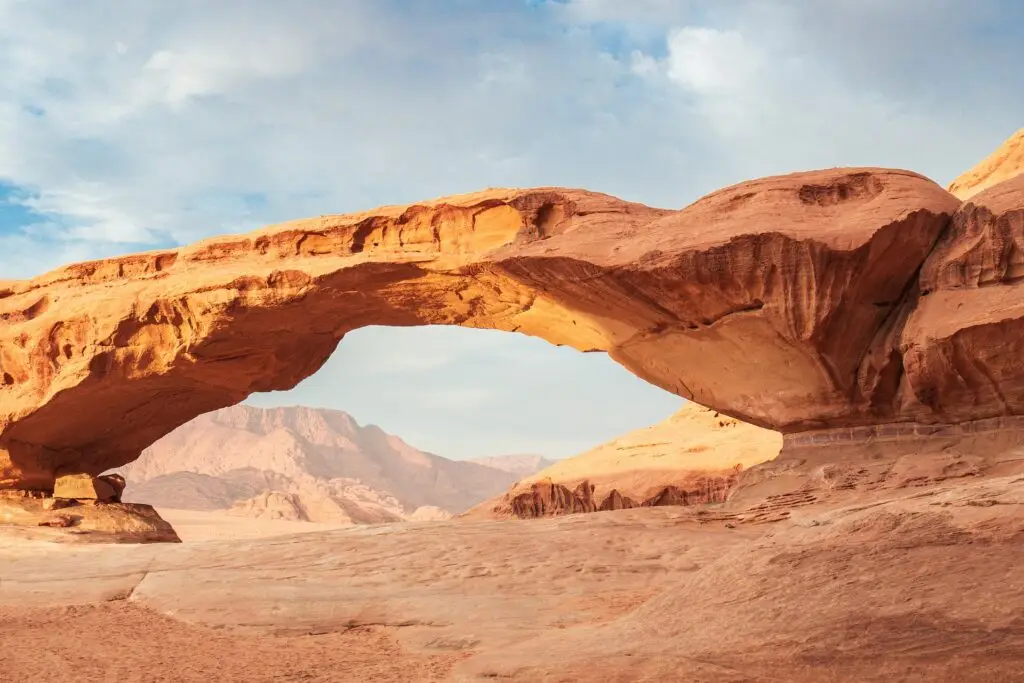
The offer is made from the hill country of Canaan, where Bethel and Ai define the ridge. From this elevation, both men can see in either direction. To the west: more of the same — rocky highland, sparse vegetation, terrain that demands patience. To the east and south: the Jordan Valley, the kikkar, the disk-shaped plain stretching toward the Dead Sea. Even from a distance, the contrast is not subtle. The Jordan corridor in the Middle Bronze Age was one of the most agriculturally productive zones in the entire southern Levant — well-watered, densely settled, commercially active. Archaeologists working the site of Tall el-Hammam, widely considered the most viable candidate for the biblical Sodom, have documented one of the largest urban centers in the region at the eastern edge of that plain (Collins, Biblical Archaeology Review, 2013).
Lot looks east. And in that look, the story pivots.
Section III
The Grammar of the Gaze
The verb is precise. Genesis 13:10 does not say Lot considered, or deliberated, or prayed. It says he lifted up his eyes. The phrase in Hebrew — va’yissa Lot et einav — appears elsewhere in Genesis at moments of heightened decision, including the near-sacrifice of Isaac in Genesis 22, where Abraham lifts his eyes and sees the ram caught in the thicket. The gesture carries weight.
What Lot sees when he lifts his eyes is described in language the narrator rarely deploys. The plain of the Jordan was “well watered everywhere — this was before the Lord destroyed Sodom and Gomorrah — like the garden of the Lord, like the land of Egypt” (Genesis 13:10, ESV). Two comparisons, stacked. Eden and Egypt: the oldest memory of abundance and the most advanced hydraulic civilization on earth. The narrator is not being neutral. He is giving us Lot’s perception — and bracketing it immediately with a parenthetical the careful reader cannot miss: this was before the Lord destroyed Sodom and Gomorrah.
The parenthetical does not moralize. It simply repositions the reader’s eye.
The rabbinic tradition has long found this sequence productive. What Rashi preserves in his commentary on Genesis 13:11 is a reading of the Hebrew mi’kedem — typically translated “he journeyed east” — that opens a second register. One strand of that tradition suggests Lot’s eastward movement was not merely geographic but theological: he removed himself, in some sense, from the One who preceded (kadam) the world. Whether or not that reading survives as historical exegesis, it catches something the plain text also communicates. Lot’s movement east is coded departure, not simply relocation.
— Genesis 13:10 (ESV)
— Genesis 13:11 (ESV)
— Genesis 13:12 (ESV)
Three verses accomplish what pages of exposition could not. Lot lifted his eyes, saw what looked like abundance, chose it, and moved toward it — incrementally at first, then all the way in. He pitched his tent toward Sodom in verse 12. By Genesis 19, when the angels arrive, he is sitting in Sodom’s gate: the seat of civic authority, the place where a man is known, trusted, and implicated.
The trajectory from “lifted his eyes” to “sitting in the gate” takes six chapters of Genesis to complete. It begins with a look.
Section IV
The Shinar Echo
The directional language of Genesis 13:11 has not escaped careful readers. In Genesis 11:2, the builders of Babel “journeyed eastward” and “found a plain” — the Hebrew biq’ah, a flat basin — and settled. In Genesis 13:11, Lot chooses the kikkar, the Jordan disk, and journeys eastward. The two phrases share the same root. The two landscapes share the same topographic logic: a flat, productive plain, accessible and visible, promising to anyone who runs the numbers.
The parallel accumulates meaning across the whole of Genesis. Eden, Cain’s exile, the flood, Babel — the primaeval history is organized around a recurring pattern of movement eastward and downward, away from the presence of God and toward the self-managed terrain that makes dependence feel unnecessary. Cain goes east of Eden after the murder (Genesis 4:16). The Babel builders move east to the plain of Shinar. Now Lot moves east to the Jordan disk. The direction carries moral weight in the narrative grammar of these chapters. It is a direction the text has already taught us to notice.
What Lot is replicating, then, is not simply a poor real estate decision. He is recapitulating a pattern.
The Shinar reflex — that deep pull toward the legible plain, the manageable terrain, the civilization that has already solved the water problem — has migrated from Mesopotamia to the Jordan Valley. It has found a new address. And it has found it because someone with every reason to choose otherwise lifted his eyes, read the landscape, and chose the version of the future he could see.
Lot’s eye was not wrong about what it found. The plain was fertile. The city was real. The water was there.
He saw abundance and a civilization that had already figured out how to make the land produce. What he did not see — what the parenthetical quietly notes on his behalf — was the tense the narrator was writing in. This was before.
The McKinsey figure cited at the opening — 216 million potential climate migrants by mid-century — is worth holding alongside this. The movement of populations toward what looks survivable is neither new nor simply blameworthy. Climate stress is real. Resource constraint drove the quarrel between Lot’s herdsmen and Abram’s. Genesis does not condemn Lot for reading the landscape. It tracks, with patient precision, what happens when the lifted eye seeks nothing beyond what the landscape offers.
Abram, at the same moment, received a fresh word. Genesis 13:14 notes that after Lot had separated, the Lord spoke again — inviting Abram to lift his own eyes in all four directions, over land not yet possessed. The contrast in what each lifted gaze is doing is the hinge of the chapter. One eye is measuring what is there. The other is being shown what is not yet visible.
Section V
The Hill Country Holds
Abram settled in the hill country. He moved to Hebron and built an altar there — not a city, not a tower, not a claim on the irrigated valley below. An altar. The form that marks presence without occupying territory, that acknowledges a jurisdiction larger than the one visible from the ridge.
Hebron is not an obvious choice. The Judean highlands surrounding it are rocky, terraced, dependent on rainfall rather than river, slower to yield and harder to work than the plain. It does not look like the garden of the Lord. It does not look like Egypt. What it looks like is exactly what it is: terrain that requires dependence on something the eye cannot assess from a distance.
The hill country, in the economy of Genesis, is where the promise is kept — not because it is fertile, but because it cannot be mistaken for the kingdom.
This is not a narrow point, and it is not limited to the ancient Near East. Every generation produces its version of the choice on the ridge. Perceptive, capable people move toward the centers of gravity that look most likely to produce the future — toward the cities with the best infrastructure, the valleys with the most reliable water, the institutions with the most visible momentum. The assessment is usually sound. The landscape is usually legible.
Genesis 13 does not fault Lot for being perceptive. It traces what perception built on appearance alone produces across time. Six chapters later, the plain that looked like Eden is gone. The hill country that offered no obvious advantage is where the covenant continues.
The separation of Abram and Lot begins as a dispute between herdsmen over grass and water. It ends as something else: a divergence in what each man’s eye is trained to find when he lifts it toward the horizon. One eye looks for what the landscape can yield. The other looks for what the landscape is being asked to hold.
Those are not the same question. And in Genesis, they do not lead to the same place.
Collins, S. (2013). Where is Sodom? Biblical Archaeology Review, 39(2). biblicalarchaeology.org.
McKinsey Global Institute. (2021). Climate risk and response: Physical hazards and socioeconomic impacts. McKinsey & Company. mckinsey.com.
Rashi. (11th–12th c.). Commentary on Genesis 13:11. In Mikraot Gedolot (M. Rosenbaum & A. M. Silbermann, Trans., 1929). Shapiro, Vallentine & Co.
Wenham, G. J. (1994). Genesis 1–15 (Word Biblical Commentary, Vol. 1). Thomas Nelson.
Jewish Theological Seminary. (n.d.). Lot’s choice: Appearances and the limits of vision. Torah Commentary, Parashat Lech Lecha. jtsa.edu.