Section I
The Morning He Did Not Argue
The call came before dawn.
Not metaphorically — the text of Genesis 22 preserves the specific temporal detail with the economy of someone who understands that what happens in the dark before a journey matters. “Abraham rose early in the morning” (Genesis 22:3, ESV). He saddled his donkey, split wood for the offering, and took two servants and his son. Three days of travel lay between Beersheba and the mountain God would show him. He had been told to offer his son as a burnt offering. He did not argue.
This is the same man who argued with God over Sodom. In Genesis 18, Abraham stood before the LORD and negotiated downward from fifty righteous to ten, pressing the divine patience with the persistence of someone who believed the argument was worth making. The man who could do that chose silence on the road to Moriah. The contrast is not incidental.
In the previous installment, we examined Genesis 21 — Isaac’s birth, Hagar and Ishmael sent into the wilderness with a day’s provision, the treaty at Beersheba, and the tamarisk tree Abraham planted as an unhurried act of confidence in a promise that ran longer than any human timeline. Now that promise is the thing being tested. Not Abraham’s obedience in the abstract. The specific, named child through whom the entire architecture of the covenant had been organized.
What the mountain required was not a theological position. It was the man himself — everything he had waited for, everything the covenant had cost him, everything he had learned to love more completely because it had taken so long to arrive.
Section II
The Pattern of the Unreturnable Concession
History records a particular kind of crisis that arises not from external attack but from the internal logic of a commitment carried to its terminus — the moment when a position, once held, cannot be modified without collapsing the entire structure it was meant to protect.
The Cuban Missile Crisis of October 1962 is often remembered as a confrontation between two superpowers. What the declassified record reveals is something more precise: a series of moments in which each party had to decide whether a stated commitment was real or performative (Fursenko & Naftali, One Hell of a Gamble, 1997). Kennedy had drawn a line on Soviet missiles in Cuba. Khrushchev had publicly denied their presence. When the U-2 photographs confirmed the missiles existed, both men found themselves in the same structural position: the cost of holding the stated position appeared potentially catastrophic, and the cost of abandoning it appeared certain. What the crisis ultimately produced was not a military resolution but a diplomatic one — the removal of missiles from Cuba in exchange for a quiet American commitment regarding Turkey, a concession never publicly acknowledged by Washington.
The resolution worked precisely because both parties understood that the commitment could not be sustained without consequence and could not be abandoned without humiliation. The path through required finding something neither side had publicly named as the real object of negotiation.
Abraham on the road to Moriah is not negotiating. He is not looking for the quiet concession that will make the crisis manageable. The text offers no interior monologue, no record of the argument he might have made and chose not to make. What the narrative preserves instead is action: the early rising, the saddled donkey, the split wood, the three-day walk.
The rabbinic tradition has long attended to this silence. What the Midrash preserves — and one strand of that tradition suggests with particular force — is that Abraham’s silence was not the silence of incomprehension but the silence of a man who understood exactly what was being asked and had, somewhere in the three days of walking, resolved the contradiction that the request appeared to contain (Bereishit Rabbah 55:4). The resolution the text will later make explicit, Abraham appears to have arrived at on the road: that the God who had given Isaac could restore Isaac, even from death. The letter to the Hebrews names this directly: “He considered that God was able even to raise him from the dead, from which, figuratively speaking, he did receive him back” (Hebrews 11:19, ESV).
The silence is not passivity. It is the most active thing in the chapter.
Section III
Three Texts and One Altar
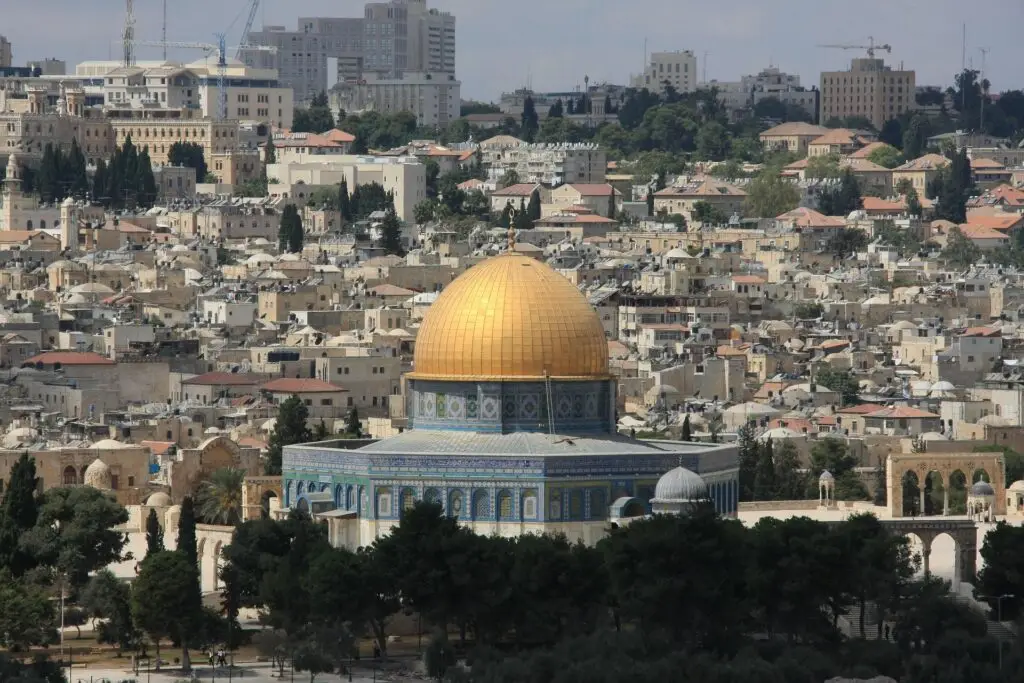
The mountain is identified as Moriah. The word appears only twice in the Hebrew Bible — here, and in 2 Chronicles 3:1, where Solomon builds the Temple on the threshing floor of Ornan the Jebusite on Mount Moriah. The connection is not incidental to the text’s architecture. The place where the knife was stayed became the place where Israel’s central act of worship was eventually housed. The geography of the near-sacrifice and the geography of the Temple belong to the same sacred terrain.
Three passages carry what the chapter presses toward from the moment Abraham rises in the dark:
“God will provide for himself the lamb for a burnt offering, my son.”
— Genesis 22:8 (ESV)
“Do not lay your hand on the boy or do anything to him, for now I know that you fear God, seeing you have not withheld your son, your only son, from me.”
— Genesis 22:12 (ESV)
“On the mount of the LORD it will be provided.”
— Genesis 22:14 (ESV)
The first passage is the pivot of the chapter. Isaac’s question is direct: the fire and the wood are here, but where is the lamb? Abraham’s answer is grammatically ambiguous in a way the Hebrew preserves and English struggles to carry. “God will provide for himself the lamb” can be read as a deflection — a father managing a child’s anxiety on a road he cannot explain. It can also be read as prophecy spoken without full comprehension of its own content. The narrative does not resolve the ambiguity, and the restraint appears deliberate. Abraham said what was true. He may not have known how comprehensively true it was.
The second passage — “now I know that you fear God” — has troubled careful readers because it implies God learned something through the test. The test did not supply God with information. It revealed, within history rather than merely within divine foreknowledge, what Abraham’s faith actually was. Fear of God in the Hebrew Bible is not an emotion. It is a posture — the willingness to hold everything else in its proper place relative to the one who gave it.
The third passage names the place. Yahweh-jireh — the LORD will provide, or the LORD will see. The ambiguity is structural. The mountain where God sees and the mountain where God provides are, in the Hebrew, the same mountain. Providence and presence are not two operations but one.
The Akedah — the binding — is the moment in the patriarchal narrative where the moral condition of the covenant is made fully visible. Not in the accumulated years of a long life or the slow accumulation of obedience across ordinary days, but in a single morning, on a three-day walk, at an altar Abraham built with his own hands.
Section IV
The Ram in the Thicket and What It Signals
The data surrounding ancient Near Eastern religious practice is well-documented and relevant here. Archaeological and textual evidence from Ugarit, Carthage, and other Phoenician-influenced sites confirms that child sacrifice — specifically the molk offering, in which firstborn children were consecrated by fire — was practiced across the ancient Canaanite world with sufficient regularity to be treated as a distinct religious category in surrounding texts (Levenson, The Death and Resurrection of the Beloved Son, 1993). The worship of Molech, condemned repeatedly in the Hebrew prophetic tradition, was not a distant aberration but a proximate cultural pressure.
Genesis 22 enters that world at its most pressurized point — the sacrifice of the firstborn, the beloved son — and then redirects the entire trajectory. The ram caught in the thicket is not an afterthought or a convenient rescue. It is the text’s decisive theological statement about what kind of God YHWH is, expressed not through abstraction but through action.
The God who commands the sacrifice does not ultimately require the child. What he requires is the surrender of the man who was willing to withhold nothing from him. The provision arrives only after the altar is built, the wood arranged, the son bound, and the knife raised.
The text itself remains remarkably restrained. Scripture offers no description of Abraham’s emotions and no psychological portrait of Isaac. The narrative refuses sentimentality precisely where later readers most expect it. What matters is not emotional disclosure but revelation: what kind of faith Abraham possessed, and what kind of God had called him.
The substitution introduced at Moriah becomes one of the earliest and clearest patterns the rest of Scripture develops. The ram in the thicket stands behind the sacrificial grammar of Leviticus, the imagery of Isaiah 53, and the argument of Hebrews concerning priesthood and atonement. Christian interpretation has long seen in Moriah a sacred geography that eventually reaches toward Jerusalem and the cross — not as a forced overlay upon Genesis 22, but as a trajectory the biblical canon itself progressively unfolds.
The rabbinic tradition preserves a particularly searching engagement with this substitution. One strand of that tradition in the Talmudic discussion of the Akedah suggests that the ram had been prepared from the six days of creation — that the provision was not reactive but constitutive, woven into the fabric of the world before Abraham had yet been born (Pirkei Avot 5:6). Whether or not that interpretive claim is pressed that far, the principle it articulates is consonant with what the text implies: that the provision at Moriah was not improvised but prepared, not an emergency response but a disclosure of something that had been true all along.
The knife was raised. The ram was prepared. And the provision arrived precisely where the willingness had been fully expressed — before the blade fell, after the altar was built. The mountain kept the name of what it had witnessed.
Section V
What the Mountain Revealed
The blessing that follows the near-sacrifice is the most expansive in the patriarchal narrative. “By myself I have sworn, declares the LORD, because you have done this and have not withheld your son, your only son, I will surely bless you, and I will surely multiply your offspring as the stars of heaven and as the sand that is on the seashore. And your offspring shall possess the gate of his enemies, and in your offspring shall all the nations of the earth be blessed, because you have obeyed my voice” (Genesis 22:16–18, ESV).
The language of self-oath — by myself I have sworn — appears nowhere else in the patriarchal narrative. God had made the covenant with Abraham in Genesis 15 in a form modeled on the treaty-cutting ceremony of the ancient Near East, in which both parties walk between the divided animals. In that ceremony, Abraham fell into a deep sleep, and only the divine presence passed between the pieces. God bound himself to the covenant in a form that required nothing of Abraham at that moment. Now, at Moriah, the covenant is confirmed by divine oath in language that matches the gravity of what Abraham has just demonstrated.
The blessing expands in two directions simultaneously: the particular line of descent through which the covenant will run, and the breadth of its eventual reach — “all the nations of the earth.” The man who climbed the mountain with his son and came down with him alive became, on that mountain, the point from which the promise projects outward to everyone who will eventually receive it.
Genesis 22 is not, finally, a chapter about obedience as a spiritual discipline. It is a chapter about the structure of the promise itself — what it required, what it cost, what it revealed about the character of the God who made it. Abraham’s faithfulness is real and the text honors it. But the center of gravity is not the patriarch. It is the provision: the ram in the thicket, the Yahweh-jireh, the name that the mountain keeps even now.
The tamarisk Abraham planted at Beersheba in the previous chapter was an act of confidence in a promise that ran longer than any human timeline. Moriah is what that confidence looked like when the timeline compressed into a single morning, and the promise was asked to hold its own weight with a knife against it.
1 Fursenko, A., & Naftali, T. (1997). One Hell of a Gamble: Khrushchev, Castro, and Kennedy, 1958–1964. W. W. Norton & Company.
2 Bereishit Rabbah 55:4. In Midrash Rabbah: Genesis. Trans. H. Freedman & M. Simon. Soncino Press, 1939.
3 Levenson, J. D. (1993). The Death and Resurrection of the Beloved Son: The Transformation of Child Sacrifice in Judaism and Christianity. Yale University Press.
4 Pirkei Avot 5:6. In The Mishnah. Trans. H. Danby. Oxford University Press, 1933.
5 Wenham, G. J. (1994). Genesis 16–50. Word Biblical Commentary, Vol. 2. Word Books.