S1 · HOOK
The Night the Lodge on Union Street Locked Its Door for the Last Time
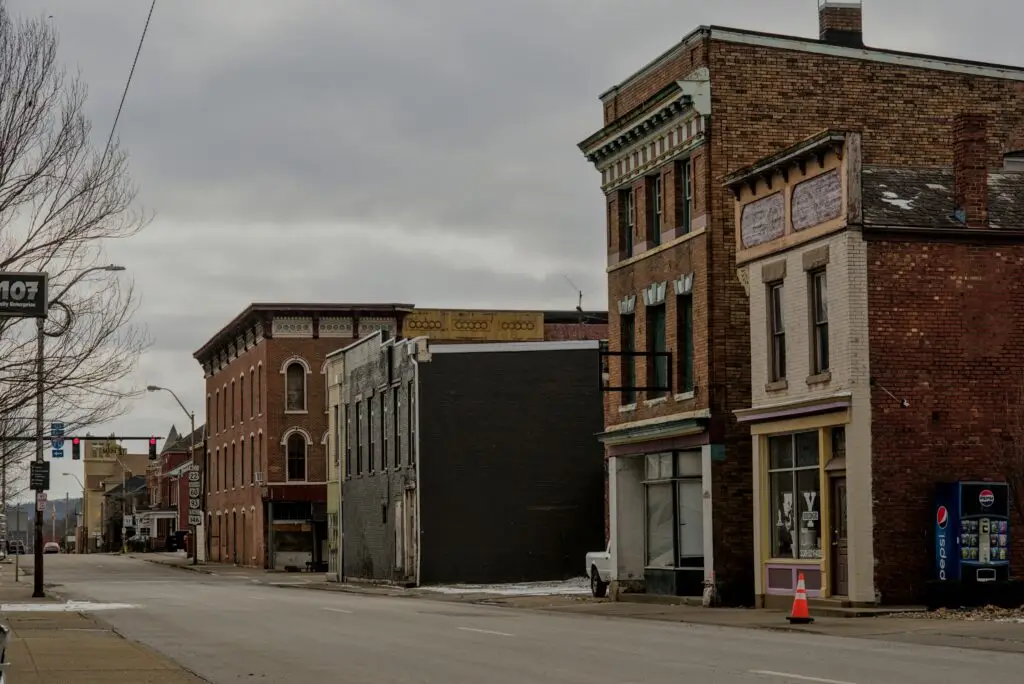
Last December, a Masonic lodge in a small Georgia town closed its doors quietly. Membership had dwindled to eight men, only three of whom could still climb the stairs. The local paper ran the news in two paragraphs, tucked beside the obituaries.
The room where the lodge had met for more than a century — second floor, above the hardware store, lit every Tuesday night for generations — is now used for storage. No one recorded who turned off the light that final evening, or whether he paused at the bottom of the stairs before walking out.
Rooms like this are going dark across the country. According to a 2019 report from the U.S. Congress’s Joint Economic Committee, American participation in voluntary associations fell from 75 percent in 1974 to 62 percent in 2004, with fraternal organizations such as the Freemasons and the Knights of Columbus posting the steepest decline of any category, at 52 percent1.
The Elks lost more than half their national membership over the same period, falling from roughly 1.6 million members in 1976 to about 750,000 today2. What sociologist Ray Oldenburg named, in 1989, the “third place” — the spaces that are neither home nor work, where strangers and familiar faces cross paths for no particular reason — has been quietly erased from the American map over the last half-century3.
In the previous installment, an AI companion sat in for a conversation partner. Confiding in it felt easy — it never grew tired, never delayed a reply, never needed comforting in return — and at the moment real vulnerability threatened to surface, the user asked it to close the door rather than risk being overheard by someone actual. That ease came at a cost: the same researchers who documented the comfort also tracked rising signs of quiet withdrawal from real people over time.
But the question worth asking now runs the other direction: was there ever another room left for that person to walk into in the first place?
S2 · HISTORICAL CASE
The Man Who Sat at the Gate
To understand what has been lost, it helps to see how long, and how essentially, that room existed before it began disappearing. In the ancient Near East, the city gate functioned as courthouse, city hall, market, and tavern rolled into one. People sat there to close deals, settle disputes, and simply pass the hours in view of one another.
When Boaz needed to resolve a legal matter involving Ruth, he did not look for a private room. He went up to the gate, sat down, and called ten elders from among the men passing by to witness the transaction in public.
Rome’s forum served a similar purpose on a grander scale. Merchants, senators, and ordinary citizens mixed there daily, trading news and arguing politics in the same open square. Medieval guild halls added a professional layer to this same instinct — a blacksmith or a weaver belonged to a hall that was simultaneously a place to trade skills and a place to bury one another’s dead.
England carried its own version of this into the modern era through the parish hall and the working men’s club, buildings that, like their American counterparts, have thinned out sharply since the 1970s.
Colonial America carried this same inheritance forward through the town square and the tavern. When Alexis de Tocqueville toured the United States in the 1830s, what struck him most was not the country’s political machinery but the sheer eagerness of ordinary Americans to form voluntary associations — fire brigades, reading circles, benevolent societies. This dense web of association, he argued, was the actual root system of American democracy, more load-bearing than any constitution.
By the mid-twentieth century, that web had reached its high-water mark. Fraternal orders — the Elks, the Lions, the Rotary, the Odd Fellows — had a presence in nearly every American town, and it was entirely ordinary for their meeting rooms to sit above a hardware store or a bank.
Political scientist Robert Putnam spent much of the 1990s tracking the scale of what came after. Bowling itself, he found, had grown more popular even as bowling leagues collapsed — Americans were, increasingly, bowling alone4.
His deeper argument was not simply that people stopped joining things; it was that membership itself had quietly changed shape, from something practiced together into something purchased and consumed alone — a check written to a national organization in place of an evening spent in a room with other members.
The causes he identified were not singular. Television absorbed evening hours that had once gone to meetings. Suburban sprawl stretched the distance between neighbors. Two-income households left less time for anything beyond work and family. Generational turnover replaced joiners with a cohort less inclined to join. But the outcome was singular: the physical infrastructure that let strangers and neighbors encounter one another regularly, and at low cost, was systematically dismantled across the American landscape.
The dismantling did not happen all at once, and it did not happen evenly. Rural towns lost their halls earlier and more completely than cities, where a thinner but still-functioning layer of civic institutions survived longer. What changed everywhere, eventually, was the assumption embedded in the built environment itself — that a town needed a room where nothing in particular happened except people showing up.
S3 · BIBLICAL LENS
No One to Lift the One Who Sits Alone
Scripture treats companionship less as sentiment than as structural engineering — a description of what actually happens when weight needs to be borne, and of the conditions under which that weight can be borne at all. Proverbs states the mechanism with a single tactile image.
“Iron sharpens iron, and one man sharpens another.” (Proverbs 27:17, ESV)
What this verse assumes is not emotional comfort but physical contact. Iron sharpens only against other iron. A blade left alone does not stay sharp by resting; it simply dulls.
The scene at the gate in Ruth translates this same principle into the language of public space.
“Now Boaz had gone up to the gate and sat down there… Then he took ten men of the elders of the city and said, ‘Sit down here,’ so they sat down.” (Ruth 4:1–2, ESV)
Justice and relationship here are not handled privately. They must happen in a public place, before witnesses who can see and hear what occurs. The early church inherited this same principle and gave it a daily rhythm.
“And day by day, attending the temple together and breaking bread in their homes, they received their food with glad and generous hearts.” (Acts 2:46, ESV)
The operative phrase is day by day. This was not an occasional gathering for a special occasion. It was the ordinary rhythm of showing up to the same place, again and again, and that repetition itself was the mechanism by which the community was built and sustained.
What began as a description of an ancient community becomes, without much translation, a diagnosis of what happens when a society quietly trades that friction for convenience: the sharpening stops, the public witness disappears, and the daily rhythm goes silent one closed door at a time.
Read together, these three passages trace a single pattern: sharpening requires contact, justice requires a public space, and community requires a repeated place. Remove any one of those three conditions, and the other two eventually collapse along with it.
S4 · PATTERN INSIGHT
The Drive-Through Is Not a Public Square
Looking closer at how this collapse actually operates reveals a mechanism hiding underneath the statistics. Twenty-five years after Putnam first measured the decline, a December 2025 analysis from the American Enterprise Institute confirms the pattern has not reversed — it calls the loss of third places “not just a cultural loss” but “a civic one,” noting that social capital does not regenerate on its own, but is produced only in spaces where people encounter one another with regularity and low stakes5.
When that contact disappears, people stop practicing the skill of sharing space with those unlike themselves, and difference begins to register as threat rather than as ordinary texture of daily life.
What remains often imitates the function of a third place without actually performing it. The most common substitute in American suburbs today is a drive-through chain coffee shop, engineered around turnover rather than dwelling — a customer who orders and leaves is worth more to the business than one who lingers. Where an old Rotary Club hall built a standing roster of familiar faces who returned week after week, a drive-through window produces a revolving stream of strangers who rarely cross paths twice.
The pattern is not uniquely American. Japan’s shotengai — the covered, family-run shopping streets that once anchored neighborhood life — have faced a similar hollowing as suburban supercenters and convenience chains pulled customers away from daily, face-to-face commerce. The American drive-through and the shuttered shotengai storefront are, at bottom, symptoms of the same substitution: convenience purchased at the price of encounter.
That difference is not incidental. NPR’s 1999 reporting on the decline of the Elks and the Odd Fellows found that members were leaving not simply out of boredom, but because the requirement of facing the same people, week after week, had itself become something people wanted to avoid6. The irony here is worth sitting with. The very repetition and inconvenience that members began fleeing from is precisely what Proverbs means by sharpening and what Acts means by day by day — neither works without friction, and neither survives the removal of it.
Economic pressure accelerated the same trend from a different direction. Rising commercial rents pushed out the low-margin cafés and independent bookstores that once anchored neighborhood life, replacing them with chain storefronts or, more often, vacancies. Declining membership has, in some cases, begun to threaten the physical survival of the buildings themselves, as the funds needed to maintain a hall and the next generation to inherit it disappear together7.
Generational transmission compounds the problem further. Joining a fraternal or service organization once functioned as something close to a rite of passage into adulthood — a father bringing his son to visit a lodge for the first time was an unremarkable event. As that pathway closed, younger Americans came of age without ever encountering these spaces as a live option. What was once a well-worn door became, for an entire generation, a door they never knew existed.
This is not a call to romanticize what was lost without qualification. Many of these old fraternal halls carried their own exclusions — membership in organizations like the Elks was, for much of their history, restricted along lines of race and sex, and the “brotherhood” they offered was not extended equally to everyone in town. Acknowledging that history does not undo the civic function these spaces once served; it simply means that whatever replaces them will need to do the same work without repeating the same failure.
It is against this backdrop that the pattern from our previous installment comes into fuller focus. An AI companion does not merely offer comfort in the abstract — it offers comfort with none of the friction that a physical third place would have required: no commute to the lodge, no dues, no need to tolerate a difficult neighbor across the table. When the room above the hardware store goes dark, the frictionless alternative sitting in a person’s pocket does not need to compete with anything. It simply becomes the only room left open at that hour.
Not every third place has vanished, and the picture is not uniformly bleak. Public libraries have, in many communities, quietly absorbed the role once played by the lodge and the guild hall — hosting job fairs, citizenship classes, and public health clinics alongside their traditional stacks, open to anyone who walks in regardless of dues or membership rolls8. A library card requires no vote of admission and excludes no one who can read.
Virginia Beach’s investment in walkable parks and small-scale cafés, and Utah’s commitment to human-scale main streets, show measurable gains in civic participation that no branding campaign could manufacture on its own5. These renewals matter, and they complicate any narrative of simple, linear decline. But they remain the exception in most American towns rather than the rule. The room above the hardware store, more often than not, still sits empty.
S5 · CLOSING
The Room That No Longer Lights Up
Like the lodge in Georgia, similar rooms are going quiet across the country. The light that once came on every Tuesday night now falls, if it falls at all, across someone else’s stored inventory. This is not a matter of nostalgia. Proverbs was precise about the mechanism: iron sharpens only against other iron, and when the place where that friction happened disappears, the sharpening disappears along with it.
The previous installment closed on someone asking an AI companion to close the door behind them. Part of why that request came so easily may be that there was no other room left for them to walk into. For someone without a room, the room on the screen becomes the only room there is.
The community Acts describes did not assemble itself by accident. Meeting day by day was not a matter of convenience — it was the visible result of a choice, renewed continually, by people willing to keep showing up. That choice remains available today, though the terms have changed. It no longer means finding a room that already exists and waiting to be invited in.
1. Joint Economic Committee, U.S. Congress (2019). Report on the Decline of Civic and Voluntary Association Membership, 1974–2004. Washington, DC.
2. Gangishetty, P. (2019). “Elks Sees Slight Increase in National Membership.” Patch.
3. Oldenburg, R. (1989). The Great Good Place: Cafes, Coffee Shops, Community Centers, Beauty Parlors, General Stores, Bars, Hangouts, and How They Get You Through the Day. Paragon House.
4. Putnam, R. (2000). Bowling Alone: The Collapse and Revival of American Community. Simon & Schuster.
5. American Enterprise Institute (2025). “America’s Third Places Are Disappearing and Why It Matters.” AEI, December 2025.
6. Burnett, J. (1999). “Clubs.” NPR, February 27, 1999.
7. University of Massachusetts Amherst (n.d.). “The Future of Masonic Lodges.” UMass Amherst research report.
8. Urban Libraries Council (n.d.). Analysis of public libraries functioning as resilient third places.