The Number Nobody Wants to Own
Between 1999 and 2021, annual deaths from suicide, drug overdose, and alcoholic liver disease — the category researchers call deaths of despair — more than doubled in the United States. By 2021 the category accounted for 176,386 deaths, enough to rank as the nation’s fifth leading cause of death, trailing only heart disease, cancer, COVID-19, and accidents (Mejia et al., 2024).1
The term itself comes from economists Anne Case and Angus Deaton, who coined it in 2015 to describe a pattern they found almost exclusively among white, non-college-educated, middle-aged Americans (Case & Deaton, 2020).2 That was the group the data pointed to first. It is no longer the group the data points to only. By 2022, the same body of research showed the rate of deaths of despair running higher among Black Americans than white Americans, and highest of all in American Indian and Alaska Native communities — a shift that turns what was once a story about one demographic into a story closer to the structure of American work and belonging itself.1
It is a strange kind of statistic. It doesn’t describe a war or a famine or a hurricane. It describes something slower — a scaffolding of ordinary life quietly giving way under people who, on paper, are simply living out their lives.
The counties where it concentrates are not randomly scattered. Appalachian coal country, the industrial belt stretching from Ohio through Michigan, the rural stretches of the Mountain West — these are not the poorest places in America by income. They are, more precisely, the places that used to have a name for what a person there did for a living, and now mostly don’t.
Part of what makes the category useful, and part of what makes it easy to misread, is that it counts three different mechanisms as one thing. A fatal overdose, a fatal liver disease, and a suicide look, on a death certificate, like three unrelated categories of tragedy. Case and Deaton’s argument is that underneath the immediate cause, a great many of these deaths share a slower cause in common — and that treating them separately, the way public health statistics traditionally have, made the pattern nearly invisible for years.
What the Depression Actually Measured
Ninety years earlier, another set of numbers told an eerily similar story. The national suicide rate climbed from roughly 18 per 100,000 in 1928 to a record 22 per 100,000 by 1932 — the highest rate ever recorded in American history, before or since (Granados & Roux, 2009).3
A man in 1932 wasn’t only losing income. He was losing the thing his whole social world had told him made him a man. The unemployment office and the breadline did something a famine cannot do by itself — it converted material loss into a verdict on the person.
That is the thread that connects a Depression-era mill town to a Rust Belt county today. The mechanism has changed — opioids where there was once only the river or the rope — but the wound underneath is recognizably the same one: work disappears, and with it, a story a person had been told about their own worth.
What made that decade survivable for so many, though, wasn’t recovery. It was that the loss was rarely borne alone. Fraternal lodges — the Elks, the Odd Fellows, the Masons — counted millions of members in the 1920s and 1930s, and a closed mill still left a church pew, a union hall, a corner tavern where a man’s name was still called out when he walked in. Poverty was real. But the web around a person was, more often than not, still intact.
The government matched that voluntary web with public projects designed to be encountered together, not received alone. Roosevelt’s Federal Writers’ Project sent workers to record ordinary Americans’ own accounts of the decade — sharecroppers, coal miners, factory hands — leaving behind an archive in which people describe hardship in their own words, witnessed and written down by someone who came to listen. The Civilian Conservation Corps put over two million young men to work building trails and dams, but it also housed them together in camps and fed them together, giving them, alongside a wage, something closer to a company they hadn’t had since their fathers lost theirs. None of it eliminated the despair the 1930s produced. But almost none of that decade’s response to economic collapse was designed to be experienced by a person sitting alone.
The comparison worth sitting with isn’t poorer-then, richer-now. The 1930s were a decade when the economy failed and the community, for the most part, held. What the data may now be describing is closer to the reverse: a decade where the economy, by its usual measures, holds — and the community is what has quietly failed.
The Psalm With No Resolution
“I am shut up, and I cannot come forth. Mine eye mourneth by reason of affliction” (Psalm 88:8-9, KJV).
Psalm 88 is the strangest psalm in the collection, because it is the only one that does not turn. Every other lament eventually pivots to praise, to trust, to a remembered rescue. This one doesn’t. It ends where it began — in darkness.
“LORD, why castest thou off my soul? why hidest thou thy face from me?” (Psalm 88:14, KJV).
For a tradition that so often reaches for resolution, it is worth noticing what the compilers of the Psalter chose to preserve: a prayer that never gets an answer inside the text.
American theologians have often called Psalm 88 the psalm of the unanswered prayer, and the label earns its place. Faith here is not proved by receiving an answer. Sometimes it is proved by refusing to stop speaking before one arrives.
“Two are better than one; because they have a good reward for their labour. For if they fall, the one will lift up his fellow: but woe to him that is alone when he falleth; for he hath not another to help him up” (Ecclesiastes 4:9-10, KJV).
Scripture does offer a counterweight to Psalm 88, though not inside it. The two texts are not in tension. Psalm 88 describes what it feels like when that second person seems to have gone missing — from the room, or from the whole architecture of a life.
Scripture stops short of naming every disaster as the wrath of heaven, yet it will not let a people escape the reckoning of what their common life, over years, has quietly disclosed.
Job is the other figure worth sitting with here — not the man who gets his answers in chapter 42, but the man for thirty-five chapters before that, who refuses the easy explanation his friends offer, because he knows his own integrity better than they do.
Job’s three friends do what well-meaning people have always done in the presence of a suffering they cannot fix: they reach for an explanation that will let them stop being unsettled by it. Eliphaz suggests, gently at first, that Job must have done something to deserve this. Bildad is blunter. Zophar blunter still. Each is offering a version of the same trade — certainty, purchased at the cost of Job’s innocence. Job’s refusal is not defiance for its own sake. It is a refusal to let his friends’ need for a tidy universe overwrite what he actually knows about his own life. That refusal costs him thirty-five chapters of being told, by people who love him, that his grief must be his fault. Scripture preserves both halves of that exchange — Job’s protest and his friends’ bad theology — without editing out the friends’ error, which is itself an unusual thing for an ancient religious text to do.
“Why art thou cast down, O my soul? and why art thou disquieted in me? hope thou in God: for I shall yet praise him for the help of his countenance” (Psalm 42:5, 11, KJV).
Psalm 42 offers a nearer cousin to Psalm 88 than Ecclesiastes does — a man interrogating his own despair rather than resolving it, twice, in the space of eleven verses, because resolution isn’t yet available to him. Even that psalm eventually turns toward hope. Psalm 88 doesn’t. Read together, the two suggest Scripture holds space for both kinds of grief: the kind that eventually turns, and the kind that, for a season or a lifetime, does not.
What Psalm 88 refuses to do — resolve a cry into a tidy verdict — is also, in its way, what a mortality table does by default. A line on a chart does not lament; it only counts. The unanswered address to God in that psalm and the uncounted address of a person to their own community are not the same thing, but they rhyme: both are cries that, for a long time, no one on the other end seemed to be tracking.
Work Was Never Only a Paycheck
In the previous installment, we traced how an institution can quietly stop honoring what it once promised. The pattern underneath deaths of despair is a cousin of that same failure, moved from a ledger to a factory floor.
Industrial America made a particular promise: that dignity would follow productivity. When the factories emptied out, the wages vanished first. The identity vanished later, and institutions — built to notice the first loss — are still struggling to name the second.
The data researchers keep circling back to is this: it is not poverty alone that predicts these deaths — it is the loss of a role poverty takes with it. A person who has never had status has less status to lose. A person who has watched a shift, a title, a whole way of being useful disappear in a single decade is losing something the balance sheet cannot fully price.
I keep returning to one detail that never makes it into the headlines: in the Case-Deaton data, the rise wasn’t concentrated among the very poorest counties. It was concentrated among counties that had recently had something — a plant, a mine, a mill — and then didn’t.
The scale of it eventually showed up somewhere hard to miss. Between 2014 and 2017, U.S. life expectancy fell for three consecutive years — the longest such stretch since 1915 to 1918, a period that includes the First World War and the influenza pandemic that followed it (NCHS, 2018).4 No war. No pandemic. Just a slow accumulation of the deaths this piece has been describing, large enough to bend a national statistic that had climbed, almost without interruption, for a century.
It is worth noticing what the country built the last time a crisis of this shape arrived. The New Deal did not only put men back to work; the WPA and the CCC built things designed to be seen and used together — town halls, park trails, murals in post offices that a whole community would walk past for decades. Social Security, whatever its flaws, was a promise that outlived any single president who signed it. The response to this crisis has looked different: individually prescribed, privately administered, measured county by county rather than announced as a national undertaking. Neither era solved the underlying wound. But one of them built shared things on the way to trying, and the other has mostly built waiting rooms.
It is also worth being honest about who that earlier promise excluded. The 1935 Social Security Act carved agricultural and domestic labor out of its coverage — categories that left roughly two-thirds of Black workers nationally, and a larger share still in the South, outside the new safety net, whatever the framers’ stated reasons for the exclusion.5 The shared thing that era built was real. It was also, from the outset, unevenly shared. That unevenness may be part of why the newer wave of despair no longer sorts as neatly by race as it did when Case and Deaton first described it in 2015 — it is reaching households the older safety net was never built to reach in the first place.
This is also, in Durkheim’s own terms, not a surprising extension. Anomie was never a diagnosis of white America specifically; it was a diagnosis of what happens to any group whose regulating structures — work, family, religious and civic belonging — come apart faster than new ones can form. Case and Deaton found it first among white, non-college workers because that group’s structures had, for most of the twentieth century, been unusually stable, which made their sudden erosion after 2000 unusually visible in the data. Communities that had never been granted the same stability to begin with — including many Black and Native American communities, for reasons that reach back through exactly the kind of exclusion described above — were often already contending with a version of this collapse. What the recent numbers may show is less a new crisis than an old one, finally becoming visible across the whole of American life at once.
But job loss on its own has never been a reliable predictor of despair; plenty of poor eras produced comparatively little of it. Durkheim, writing more than a century before Case and Deaton, distinguished what he called egoistic suicide — the isolation of a person cut loose from any group — from anomic suicide, which he tied specifically to a rupture in the rules a person had built a life around: a job, a rank, a settled sense of where one stood (Durkheim, 1897/1951).6 A shift schedule taped to a refrigerator is a small, almost comic object. It is also, in Durkheim’s terms, exactly the kind of regulating structure whose sudden absence he thought could kill. The regulating structure itself has been thinning for decades on its own account: the share of American workers belonging to a union has fallen from roughly one in five in 1983 to about one in ten today — a halving of exactly the kind of standing membership Durkheim had in mind (BLS, 2024).7 The job was often just the last visible thread. The web around it had usually been thinning for years.
The retreat is measurable in more than lodge membership. Weekly religious attendance in the United States has fallen from roughly 49 percent of adults in the late 1950s to about 30 percent today — a decline that runs almost exactly alongside the Case-Deaton timeline (Gallup, 2023).8 None of these declines caused deaths of despair on their own, any more than a closed factory did by itself. But each one removed a place where a person’s absence would eventually have been noticed — a pew that would ask after you, a union local that expected your dues and your presence both, a shift line where someone would have said something the first week you didn’t show up.
Every civilization eventually reveals what it measures by what it mourns. America has, for a long time, measured its own progress in output, wages, and growth — and mourned, mostly in private, whatever those numbers left out.
Before any of this can be told as an economic story, it has to be told as a covenantal one. Genesis does not describe humanity primarily as a labor force to be deployed or idled at will; it describes a being made for relationship — with God, with a garden, and unmistakably with another person, the one the text insists it is “not good” for a man to be without (Genesis 2:18, KJV). As Scripture’s oldest verdict on isolation puts it plainly, aloneness was never the design — a claim this space sat with a few days ago in a different key, watching a soldier discover the identical emptiness once the structure of service disappeared, in Falling In, Alone. Work, in that design, was never separable from belonging. It was one more room in the same house.
Only after that relational design is drawn does Genesis turn to vocation: humanity placed in the garden “to dress it and to keep it” (Genesis 2:15, KJV) — a calling, not a punishment or a proof of worth to be earned. What deaths of despair may be measuring, underneath the epidemiology, is what happens to a people when both rooms of that house — belonging and calling — empty out in the same generation, faster than either can be rebuilt.
A Silence That Deserves a Name
None of this resolves into a policy paragraph, and Scripture itself, in Psalm 88, seems to know that some griefs don’t resolve on schedule. What the text offers instead is smaller and, maybe, more durable: permission to name the loss precisely, rather than dressing it in language vague enough to keep anyone from having to look at it directly.
That permission matters because the alternative is not neutral. Softened language doesn’t just fail to help; it participates in the very invisibility this piece has been describing — the slow attrition of somebody’s belonging, rendered by euphemism into something too abstract to require a response from anyone in particular.
Nations tend to notice despair only after it starts filling cemeteries. Scripture asks the harder question much earlier than that — what happens the moment a person begins to believe no one still needs them. Every era measures itself by what it counts: output, wages, growth. What it is slower to count is dignity, and slower still to notice the exact moment a person stops believing anyone is counting them at all. That is the same failure, asked from a different room, that the previous piece in this series raised about a debt no one ever called in.
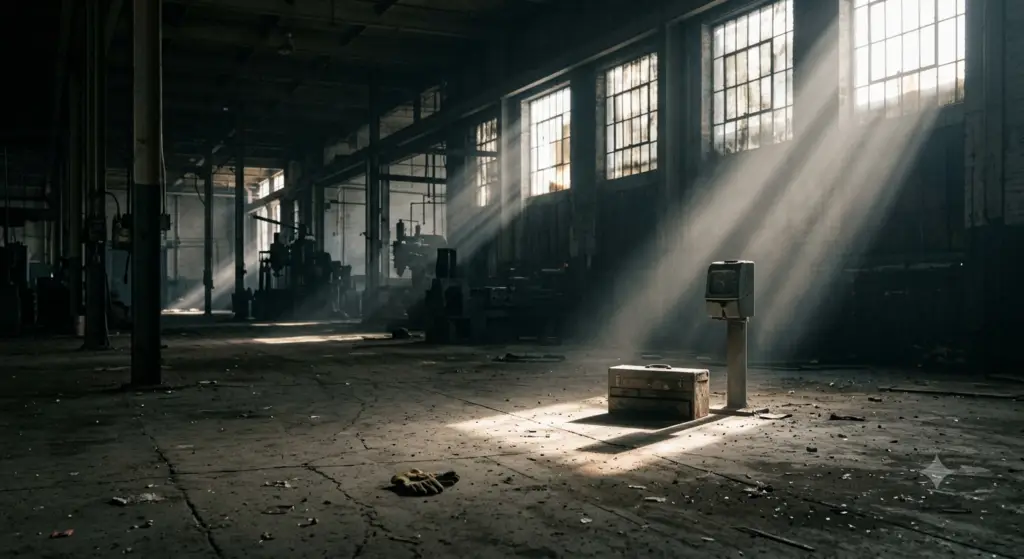
Somewhere, a schedule is still taped to a refrigerator door — a shift someone used to work, in a place that no longer exists, kept up long after it stopped being useful for anything but remembering. That, and not any chart, may be the truer record of what a life measured only in output leaves behind.
If you or someone you know is in crisis, the 988 Suicide & Crisis Lifeline is available 24/7 by call or text at 988.
- Mejia, M.C., et al. “Deaths of Despair in the United States, 1999–2021.” Florida Atlantic University / Schmidt College of Medicine, 2024.
- Case, A. & Deaton, A. Deaths of Despair and the Future of Capitalism. Princeton University Press, 2020.
- Granados, J.A.T. & Roux, A.V.D. “Life and Death During the Great Depression.” PNAS, 2009.
- National Center for Health Statistics. “Mortality in the United States, 2017.” CDC, 2018.
- DeWitt, L. “The Decision to Exclude Agricultural and Domestic Workers from the 1935 Social Security Act.” Social Security Bulletin, 2010; and subsequent scholarship on the Act’s occupational exclusions and their disproportionate effect on Black workers.
- Durkheim, É. Suicide: A Study in Sociology. 1897/1951.
- U.S. Bureau of Labor Statistics. “Union Members Summary.” 2024.
- Gallup. “How Religious Are Americans?” 2023.
New essays every week. Delivered quietly.