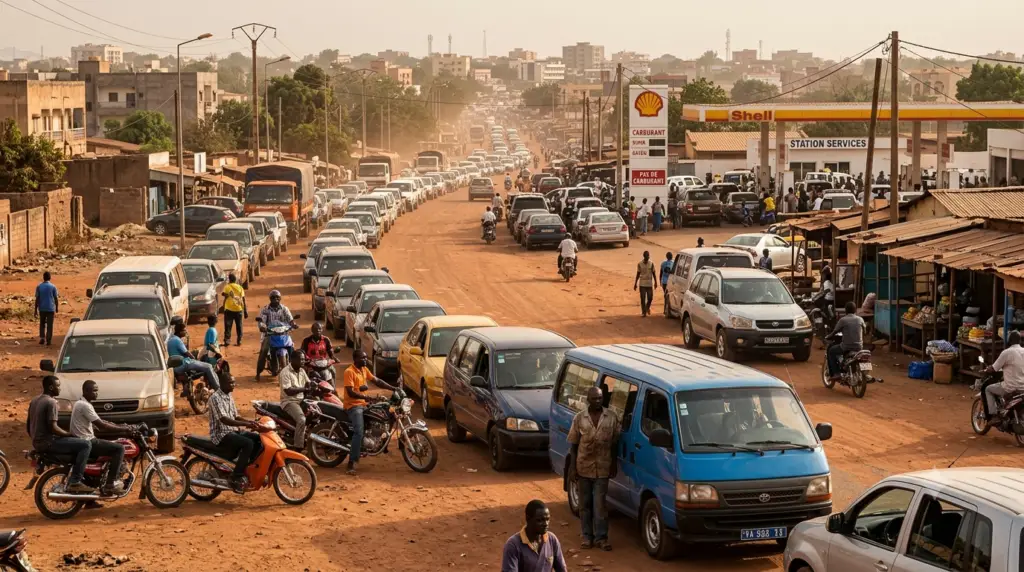
A Litre That Cost Five Times What It Cost a Season Ago
Omar Sidibe drives for a living in Bamako, and for months now his living has consisted mostly of waiting. He sits in queues that wrap around gas stations for blocks, sometimes for a full day, sometimes for nothing at all. When an Al Jazeera reporter asked him in late October who was responsible for the shortage, Sidibe didn’t reach for a side in the war.
He said it was up to the government to uncover the real reason behind it — a driver’s plain demand for an explanation, not a verdict.
By then the price of the fuel he was queueing for had already gone from 25 dollars a litre to 130. Since September 2025, fighters from Jama’at Nusrat al-Islam wal-Muslimin, an al-Qaeda-affiliated group known as JNIM, have been attacking the tanker convoys that supply Mali’s landlocked capital, burning more than 300 trucks along the roads from Senegal and Côte d’Ivoire.
Schools closed. The lights in Bamako dimmed at night as generators ran dry. The United States told its citizens to leave the country immediately.
It is tempting to file this under distant catastrophe and move on — another country, another war, another shortage. But a reader in Ohio or Ontario runs on the same hidden logic Sidibe is queueing inside of: a single unglamorous input, moved by truck, quietly multiplying into everything else a household needs.
What doesn’t make the same headlines is what happens next, three or four links down the same chain. A nation that imports roughly 95 percent of its fuel by road cannot move food without moving fuel first — not the diesel for the trucks, not the irrigation pumps, not the mills that turn grain into flour a family can actually eat. A blockade on fuel is never only a blockade on fuel.
By November, FEWS NET’s own analysts were already tracing the line from burned tankers to disrupted markets to a food security outlook sliding backward across the regions nearest the capital.
The City That Learned to Live on What Could Be Flown In
In June 1948, Soviet forces closed every road, rail line, and canal leading into West Berlin. The city sat more than a hundred miles inside Soviet-occupied territory, and its two million residents depended on outside supply for nearly everything — coal for heat, flour for bread, milk for children who had already lived through one war and were not yet old enough to remember it clearly.
The Western Allies did not have a way to reopen the roads without provoking the war everyone was trying to avoid. What they had instead was the air.
For the better part of eleven months, American and British aircrews flew cargo planes into Tempelhof and Gatow on a schedule so tight that historians of the operation have compared it to a conveyor belt more than an airlift — a plane landing, unloading, and lifting off again every few minutes, day and night, through a winter cold enough to freeze fuel lines mid-flight. Over roughly 200,000 flights, the airlift delivered more than two million tons of coal, food, and medicine before the blockade was lifted in May 1949.1
Nobody in 1948 called the blockade a famine, and nobody should retroactively dress it as one. What it produced instead was something narrower and in some ways more instructive: proof that when the ground routes into a city are cut, its survival becomes a question of logistics before it becomes a question of anything else.
There is a colder logic underneath both stories, and it is worth naming directly. A siege rarely aims at territory alone; more often it aims at dependency — at finding the one system a city has stopped noticing it depends on, and interrupting that instead of the city itself. Berlin depended on roads it assumed would stay open. Bamako depended on a fuel supply nobody had thought to defend until the trucks began burning.
The sharper difference is not tactical but a matter of where attention goes. Berlin sat at the exact center of the twentieth century’s defining rivalry, and an airlift materialized within days because two superpowers had already decided the city mattered enough to justify it.
Bamako sits at the edge of a region that competes for global attention against wars, elections, and crises that arrived first and louder. No air bridge has materialized over Mali, not because one is technically impossible, but because the machinery that produces an airlift — sustained international will, pooled resources, a shared sense that this specific city cannot be allowed to fall — has simply gone somewhere else.
Mali has escorted convoys instead, a general assigned to what local media now call the fuel war, and roads that keep burning faster than they can be rebuilt.
Bread Weighed Out, Water Measured
Scripture does not require that every catastrophe be interpreted as divine judgment; it does, however, insist that societies eventually reveal the moral conditions under which they have chosen to live.
Centuries before anyone had a word for logistics, the prophet Ezekiel was told to act out a siege rather than merely describe one. He was instructed to lie on his side for months, cooking meager food over dung fuel, as a living model of a city cut off from its supply.
“Moreover he said unto me, Son of man, behold, I will break the staff of bread in Jerusalem: and they shall eat bread by weight, and with care; and they shall drink water by measure, and with astonishment.” — Ezekiel 4:16 (KJV)
The staff of bread is not a poetic flourish. In an agrarian household, it named the entire support system a body leaned on to keep standing — grain stored, mills turning, roads open, ovens fed.
To break the staff is to break the system, not merely the loaf — which is another way of saying that Ezekiel’s sign-act is a diesel shortage three thousand years before diesel existed: the same single interruption, quietly disabling everything downstream of it. The text does not ask what side is right in the siege surrounding the city. It only insists that the household economics of a blockade — food rationed to the gram, water counted to the cup — are themselves worth recording, independent of who laid the siege or why.
“And such as be for death, to death; and such as be for the famine, to the famine; and such as be for the captivity, to the captivity.” — Ezekiel 5:12 (KJV)
That third of a besieged city’s fate — famine — sits in the text with the same weight as war and exile, not as their footnote. The prophet does not distinguish between a famine caused by an enemy’s spear and a famine caused by an enemy’s checkpoint. Both are named as siege.
“The children’s tongue cleaveth to the roof of their mouth for thirst: the young children ask bread, and no man breaketh it unto them.” — Lamentations 4:4 (KJV)
Lamentations follows the same siege to its aftermath, and it does not spare the reader the image of a child asking for bread that no adult present has the power to break for them — not from cruelty, the text implies, but from having nothing left to break.
Elsewhere in the same canon sits a quieter counter-example: a story of grain stored ahead of scarcity rather than measured out during it, and a wisdom tradition that praises the instinct to gather in a season of plenty against a season with none. Neither figure resolves what Bamako is living through. But both suggest that scripture treats supply itself — the boring, unglamorous work of getting bread from a field to a table — as a subject worth its attention, long before any siege makes that attention urgent.
The Second Ledger a Blockade Writes
FEWS NET’s October 2025 outlook does not describe Mali’s fuel blockade as a famine either — the numbers, as of this writing, describe deterioration rather than catastrophe. What the analysis does trace, carefully, is a mechanism: fuel prices rising among informal distributors, transportation costs climbing behind them, and staple food prices following a step further back, with agricultural work like threshing and irrigation slowing wherever diesel-powered pumps went quiet.2
Economists sometimes describe infrastructure less as a commodity than as a multiplier. Fuel does not simply move a truck from one point to another; it multiplies the productivity of every farm, mill, clinic, and market the truck was ever going to reach.
Cut the fuel, and the loss is not one truckload — it is every harvest, every ground sack of grain, every reopened stall that truckload was quietly making possible. This is the arithmetic FEWS NET is tracking without ever using the word: not a single failure, but a failure that compounds.
The Cadre Harmonisé’s November count puts 1.6 million people in acute food insecurity during the coming lean season, a 9 percent rise over the year before, concentrated in regions like Kidal and Ménaka where markets have not merely slowed but, in places, stopped functioning altogether. That number sits inside a country where roughly 80 percent of the population farms for a living — meaning the blockade does not only make food harder to buy. It makes food harder to grow, harvest, and mill in the first place.
This is the second ledger every blockade writes, whether it besieges a bread supply directly or reaches it sideways through fuel. The first ledger counts the trucks burned, the convoys attacked, the immediate cost of the confrontation itself. The second ledger opens later, in a column nobody assigned to track it: the field that didn’t get irrigated on schedule, the mill that sat idle for want of diesel, the season’s harvest quietly diminished by an interruption that had nothing to do with rain or soil.
American readers do not need to travel to the Sahel to recognize the shape of this. A pandemic did something structurally similar a few years ago, closing not roads but ports and factories, and the effect ran along the same hidden chain — a shortage of one unglamorous input, shipping containers, computer chips, truck drivers, showing up months later as empty shelves that had nothing directly to do with the original disruption.
The systems people forget they depend on are usually the ones that fail loudest once they finally do. Mali’s fuel blockade is that same lesson, compressed into a country where the margin for delay was already thin before a single tanker burned.
Berlin’s blockade wrote both ledgers too, but it had an answer the Sahel does not: an air corridor no ground force could reach. Bamako’s convoys move under military escort now, delivering fuel a truck at a time along roads still contested mile by mile. There is no equivalent lift waiting overhead — only the same arithmetic Ezekiel staged on his own body three thousand years ago, playing out again in bread weighed by scarcity rather than by choice.
What the prophet’s sign-act and the blockade share is not a verdict about who is righteous. It is a shared insistence that the machinery connecting a road to a harvest to a meal is fragile enough to break from a single interrupted link, and that what a society does for the people standing at the far end of that chain, once it breaks, tends to say more about it than the siege itself ever could.
What a Litre of Fuel Was Never Supposed to Cost
Sidibe is still, as far as any outside account can confirm, waiting in the same lines. The blockade eased for a season and tightened again, the way sieges tend to — not resolved so much as postponed, the way a body under Ezekiel’s rationed bread does not starve on the first day of measuring, only on the accumulation of every day after.
A litre of fuel was never supposed to be a referendum on whether a family eats this month. That it has become one in Mali says less about fuel than about how many ordinary transactions quietly depend on a road nobody thought to defend until it was already cut. The staff of bread breaks in the same place every time — not at the moment of the siege, but somewhere further down the chain, in a mill, a field, a queue, where almost no one is watching.
The households reading this from well-stocked kitchens are not besieged, and it would be dishonest to pretend otherwise. But they, too, live downstream of trucks, ports, and pipelines they rarely think about until one of them stops — the same staff of bread, resting on a longer and less visible chain than most days ever require anyone to notice.
Ezekiel never tells his readers whether the besieged of Jerusalem deserved what befell them. He only tells them how it was measured, day by day, cup by cup. History remembers the roads that were cut and the trucks that burned. Scripture, more quietly, remembers the bread that still had to be weighed the morning after.
Sources: FEWS NET, Mali Food Security Outlook (2025.10) · World Food Programme, Mali Country Page & Cadre Harmonisé (2025.11) · Al Jazeera (2025.10.29) · Associated Press (2025.10)
1. U.S. Air Force Historical Support Office archival accounts of Operation Vittles document the Berlin Airlift’s flight volume, tonnage, and winter operating conditions between June 1948 and May 1949.
2. FEWS NET’s Mali Food Security Outlook, published October 2025, explicitly traces the JNIM fuel blockade’s downstream effects on transportation costs, staple food prices, and agricultural activities including irrigation and threshing.
New essays every week. Delivered quietly.