A Shadow Right on Schedule
On the night of August 27, 2026, the moon slipped into the deepest partial eclipse North America had seen in years — 96.3 percent of its disk swallowed by Earth’s shadow, visible from the Americas to western Europe and western Africa (NASA Scientific Visualization Studio, 2026).
People stepped outside, phones raised, mildly delighted, and went back inside a few minutes later, unchanged. No flight was grounded for it. No wedding was moved to another night.
We know exactly what it is. A rock passing between two other rocks. Nothing rides on it.
Almost twenty-five hundred years earlier, another lunar shadow crossed another sky — and a commander’s reading of it helped turn a failed expedition into a catastrophe.
Twenty-Seven Days at Syracuse
By the summer of 413 BC, Athens’s expedition against Syracuse had already cost two years and most of a fleet. Nicias, a commander already inclined toward caution, had argued against the invasion from the start and led it reluctantly once overruled.
By late August, with a relief force finally in place, the decision was made: abandon the siege, slip out by sea, sail home.
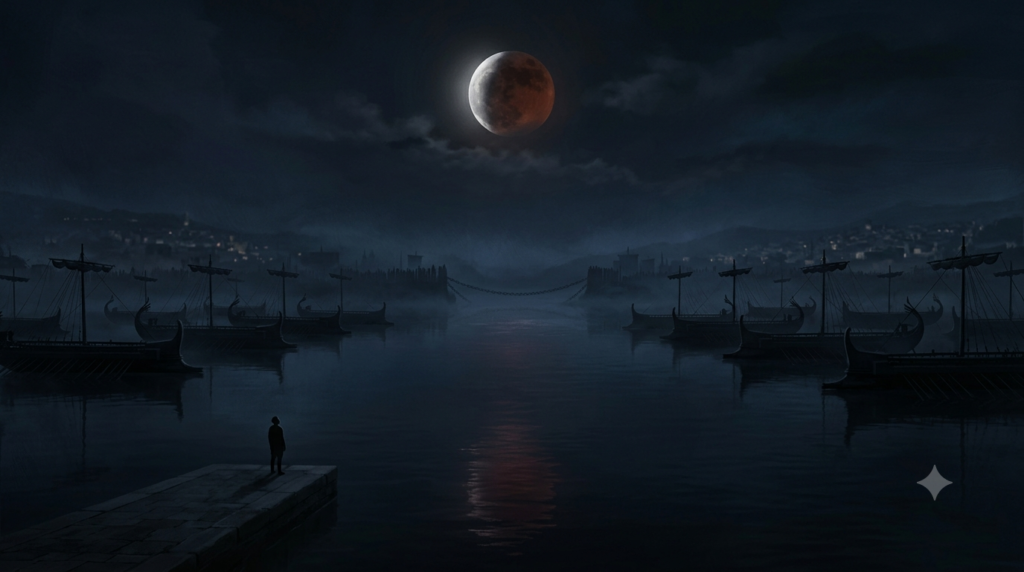
Then, on the night the ships were to leave, the moon began to darken.
Modern astronomy can explain it in a sentence. Nicias’s soothsayers offered a different one — that the sign demanded a full waiting period before the gods would permit safe passage: twenty-seven days, “thrice nine” in the ancient reckoning (Livius, 2020). A commander already inclined toward caution was given one more reason to delay — and this time, the reason came from the sky.
He gave the order to stay. The Syracusans, who had been watching the preparations for weeks, understood exactly what the delay bought them. While the Athenians waited on the moon, the defenders closed the mouth of the Great Harbor and moved their fleet into position (History of War, 2021). The naval battle that followed was fought in water too crowded for the maneuvers that had built Athens’s reputation. They lost.
What followed the battle was worse than the battle. Cut off from the sea, the survivors tried to march overland to a friendly city, harassed the entire way by cavalry; thousands died of thirst before the retreat reached its sixth day. Nicias was captured and executed not long after. Most of what remained of the army ended in the stone quarries outside Syracuse.
A Sign Is Not a Command
Centuries before Nicias stood on that harbor, a different commander faced a version of the same test — from the opposite direction.
“And he tarried seven days, according to the set time that Samuel had appointed: but Samuel came not to Gilgal; and the people were scattered from him.” (1 Samuel 13:8, KJV)
Saul was not reading a sign. He had been given an appointed waiting period, with an actual endpoint, by explicit instruction. The Philistines were massing. His troops were deserting by the hour. Samuel, the one authorized to make the offering, had not yet arrived.
“And Saul said, Bring hither a burnt offering to me, and peace offerings. And he offered the burnt offering.” (1 Samuel 13:9, KJV)
He performed the office himself.
“And Samuel said, Thou hast done foolishly: thou hast not kept the commandment of the LORD thy God… but now thy kingdom shall not continue.” (1 Samuel 13:13–14, KJV)
Nicias had no order to wait. He manufactured one, out of a sign nobody had given him, and used it to justify staying still when everything already pointed toward leaving. Saul had the opposite problem — an order already given, a deadline already set — and he could not hold himself inside it. One man invented permission to freeze. The other invented permission to move. Passive delay and premature action look like opposites, and in every visible way they are. But they solve the same unbearable problem: how to stop feeling like you don’t yet know what to do.
They did not fail in the same way. They failed at the same threshold — the point where uncertainty becomes harder to bear than a wrong answer. In both cases, fear found a language that sounded like faith.
The Answer Doesn’t Have to Be Right
It only has to make the uncertainty stop.
Psychologists have a name for one of the forces that can make moments like these so difficult: the need for cognitive closure — a documented preference for a firm, immediate answer over the discomfort of an unresolved question, a pull that strengthens under time pressure and high stakes.1 It doesn’t ask whether an answer is correct. It asks whether the answer will make the ambiguity stop.
The eclipse gave Nicias something information could not give him: permission to stop deciding. It converted uncertainty into an instruction.
For Saul, the sacrifice offered something different — not relief from a decision, but the feeling of control at the exact moment obedience required him to stay powerless a little longer. Nicias let meaning replace decision. Saul let action replace waiting. Different mechanisms, same escape route.
The same pressure shows up far from ancient harbors. Physicians studying their own decision-making describe how, under time constraint and incomplete information, a high need for closure can push toward the first plausible diagnosis rather than the slower work of ruling alternatives out — not from carelessness, but because a working answer relieves a discomfort that has become harder to sit with than the risk of being wrong. The chart still says something. The waiting stops.
That is the danger of premature certainty: not that it gives us an answer, but that it gives us relief.
What the Moon Never Promised
Two days ago, this space looked at a very different kind of pressure — what happens when an enemy hands you the exact story you already wanted to believe. Salamis and Ai were won by exploiting someone else’s certainty. Syracuse was not lost because the moon spoke. It was lost because a man decided what the moon had said.
Last month’s eclipse asked nothing of anyone watching it. That’s the difference worth sitting with.
The danger is not always that we will misread the sign. It is that we will hear exactly what we were already prepared to hear.
Sometimes the hardest thing faith asks of us is not to act, but to remain uncertain without inventing an answer.
1. Arie W. Kruglanski, “Only One? The Default Interventionist Perspective as a Unimodel,” Behavioral and Brain Sciences 36, no. 3 (2013): 251–252.
New essays every week. Delivered quietly.