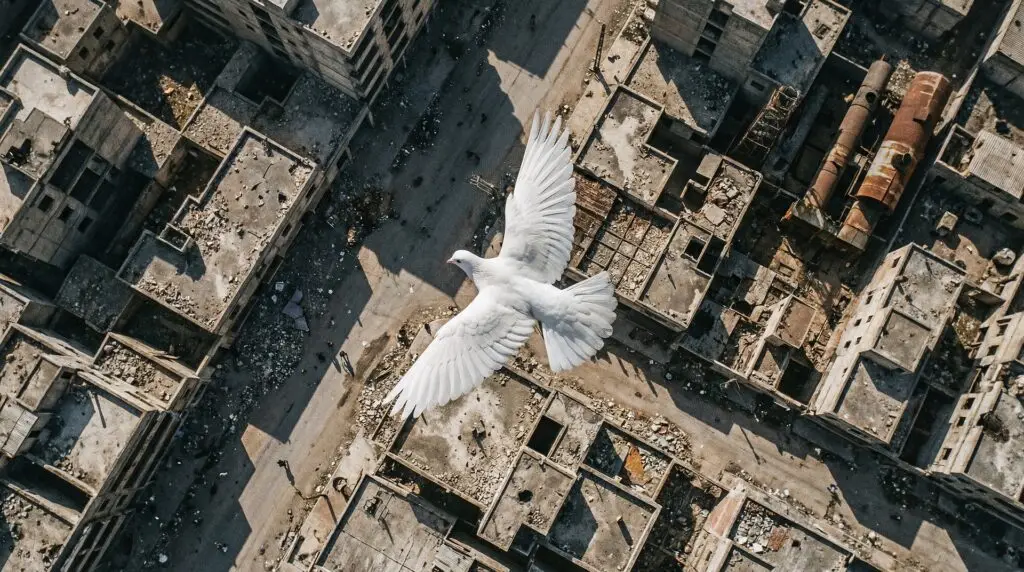
Reading the Pattern Behind the Headlines
This series is not about old battles recorded in old books. It is about a force still moving through the world — and what it may mean that we keep failing to recognize it.
Series Introduction · Biblical Discernment · Geopolitical Watch
Hook
The Question No Headline Answers
Open any newspaper on any given morning — in any decade, in any century — and you will find it. A border disputed. A city shelled. A treaty collapsed. An alliance redrawn overnight. The names of the nations change. The weapons evolve. The justifications are repackaged in the language of the moment. But the structure beneath it all remains almost eerily constant: ambition, fear, miscalculation, and the long aftermath of grief.
We are very good at reporting war. We are considerably less practiced at reading it. This series is an attempt at the latter. Not to predict the next conflict, and not to assign blame to any particular flag or faction — but to ask a prior question, the kind that tends to get crowded out by the urgency of events: Is there a pattern here? And if so, what does it mean?
Historical Case
The Pattern Beneath the Wars
The historian Thucydides, writing in the fifth century B.C., described the Peloponnesian War between Athens and Sparta not merely as a record of battles but as a study in human nature itself. His conclusion was bleak and durable: that fear, honor, and self-interest drive states toward conflict with a consistency that transcends any particular era.1 Twenty-five centuries later, scholars still assign his text in international relations courses — not as ancient history, but as current analysis.
The pattern holds across civilizations. The Roman Republic collapsed not under a single external blow but under the accumulated weight of internal fracture, economic inequality, and imperial overreach — dynamics that historians of the twentieth century would recognize immediately in the fall of other empires far removed in time and geography.2 The First World War, once called “the war to end all wars,” produced within two decades the conditions for an even larger one. The mechanisms differ; the underlying logic does not.
This is not fatalism. It is pattern recognition — and pattern recognition is the beginning of wisdom.
Biblical Lens
What Scripture Saw First
“You will hear of wars and rumors of wars, but see to it that you are not alarmed. Such things must happen, but the end is still to come. Nation will rise against nation, and kingdom against kingdom.”
Matthew 24:6–7 (NIV)
The words attributed to Jesus in the Olivet Discourse have been cited so frequently in the context of end-times speculation that their structural insight is often missed entirely. The text does not say that war is exceptional. It says that war is expected — not as a novelty to be shocked by, but as a condition to be understood. The Greek word translated as “nation” here is ethnos — people group, tribe, ethnic community. The text anticipates not merely state-on-state conflict, but the deeper fractures of identity and belonging that drive the worst violence.
“What causes fights and quarrels among you? Don’t they come from your desires that battle within you? You desire but do not have, so you kill. You covet but you cannot get what you want, so you quarrel and fight.”
James 4:1–2 (NIV)
James locates the origin of conflict not in geopolitics but in anthropology — in the interior condition of human desire unrestrained by anything larger than itself. This is not a naive reduction of complex historical forces to individual psychology. It is, rather, a diagnostic that operates at every scale simultaneously: the same dynamics that destroy a marriage, fracture a community, and collapse a republic are the dynamics that send armies across borders. The scale changes; the root does not.
Scripture does not offer a foreign policy prescription. What it offers is a framework for seeing clearly — which may, in the end, be the more urgent gift.
“There is no wisdom, no insight, no plan that can succeed against the Lord. The horse is made ready for the day of battle, but victory rests with the Lord.”
Proverbs 21:30–31 (NIV)
Proverbs is not pacifism. It does not counsel the abandonment of strategy or the surrender of preparation. What it insists upon is a different kind of humility — the recognition that the outcome of history is not finally determined by the superiority of any army, the genius of any general, or the resources of any treasury. This is a claim that makes empires uncomfortable, which may be precisely why it has survived so many of them.
Pattern Insight
Reading War as a Pattern, Not an Event
The premise of this series is simple, though its implications are not: war is not a series of isolated accidents. It is a pattern — structural, recurring, and legible to those willing to look past the noise of immediate events. Each installment will take a specific conflict or geopolitical moment, place it alongside a relevant historical precedent, and then hold both up against the light of a biblical text — not to decode current events as prophetic fulfillment, but to ask what the long arc of human history, read alongside Scripture, might help us understand about the present.
The series will move through several distinct lenses. Some pieces will focus on the mechanics of imperial collapse and what they share across centuries. Others will examine the role of ideology and religion in sanctifying violence — and what Scripture says about the seduction of holy war. Still others will trace the quieter conflicts: economic coercion, demographic pressure, the slow erosion of institutions that once held the peace. In each case, the goal is the same: not alarm, but clarity.
The historian Barbara Tuchman once observed that folly in statecraft is defined not by ignorance but by the persistent pursuit of policies that have already been shown to fail.3 What strikes a reader of both history and Scripture is how often this observation applies — and how rarely it changes anything. The question this series sits with is an uncomfortable one: why does the pattern persist, and what, if anything, interrupts it?
Between Warning and Tragedy
An Invitation, Not a Verdict
This series does not claim to know how the story ends. It does not map current events onto prophetic timelines, and it does not treat any nation, movement, or leader as the definitive fulfillment of ancient text. What it does claim is that the tools Scripture offers — moral clarity, historical memory, and a willingness to ask hard questions about the human condition — are precisely the tools most absent from our current public conversation about war and peace.
The wars recorded in history books were once breaking news. The people caught inside them did not know how they would end either. They had to decide, in the midst of confusion and grief, what kind of people they intended to be. That decision — and not the outcome of any particular battle — may be what Scripture is most interested in. Whether that is also what we are interested in is a question each reader will have to answer for themselves.
Sources & Notes
1 Thucydides. History of the Peloponnesian War, trans. Rex Warner. Penguin Classics, 1954. Book I, “The Melian Dialogue” and the account of Spartan-Athenian rivalry remain standard texts in political science curricula worldwide.
2 Gibbon, Edward. The History of the Decline and Fall of the Roman Empire, 1776–1789. See also: Ward-Perkins, Bryan. The Fall of Rome and the End of Civilization. Oxford University Press, 2005.
3 Tuchman, Barbara W. The March of Folly: From Troy to Vietnam. Alfred A. Knopf, 1984.
All scripture quotations from NIV (New International Version). Biblical interpretation presented as a framework for reflection, not doctrinal declaration. This series examines war as a historical and moral pattern; it does not advocate any specific political position.