Wars and Rumors of War — Part III
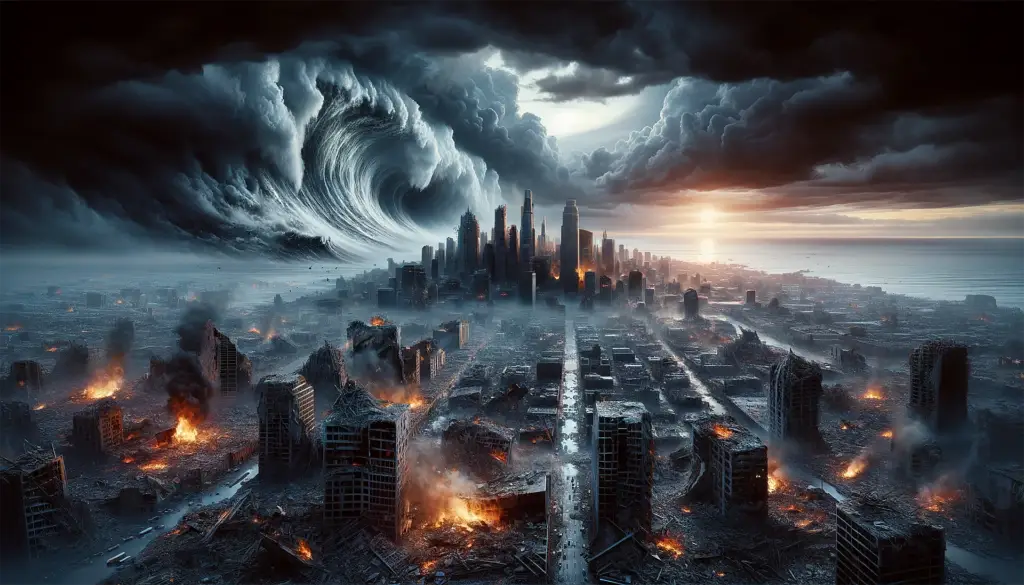
There is a moment when violence stops being a crime and becomes a climate. Genesis 6 is where that moment is recorded.
Hook
The World Did Not End Because It Was Sinful. It Ended Because It Was Saturated.
There is a difference between a world that contains violence and a world that has been organized around it.
The first is a description of every human society in history. The second is something rarer — and far more dangerous.
Genesis 6 does not say that humanity had become wicked in the way a single person becomes wicked. It says something more atmospheric, more structural, and in many ways more frightening:
“The earth was filled with violence.”
— Genesis 6:11 (ESV)
Filled. Not scattered with. Not troubled by. Filled.
The word matters. It implies saturation — the way water fills a vessel, leaving no room for anything else. By the time the flood narrative opens, violence had ceased to be an aberration. It had become the environment itself.
Historical Case
When Killing Becomes Industrial
In August 1914, Europe went to war the way wars had always been fought — with soldiers, cavalry, flags, and a general assumption that it would be over by Christmas. What followed instead was four years of industrialized slaughter on a scale the world had never seen.
The First World War did not simply kill more people than previous wars. It restructured the relationship between civilization and violence. Poison gas, aerial bombardment, the systematic targeting of civilian infrastructure — these were not aberrations. They were innovations. Nations had reorganized their economies, their science, their social structures around the production of death. Violence had become, in the language of Genesis 6, environmental. (John Keegan, The Face of Battle, 1976.)
By the mid-twentieth century, the process was complete. The doctrine of Mutually Assured Destruction — MAD — did not merely threaten violence. It institutionalized it as the foundation of global peace. The world was held together, its defenders argued, precisely because the capacity for total destruction had been built into the architecture of civilization itself. Lamech’s seventy-sevenfold threat had been formalized into megatons, targeting grids, and launch protocols.
Violence had stopped being something civilization did. It had become something civilization was.
Today, the mechanism is subtler but the logic is identical. Social media platforms have built engagement algorithms that reward outrage — the faster a grievance spreads, the more the system amplifies it. Retaliation has become an economy. Offense is currency. The individual act of aggression disappears; what remains is a perpetual atmospheric hostility, a world filled with the noise of a thousand simultaneous Lamechs, each convinced that their seventy-seventh response is the justified one.
The structure is not new. Only the infrastructure has changed.
Biblical Lens
What Genesis 6 Is Actually Describing
Genesis 6 introduces figures described as gibborim — mighty men, men of renown. Whatever their precise nature, the text places them at the center of a society organized around power, reputation, and dominance.
The appearance of these figures may reflect the rise of what we might call a warrior aristocracy — a ruling culture that admired violence, rewarded strength, and measured human worth in terms of the capacity to dominate. Genesis presents them not merely as powerful individuals, but as symptoms of a world increasingly organized around force, prestige, and fear.
The conflict of Noah’s era was no longer merely personal. Violence had become structural — embedded into the fabric of society itself.
This is the progression the text has been tracing since Genesis 4. Cain committed a murder. Lamech composed a philosophy of retribution. By Genesis 6, that philosophy had metastasized into a civilization. The logic of the individual act had become the logic of the entire social order.
“Now the earth was corrupt in God’s sight, and the earth was filled with violence. And God saw the earth, and behold, it was corrupt, for all flesh had corrupted their way on the earth.”
— Genesis 6:11–12 (ESV)
The Hebrew word translated “corrupt” — shachat — carries the sense of something ruined beyond repair, spoiled from within. It is the word used for meat that has gone bad, for a vessel that can no longer hold what it was made to hold. The earth had not simply sinned. It had been structurally compromised.1
Scripture does not require that every era of institutional violence be read as a civilization approaching judgment; it does, however, insist that human beings pay attention to the moment when violence ceases to be exceptional and becomes ambient — when it is no longer something that happens, but something that simply is.
Pattern Insight
The Anatomy of a Saturated World
The pattern Genesis 6 describes has a recognizable anatomy. It does not arrive suddenly. It accumulates.
It begins with the individual act — Cain’s murder, the border skirmish, the political assassination. Then comes the philosophy — Lamech’s song, the doctrine of deterrence, the ideology of justified retaliation. Then, quietly, the infrastructure: the weapons industry, the engagement algorithm, the legal architecture that normalizes what was once unthinkable. Finally, the atmosphere: a world in which violence is no longer exceptional, in which it requires no justification because it has become the assumed background condition of existence.
Barbara Tuchman noted that the most durable historical folly was not the single catastrophic decision, but the accumulated momentum of policies that each seemed rational in isolation, each adding one more layer to a structure that no individual actor had designed and no individual actor could dismantle. (Tuchman, The March of Folly, 1984.) Genesis 6 describes exactly this: not a world of monsters, but a world of increments — each step following logically from the last, until the logic itself had become the catastrophe.
The flood, in this reading, is not arbitrary divine punishment. It is the moment when a structure built on violence encounters the limit of what any structure built on violence can sustain.
When a civilization is organized around destruction, the question is not whether it will collapse. The question is only when.
Between Warning and Tragedy
Before the Rain
Noah is described in Genesis 6 as a man who “found favor in the eyes of the Lord” — not because he was sinless, but because he had not been absorbed. In a world saturated with violence, he remained legible as something other than what the world had become.
The text does not romanticize him. It simply notes that he was there — a single point of contrast in an atmosphere of corruption.
That detail may be the most quietly unsettling thing in the entire passage. Not the flood. Not the violence. The fact that one man’s resistance to the ambient culture of his world was remarkable enough to be recorded.
Which raises a question the text leaves open — and leaves, finally, to the reader:
In a world that has learned to call its violence civilization, what does it mean to remain legible as something else?
In the next post, we will ask what the flood narrative actually resets — and whether the answer is as hopeful as it first appears.
1 Hebrew lexical analysis: shachat and gibborim — Francis Brown, S.R. Driver, and Charles A. Briggs, A Hebrew and English Lexicon of the Old Testament (BDB); Gordon Wenham, Genesis 1–15, Word Biblical Commentary (1987).
All biblical quotations from the English Standard Version (ESV). Genesis 6:11; Genesis 6:11–12; Genesis 6:8.
Barbara Tuchman, The March of Folly: From Troy to Vietnam (Knopf, 1984). John Keegan, The Face of Battle (Viking, 1976).