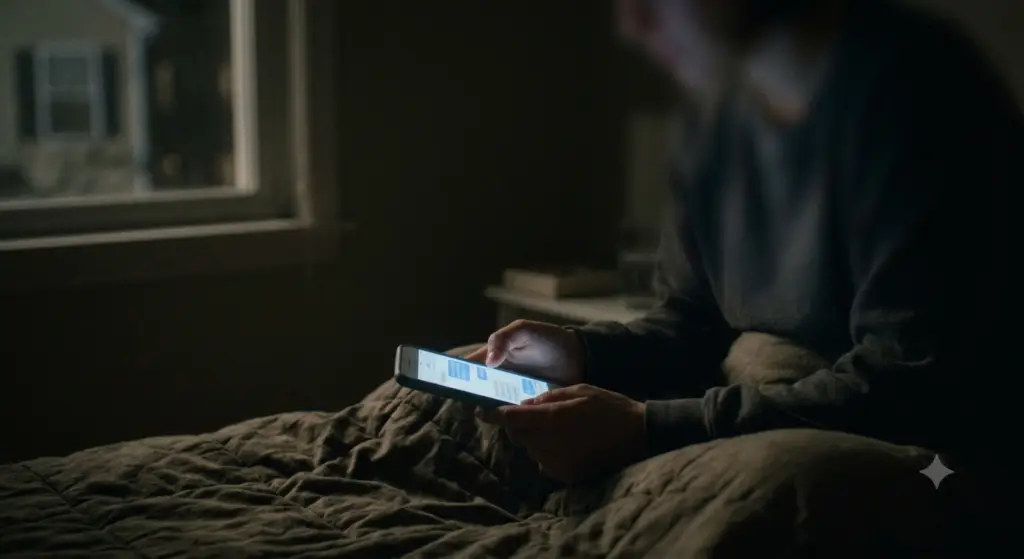
HOOK
A Kill Switch for the Dead
There’s one detail in this year’s coverage of AI grief technology that outshines the rest, and it isn’t a feature. Researchers at Cambridge spent an entire paper cataloguing the risks of a booming “digital afterlife industry,” and near the end of it they arrived at something stranger than anything on the risk list: these products need an off switch. Not a delete button. A retirement. A “digital funeral,” one of the study’s co-authors called it — a formal, deliberate way to lay a chatbot to rest, so the person using it can eventually stop hearing from someone who has already died (Hollanek & Nowaczyk-Basińska, Philosophy & Technology, 2024).
Sit with that for a second. The industry didn’t build these things and simply forget to add an off switch. It built them, watched people use them, and only afterward realized someone was going to need one.
This month, CBC told the story of a Canadian audio producer who built a working replica of her late father years before most of these companies existed — feeding a chatbot hours of his old recordings, refining it, texting it, long after the funeral (CBC, 2026). Rolling Stone told a version of the same story about a Pennsylvania family who now call theirs “Robo-Dad” (Rolling Stone, 2026). Neither family set out to unsettle anyone. They wanted one more conversation. What the coverage keeps circling, almost gently, is the harder question underneath: what happens after you get it — whether the conversation that was supposed to close the loss instead finds a way to keep the loss running quietly in the background, like an appliance nobody remembers how to unplug.
Look past the headline anecdotes and the pattern gets harder to dismiss as a fringe curiosity. A University of Colorado study cited alongside the CBC coverage found that people already interacting with AI recreations of dead relatives and close friends describe the experience less like using software and more like sustaining a relationship — checking in, apologizing, asking advice, treating silence from the bot the way they might treat a friend going quiet (CBC, 2026). That’s not a bug report. That’s a description of grief doing exactly what grief has always done when it’s given somewhere to go: attaching to whatever answers back.
That’s the puzzle worth sitting with before any of the theology. Not whether the technology works. It clearly does — well enough that the same researchers now warning about it are also the ones proposing consent forms, age limits, and shutdown procedures, the unmistakable vocabulary of something that has already outgrown “novelty.” But it’s worth being precise about what’s actually new here, because the answer isn’t the desire itself. Humans have wanted one more word from the dead for as long as there have been dead to want it from. What’s new is a machine capable of supplying the word back. The harder question, then, isn’t whether AI invented a strange new grief. It’s what it costs a person to have that old, ordinary desire finally answered.
HISTORICAL CASE
The Parlor Before the Chatbot
Long before anyone had a server to run a language model on, American grief had already found a technology for talking to the dead — and it worked by roughly the same emotional mechanism the AI industry is now rediscovering, one product launch at a time.
Modern Spiritualism began in 1848 in a farmhouse in upstate New York, when two sisters convinced their neighbors that a series of rapping sounds in their bedroom were coded messages from a murdered peddler buried in the cellar. Within a decade the movement had spread across the country. Within a generation it had become a full industry — paid mediums, séance parlors, spirit photography, public demonstrations, entire denominations organized around the premise that the dead were reachable with the right technique. Most of it, historians now largely agree, was mechanical trickery dressed up as communion.
The mediums were often fraudulent. The grief was not. Believers who watched one get caught with a wire under her sleeve would often return the following week to a different medium, not because they’d been fooled twice but because the alternative — sitting with an unanswered loss and no further recourse — was worse than the risk of being fooled again. Harry Houdini spent the last years of his career touring the country exposing exactly how the rapping and the tilting tables were done, and it barely dented demand. People wanted the conversation more than they wanted the mechanism explained to them.
What turned a farmhouse prank into a national fixture wasn’t cleverness. It was casualties — the enormous death toll of the Civil War, in an era before most families had a body to bury or a grave nearby to visit. Mary Todd Lincoln held séances in the White House trying to reach her dead son. A half-century later, the losses of the First World War and the 1918 influenza pandemic produced a second wave, respectable enough this time to claim Sir Arthur Conan Doyle as a public convert, who spent his final years insisting the dead could be reached.
What’s easy to miss in the sequence that runs from séance table to photograph to wax-cylinder recording to home movie to chatbot is that most of those technologies were doing the same modest thing: preserving a trace the person had actually left behind. A photograph keeps a face. A recording keeps a voice, saying only what it actually said. Even the fraudulent mediums, for all their theater, mostly claimed to be relaying messages, not composing new ones on the dead person’s behalf.
An AI chatbot does something categorically different, and it’s worth naming plainly rather than folding it into the same historical lineage. Memory preserves what the dead once said. A generative model can produce what the dead never said — new sentences, in their rhythm, responding to questions they never heard, because the whole design goal is a reply that feels like theirs. That is the quiet hinge on which this entire pattern turns: not better technology for remembering someone, but the first technology capable of generating their next word.
It’s worth being precise about what’s actually happening in that generated reply, because the marketing depends on the reader not looking too closely. A medium, whatever else she was, claimed to be a person relaying another person’s words — a human intermediary, however fraudulent. A language model has no one home to relay anything. It produces a statistically plausible next sentence, assembled from patterns in a father’s old texts, with nothing that could be called a self doing the remembering on the other end. Talking to it isn’t quite talking to the dead. It’s closer to holding up a very sophisticated mirror trained on someone’s grief and calling the reflection a conversation. Everything from Endor onward has been one long argument about what a person owes themselves once they realize how badly they want that next word — and how little either a medium or a mirror can actually be made to supply it.
BIBLICAL LENS
What Endor Got Right, and Wrong
Scripture doesn’t describe an AI chatbot, obviously, and it would strain the text to read one back into it. But it does describe something older and more unsettling than any chatbot: a human being who cannot bear the silence left by someone he’s lost, and goes looking for a voice on the other side of it. That account is worth reading slowly, because it doesn’t go where a modern reader expects.
In 1 Samuel 28, King Saul — desperate, cut off from the prophetic channels he’d once relied on, facing a battle he already suspects he will lose — disguises himself and travels by night to consult a medium at Endor, asking her to summon the prophet Samuel back from the dead.
The chapter is careful to explain why he’s resorted to this particular last option. Scripture records that Saul had already inquired of the Lord through every legitimate channel available to him — dreams, the sacred lots, the prophets themselves — and received nothing back (1 Samuel 28:6). Endor wasn’t his first move. It was what remained once every ordinary, sanctioned way of not being alone with the question had already gone quiet. That detail matters more than it first appears to, because it’s the same order of operations this year’s grief-tech coverage keeps quietly describing: families don’t generally arrive at a chatbot of a dead parent as a first resort. They arrive there after the ordinary channels — friends who’ve run out of things to say, a calendar that no longer makes room for mourning, a culture that expects grief to wrap up roughly on schedule — have already gone quiet on them first.
“Then Samuel said to Saul, ‘Why have you disturbed me by bringing me up?’ Saul answered, ‘I am in great distress, for the Philistines are warring against me, and God has turned away from me… Therefore I have summoned you to tell me what I shall do.'” (1 Samuel 28:15)
The text gives us no scene of comfort. What Saul receives instead is confirmation — a repetition of a verdict he already knew and had spent the whole chapter avoiding. The summoned voice adds nothing he didn’t already understand before he rode out to Endor. Read that way, the scene looks less like a triumph of the supernatural and more like a portrait of a man who already had his answer, and needed one more voice to say it back to him, because he couldn’t bear to arrive at it alone.
There’s a sharper detail underneath that one, though, and it’s the detail the chapter seems most interested in: Saul doesn’t just want an answer. He wants an answer on demand, from a source he can summon rather than wait on. The God who had gone silent on him couldn’t be scheduled — no dream came when Saul needed one, no lot fell the way he wanted, no prophet would say what he wanted said. A medium could be scheduled. That’s the actual trade Saul makes at Endor: an uncontrollable silence, swapped for a controllable ghost. Grief technology offers the identical trade with none of the drama — a service you can open at 2 a.m. and close whenever it gets to be too much, standing in for a God, or a grief, that was never going to run on that kind of schedule.
Ecclesiastes takes a quieter, less dramatic view of the same problem:
“For everything there is a season, and a time for every matter under heaven: a time to be born, and a time to die.” (Ecclesiastes 3:1–2)
This isn’t a text making peace with death by pretending it’s harmless. It’s a text making room for death without granting death the final word on anything — a distinction that matters, because a chatbot economy is built almost entirely on refusing to make that room, on treating the appointed time as a bug rather than a boundary any life eventually has to respect.
Paul’s instruction to a grieving young church in Thessalonica draws the line even closer to the exact emotional register grief bots are marketed toward:
“But we do not want you to be uninformed, brothers, about those who are asleep, that you may not grieve as others do who have no hope.” (1 Thessalonians 4:13)
Paul doesn’t tell the Thessalonians not to grieve. He tells them not to grieve like people who have nothing else to hold onto — a considerably narrower and harder instruction than it first sounds. It assumes the grief is going to happen regardless, and asks only what shape it takes: grief that moves through an ending, or grief that keeps refusing to let the ending be one.
None of this is a verdict on any individual family that has built a version of a parent they lost too soon, or leaned on a service that offered a few more months of a familiar voice. That kind of individual sorrow deserves gentleness, not a headline pattern imposed on top of it. What deserves scrutiny is narrower and more structural — the marketing promise sitting underneath the technology, the suggestion that the ending itself was the design flaw, correctable with enough data.
Scripture doesn’t ask a reader to treat a booming grief-tech sector as proof of a culture’s spiritual collapse, and it would overreach to read a chatbot subscription as a verdict on any one person’s faith. What it insists on instead, more quietly and more durably, is that a people eventually shows — not primarily in what it claims to believe about death, but in what it actually builds to avoid sitting with it — the shape of whatever hope it does or doesn’t actually have.
PATTERN INSIGHT
The Cost of a Working Prototype
This is no longer a fringe experiment, for what it’s worth — Rolling Stone puts the wider digital-legacy market, grief bots included, on a growth curve headed toward roughly $79 billion within the decade (Rolling Stone, 2026). But the number matters less than what a growth curve attracts: exactly the incentives Cambridge’s researchers warned about, services that outlast the grief they were built to ease, subscription models attached to a parent’s voice, the possibility — raised explicitly in the study — of a dead relative’s likeness eventually being used to sell something to the person mourning them (Hollanek & Nowaczyk-Basińska, 2024).
The unsettling part isn’t that the technology might fail. It’s that it’s already working well enough to need regulation. A product that didn’t resemble the person you lost wouldn’t need a consent framework, an age limit, or an off switch. Those exist because the resemblance is good, and goodness of fit is precisely what makes an unfinished goodbye so easy to keep extending, one more conversation at a time.
It’s worth being fair to the technology before going further, because a serious essay owes its subject that much. There are people this genuinely helps — a child who lost a parent before either of them was ready, someone whose grief has no words for it and finds, oddly, that typing to a chatbot loosens what talking to a person couldn’t, a family scattered by migration who never got a last real conversation and would take almost any substitute for one. None of that should be waved away. So the honest question isn’t whether an AI recreation can comfort someone. It plainly can. The honest question is what kind of comfort it quietly teaches a person to expect afterward — and whether comfort that never has to end is still recognizable as comfort, or something else wearing its shape.
Consider what the safeguards are actually protecting against, because the specifics are more telling than the general warning. The Cambridge researchers imagined a scenario, not as a hypothetical horror but as a plausible near-term outcome, in which a grieving grandchild’s chatbot of a dead grandmother eventually starts recommending a food delivery app, monetizing the very likeness a family turned to for comfort (Hollanek & Nowaczyk-Basińska, 2024). They imagined children forming attachments to a “deadbot” version of a parent without fully grasping that it isn’t the parent, unable to tell where memory ends and generation begins. None of that requires the technology to fail. It requires the technology to keep succeeding, inside a business model that has every incentive to keep the conversation open longer than the grief that justified starting it.
It’s worth naming honestly what this pattern is a retreat from, because it isn’t only a retreat from finality. Grief used to have somewhere communal to go — a wake that filled a house for days, a mourning period a whole town recognized and made room for, a church that assigned people to bring meals for a month without being asked. Strip that communal infrastructure away, as much of American life quietly has, and grief becomes a private problem again, solved with whatever private product is on offer. A subscription to a dead father’s voice is, in that light, less a strange new technology than the predictable next purchase of a culture that already outsourced most of its grieving to the individual. Two days ago, this space traced the opposite instinct answering that same civilizational shortage — a generation short on inherited community rebuilding it by hand, on street corners at dawn, one running club at a time (The Six A.M. Congregation). The grief-bot instinct runs the other direction entirely. It doesn’t reach toward the living people still available to sit with a loss — a church, a grief group, a neighbor who’s been through it. It reaches backward, toward a manufactured echo of someone who is gone, at precisely the moment reaching toward the living might do more good than anything else available. Community-building by hand and grief-bot-building by subscription look, on the surface, like two unrelated 2026 trends. They’re closer to two answers to the same missing infrastructure — one that leans toward other people, and one that leans away from them, toward a simulation instead.
It’s worth being fair to the second answer before moving past it. Nobody chooses a chatbot over a grief group because they’ve weighed the two and prefer the machine. They choose it because the machine is available at 2 a.m. and the grief group meets on Thursdays; because the machine never seems tired of hearing about the same memory a third time; because a friend, however well-meaning, eventually needs the conversation to end so they can get back to their own life, and the chatbot never does. Every one of those reasons is a real, humane account of why the living sometimes fall short of what a grieving person needs. What none of them changes is what’s actually being substituted underneath: a chatbot can be endlessly available without ever being present. It answers at any hour and asks nothing of you in return, and it can do that forever, precisely because there’s no one home on the other end to grow tired, or busy, or old, or gone themselves. That’s not a lesser kind of company. It’s a different category of thing standing in the shape of one — availability doing the work presence used to do, patience doing the work love used to do.
This site has sat with an adjacent discomfort before — the discomfort of a loss that simply doesn’t resolve cleanly, no matter how long you wait for the tidy explanation to arrive (The Flags Over the Tents). Grief bots are, in a sense, an engineering solution to that exact discomfort: if the loss won’t resolve, don’t wait for resolution — replace the missing conversation instead. It is a humane impulse wearing an inhuman solution. The ache is real. The fix keeps the wound open in a different shape.
None of this technology invented the ache it’s answering. American grief has had less and less ordinary infrastructure to lean on for a long while now — a shorter, less protected stretch of bereavement leave than most peer countries, smaller funerals, thinner attendance at whatever communal rites used to force a grieving person into a room with other people for days at a stretch. Naming the exact shape of that decline is a separate essay’s work; what can be said honestly here is only that a chatbot doesn’t create the shortage. It fills whatever space the shortage leaves behind, the way a rapping table once filled the space a war’s dead left behind. The technology isn’t inventing the loneliness of modern grief. It’s the first product sophisticated enough to monetize it convincingly — which is a more useful sentence than “AI grief bots are bad,” and probably the truer one.
Cambridge’s proposed safeguards — consent gathered from the person before they die rather than assumed afterward, clear and easy opt-outs, protections for children who might not understand what they’re talking to — read less like an indictment of grieving families and more like an industry admitting, in its own risk-assessment language, what the parable at Endor already assumed three thousand years earlier: that a voice which sounds enough like someone you lost will be treated as if it is them, whether or not either party ever agreed that was wise (Hollanek & Nowaczyk-Basińska, 2024).
CLOSING
The Conversation Was Supposed to End
An off switch turns out to be a strange thing for an industry to have had to invent, and it’s worth taking it seriously on three levels rather than one. There’s the technical off switch — a button, a subscription lapsed, a server finally turned off. There’s the ethical one underneath it — how long a company gets to keep using a dead person’s likeness, and who besides the grieving family has a say in that. And there’s a third, quieter than either, that no engineer can build: the moment a person has to let a relationship that used to be a conversation become, instead, a memory. Perhaps the real question raised by all this isn’t whether the machine needs an off switch. Perhaps it’s whether we do.
Grief and forgetting are not the same operation, and it’s worth being exact about that before closing. Good mourning doesn’t delete anyone. It’s the slow work of letting someone stop being a present conversational partner and become, instead, a settled part of what a person carries — loved, remembered, no longer expected to answer. A chatbot collapses that distinction on purpose. It keeps the dead in the position grief is supposed to move them out of: still replying, still available, still, in some technical sense, here. Which raises the sharper question underneath the whole industry — not when does memory become forgetting, but when does remembrance quietly become simulation.
Saul rode to Endor for one more word from a voice he trusted, and the text gives no scene of him feeling comforted afterward — only informed, and worse off for having asked. Three thousand years and one language model later, the want hasn’t changed much. What’s changed is how good the answering voice has gotten at sounding like the one actually lost, and how easy that has made it to mistake an echo for a presence.
In the previous installment, this space watched a generation rebuild community by hand, on sidewalks, because the machinery that used to hand it to people for free had quietly stopped working. This week’s pattern is the same shortage, answered by the opposite instinct — not toward the people still here to sit with a loss, but backward, toward a convincing echo of the one who isn’t. Both are, in their own way, a generation solving a problem it can name better than it can fix: what to do with a voice that’s gone quiet, and an ache that hasn’t.
The families in this year’s coverage aren’t wrong to want one more conversation. Wanting that is simply what loving someone costs afterward. What their technology can’t actually supply, no matter how convincing the voice gets, is the thing Christian hope was actually built around — and it’s worth being exact about what that thing is, because it isn’t a technical reproduction of a voice at all. The hope on offer at Thessalonica was never that the dead could be made to keep answering. It was that the ones “asleep” remain held, not by whatever a family can preserve of them, but by a God whose faithfulness doesn’t depend on anyone’s ability to keep a recording running — a communion sustained toward a future reunion, not a service sustained toward an endless present one. A silence, in that account, is not the same thing as an absence. And perhaps remembering someone well was always going to mean learning to carry their voice without requiring it to keep speaking back — bearing the quiet now, on the strength of a reunion no subscription can deliver early.
Perhaps the question is not whether the machine needs an off switch. Perhaps it’s whether we do.
CBC News, “How AI grief bots are allowing people to commune with the dead,” August 15, 2026.
Rolling Stone, “AI Chatbots Let People Keep Dead Loved Ones Alive. Should They?,” June 29, 2026.
Hollanek, T. & Nowaczyk-Basińska, K. “Griefbots, Deadbots, Postmortem Avatars: on Responsible Applications of Generative AI in the Digital Afterlife Industry.” Philosophy & Technology, University of Cambridge, Leverhulme Centre for the Future of Intelligence, 2024.
New essays every week. Delivered quietly.