The Week
What Went Up, What Stayed
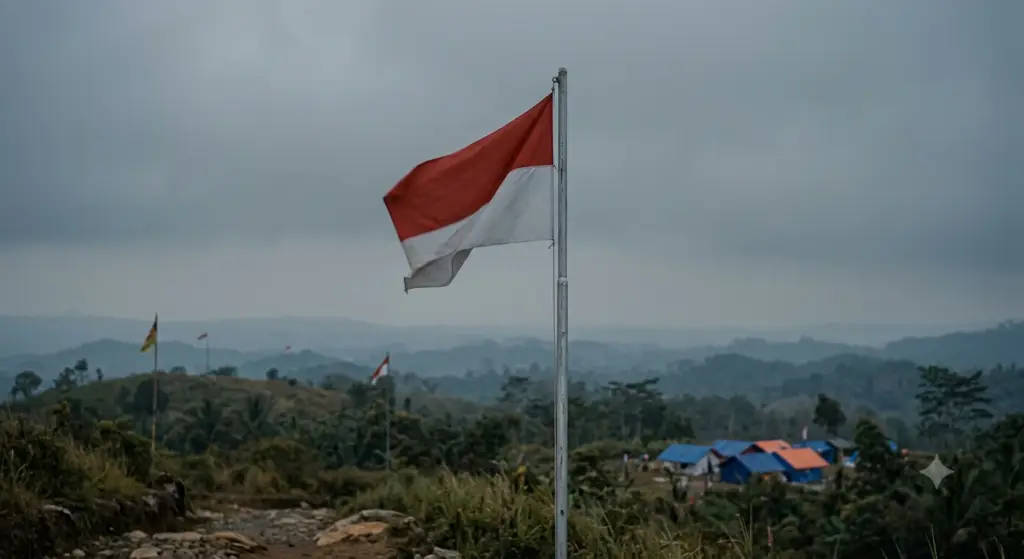
By the morning of August 17, flags were going up across Indonesia for the country’s eighty-first Independence Day. Two days earlier, a 7.7-magnitude earthquake had struck Flores Island. Tents were still standing where houses had been — not decoration, but the only shelter left.
Survivors described the ground’s first movement the way earthquake survivors often do: too fast to name before it was already finished, the dust settling before anyone had a word ready for what had just happened.
Nobody chose to hold the anniversary that week. The earthquake did not check a calendar. It simply arrived, and the flags went up anyway, over tents that had not come down.
That arrangement — an ordinary national joy interrupted mid-gesture — is old enough to have a name in a book most people have heard of and few have finished reading.
The Text
The Man Who Kept Asking
In the Book of Job, the disaster also lands mid-celebration. Job’s sons and daughters are eating together in their eldest brother’s house when a servant runs in to report they are dead — a wind, a collapsing roof, no warning attached to it.
Job does not respond with acceptance. He tears his robe. He curses the day he was born. He spends thirty-some chapters refusing every explanation his friends offer, because none of them fit what actually happened. Faith, in Job’s version of it, does not mean the absence of protest.
His friends make the oldest mistake available to comforters: they need his suffering to mean something specific, so they supply a verdict where none was given. Scripture does not ask its readers to repeat that certainty — a collapsed roof is not a court transcript. What it insists on instead is quieter and harder to escape: a people’s real convictions tend to surface, sooner or later, in what they do with what they cannot explain.
The Film
The Space Around the Question
Terrence Malick carried a version of this story for most of his career before The Tree of Life reached screens in 2011, decades after he first began circling it. He was the oldest of three brothers, raised in Waco, Texas, in the 1950s — the same setting as the family at the center of the film. His younger brother Larry studied classical guitar under Andrés Segovia in Spain and, according to biographical reporting on Malick’s life, died there as a young man; their father traveled to bring him home and returned instead with his body.
A version of that rupture — an ordinary day, a telegram, no explanation attached — opens the film. Before any of it, on a black screen, Malick places a citation:
“Where wast thou when I laid the foundations of the earth? … When the morning stars sang together, and all the sons of God shouted for joy?” (Job 38:4, 7, KJV)
The film’s own internal argument, voiced by the mother early on, splits existence into two competing postures toward the world — one that takes, one that yields. Nature and grace, in Malick’s terms, aren’t opposites so much as two different answers to the same unanswered question the epigraph poses. The dinosaur sequence stages that split directly: one predator, for no cause the film explains, chooses not to kill.
The scholar Robert Sinnerbrink situates The Tree of Life within a lineage running through Job and the wisdom literature more broadly — texts less interested in resolving suffering than in enlarging the frame around it (Sinnerbrink, 2019). Malick does not solve Job. He films the space around Job’s question.
The Answer
What the Whirlwind Isn’t
God does eventually answer Job — out of a whirlwind, not a courtroom. What follows isn’t a reason. It’s page after page of wild goats giving birth on cliffs no person could reach, ostriches abandoning their eggs in sand, a war horse charging into battle for a cause it couldn’t have named either — the created order laid out at a scale no single grief was built to hold.
Job never learns why his children died. What he receives is something closer to presence than to argument.
“I have heard of thee by the hearing of the ear: but now mine eye seeth thee.” (Job 42:5, KJV)
Not now I understand. Now I see. Explanation and encounter are not the same event, and Job’s story is careful never to confuse them.
His family and fortune are later restored, doubled, according to the text. But restoration is not reversal. Job’s ending does not erase Job’s dead children — the book simply stops asking that question after chapter 42, and so, in a different register, does anyone who has lost someone the same way.
C.S. Lewis reached a related edge decades later, writing through his own late grief that no one had told him grief would feel so much like fear — not despair exactly, but a kind of circling, the mind reaching for a shape the loss refused to hold still long enough to give it one.
The Data
The Number and the Meaning
Flores generated its own version of scale within days — more than sixty confirmed dead, over two hundred injured, tsunamis recorded at sixteen coastal points across four provinces. Numbers like these accumulate fast after catastrophe, and they matter: they route aid, hold agencies accountable, tell rescue teams where to dig next.
A number can tell us how many died without telling us what any one death means. That isn’t a flaw in the counting. It’s a different question than the one the counting was built to answer — the same gap the whirlwind opens in Job, measured now in a different unit.
The question was never only whether an explanation eventually arrives. Sometimes it’s what a person becomes while still waiting on one.
The Return
The Flags Come Down
The Tree of Life ends on a beach — the adult Jack, still not reconciled to his brother’s death, watching figures move toward each other across the sand. Not a resolution so much as a change in what the memory is allowed to do: the loss stops being the only sentence his life knows how to say about itself.
The flags in Indonesia will come down this week, on schedule, the way flags do. Most of the tents will still be standing after that. Nobody will fold them up simply because the holiday ended.
That is, in the end, the only honest answer either story gives: not an explanation traded for the loss, but a people who keep standing up the flag, and keep sleeping in the tent, in the same unresolved week — proof that living inside an unanswered question is not defeat. It is, apparently, what the living do.
Some questions are not solved. They are carried, faithfully, by people who never learn why — and who put the flag up regardless.
Notes: Biblical quotations from the King James Version, the translation quoted in the film’s opening. On Malick’s biography — Peter Biskind, “The Runaway Genius,” Vanity Fair (1998). On the film’s philosophical lineage — Robert Sinnerbrink, Terrence Malick: Filmmaker and Philosopher (Bloomsbury, 2019). Earthquake figures — PBS News / AP, August 17, 2026. The Tree of Life, dir. Terrence Malick, Fox Searchlight Pictures (2011).
A related meditation on what a community decides is worth keeping — What the Hive Forgives.
New essays every week. Delivered quietly.