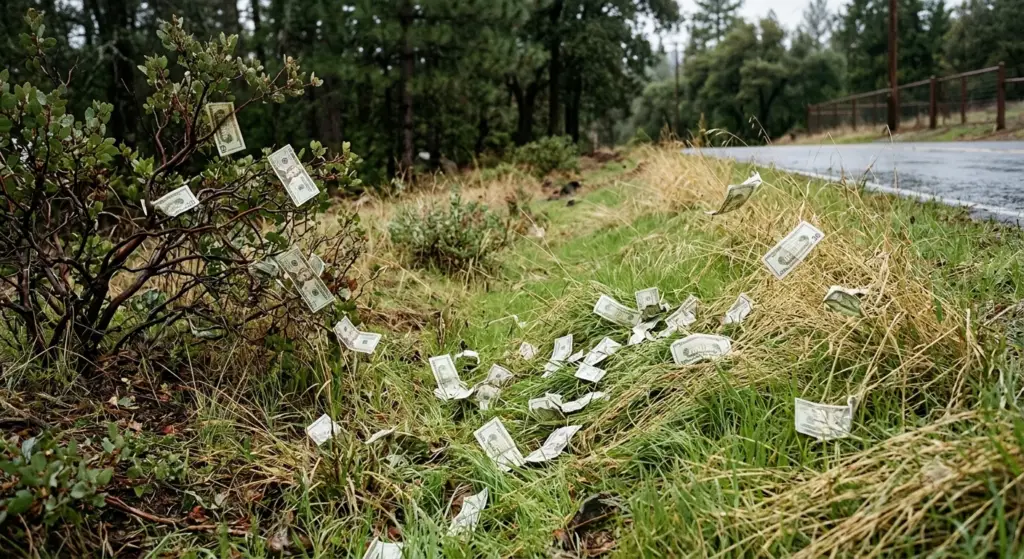
A Torn Envelope on Pine Hill Road
I keep returning to one detail that never makes it into the headlines.
It wasn’t the amount. Six thousand two hundred and seventy dollars is a number large enough to make a news editor’s morning, and it did — UPI picked it up in March, Yahoo News ran it the same week, and for a day or two the story traveled the way small true things sometimes do (UPI, 2026). A resident of Nevada City, California, driving the stretch of road above town after a windstorm, saw paper moving in the ditch grass that wasn’t leaves. Bills. Loose, torn at one corner where an envelope had given up, some flattened against the wet asphalt, some caught high in a manzanita bush like strange flags. They stopped the car.
That’s the part everyone remembers, if they remember anything. What I keep circling back to is what happened over the next several hours, which is the part that doesn’t fit in a headline. The driver didn’t count the money on the roadside. They gathered it — all of it, working the ditch on hands and knees in the wind, chasing a few bills that lifted and ran before they could reach them — and only then did the counting happen, at a kitchen table, twice, to be sure. Then came the slower work: a name on a torn receipt caught in the same grass, a phone number cross-referenced, a knock on a door two miles away belonging to a family who hadn’t yet realized what the wind had taken from their car.
The money had been meant for something. Reports differ on exactly what — a large purchase, a debt being settled, cash held instead of banked for reasons the family didn’t explain to reporters and that are frankly none of ours (UPI, 2026). What’s not in dispute is that it was gone, and then it wasn’t. The family’s account, relayed secondhand through the article, called it “an answered prayer.” The person who returned it declined to be named.
I want to sit with that refusal for a moment before we go any further, because it’s the hinge the whole story turns on. We are a culture that has grown suspicious of unclaimed virtue. We assume, reflexively, that the anonymous good deed is either a marketing move waiting to be unmasked or a story too good to be fully true. Neither assumption fits here. There was no GoFundMe. No reward was requested or, as far as the record shows, offered. The driver simply did the searching, made the call, handed back an amount of money that would have solved a real problem for most households in this country, and then declined the one thing that would have made the story theirs: a name.
Two weeks ago in this space, we sat with a very different kind of reckoning — a woman deciding, slowly and at real cost to herself, whether she could forgive a man who had taken something from her that money could never replace. That essay ended without resolution, because some debts don’t resolve; they get carried differently once you decide how you’re going to carry them. This week’s story is almost the photographic negative of that one. Here, the thing taken by accident — by wind, not by will — was simply given back, in full, by someone who wanted nothing for it and told no one who they were. It’s worth asking why that feels, to most of us, like the rarer miracle.
What Forty Countries Learned From Twelve Thousand Lost Wallets
If you want to know how humans actually behave with someone else’s money when they think no one is watching, you don’t have to speculate. Economists have run the experiment, repeatedly, at a scale that makes any single roadside story look like an anecdote — which, strictly, it is. In 2019, a team led by Alain Cohn and colleagues published the results of what remains the largest field experiment of its kind: research assistants “lost” more than seventeen thousand wallets in forty countries, some empty, some containing modest cash, a few containing what the researchers called a “large” amount, and then simply recorded how many were returned, and how quickly, to the owner listed inside.1
The finding that made headlines wasn’t the one anyone expected going in. Economic theory — the coldest, most self-interested version of it — predicts that a wallet with more money in it should be returned less often, because the temptation to keep it scales with the reward. The data said the opposite, in almost every country tested. Wallets containing more money were returned at a higher rate than wallets containing less, and wallets with the largest cash amounts were returned most often of all.1 When the researchers asked people why, in follow-up surveys, the honest answer that kept surfacing wasn’t civic duty or fear of punishment. It was something closer to self-image. Keeping a stranger’s wallet, once the stranger’s name is right there on a card inside it, requires a person to look at themselves and decide they are the kind of person who steals from a stranger. Most people, given the chance to avoid that verdict about themselves, will avoid it — and the more money is on the table, the more that verdict would cost them to reach.
There is a wartime echo to this that the study doesn’t mention but that historians of the home front have documented on both sides of the Atlantic: rationing-era Britain and the American home front of the 1940s produced their own version of the same finding, in a different key. Scarcity did not, on the whole, produce the wholesale collapse into theft and hoarding that planners feared. It produced, instead, elaborate informal economies of tracking, trading, and returning — ration books lent between neighbors and accounted for down to the coupon, found property turned in to wardens rather than kept, communities that policed their own honesty more tightly precisely because everyone understood how much was at stake if the system broke down. Scarcity, it turns out, tends to concentrate a community’s attention on its own reputation rather than dissolve it.
None of this explains away what happened on Pine Hill Road. It does something more useful than explaining it away: it tells us the driver who gathered those bills out of wet grass wasn’t behaving like an outlier. They were behaving like the median case, once you strip away the cynicism we bring to the story before we’ve heard it. The rare thing wasn’t the honesty. The rare thing was that anyone happened to be watching closely enough, in this instance, to write it down.
The Law That Assumed You’d Find Something
Scripture has surprisingly little patience for the idea that lost property is simply gone, morally speaking, once it leaves someone’s hands. Deuteronomy is blunt about it, in the plain administrative language the law code favors:
“If you see your fellow Israelite’s ox or sheep straying, do not ignore it but be sure to take it back… Do the same if you find their donkey or their cloak or anything else they have lost. Do not ignore it.” (Deuteronomy 22:1–3)
Notice what the text refuses to allow: the passive voice. It doesn’t say lost property “should be returned,” as though return were a nice outcome that might occur. It says do not ignore it — twice, in the space of three verses, aimed at someone who has done nothing wrong and stands to gain nothing but inconvenience by getting involved. Leviticus extends the same logic into cases where wrong has actually been done, prescribing not just return but return plus a penalty on top, when something is taken by deceit rather than found by accident:
“They must make restitution in full, add a fifth of the value to it and give it all to the owner on the day they present their guilt offering.” (Leviticus 6:5)
The math there is worth sitting with. Full restitution wasn’t considered sufficient on its own; the law assumed that simply returning what was taken still left something unaddressed — the disruption itself, the trust spent in the taking — and priced that disruption at twenty percent. Whoever gathered those bills off Pine Hill Road wasn’t operating under threat of guilt offering, obviously. But the instinct the law is trying to encode — that a found or misplaced thing carries an obligation the finder didn’t ask for, and that the obligation is worth more than the mere convenience of walking away — showed up anyway, unprompted, on a stretch of wet road in Nevada County.
And then there’s Luke, doing something neither Deuteronomy nor Leviticus attempts: turning the search itself into the point, rather than the return.
“Or suppose a woman has ten silver coins and loses one. Doesn’t she light a lamp, sweep the house and search carefully until she finds it?” (Luke 15:8)
The coin in that parable isn’t lost through anyone’s fault. No one stole it; it simply rolled somewhere, the way a torn envelope simply opens in the wind. And the woman’s response isn’t measured or reluctant — she lights a lamp in the middle of the day, sweeps a dirt floor, searches until she finds it, and then, having recovered a single coin worth perhaps a day’s wage, throws a party that likely cost more than the coin itself. The math doesn’t work if the point is the coin. It works if the point is what recovery means to the person doing the recovering.
Scripture doesn’t ask us to read a torn envelope in a ditch as evidence of anything supernatural, and it would overreach the text to claim otherwise. It does insist, across two very different genres of writing separated by a thousand years, that what a community does with the things it finds — the search it’s willing to mount, the return it’s willing to make when no one would ever know otherwise — ends up telling the truth about that community more reliably than what it says about itself.
Why the Biggest Wallets Came Back First
Put the numbers next to the text and something clicks into place that neither one quite manages alone.
Cohn’s team found that self-image, more than fear or virtue in the abstract, predicted whether a stranger’s money made it home.1 Bigger amounts triggered stronger self-image concerns, and stronger self-image concerns produced higher return rates — a finding replicated country after country, culture after culture, with enough consistency that the researchers described it as one of the most robust results in the whole study. People do not, on average, want to be the kind of person who profits from someone else’s misfortune, and they will go considerably out of their way to avoid finding that out about themselves.
That’s a psychological finding. It is not, on its face, a theological one. But watch what happens when you set it beside Deuteronomy’s refusal to let lost property sit in a moral gray zone, or beside Leviticus pricing restitution twenty percent above the bare minimum, or beside a woman sweeping a dirt floor for a single coin she could easily have written off. The behavioral economists arrived, four thousand years later and using an entirely different vocabulary, at something the ancient law code had already assumed as its starting premise: that human beings are wired to care, more than we like to admit, about who we are when something valuable is sitting in front of us and no one else is looking. The law didn’t need a randomized field experiment to know that. It built an entire restitution system on the assumption.
Where the modern data adds something the ancient text couldn’t have measured is scale. Cohn’s study wasn’t run in one town; it ran in forty countries, across radically different economic conditions, political systems, and religious majorities, and the pattern held anyway.1 This isn’t a phenomenon that depends on a particular culture’s church attendance or a particular nation’s legal penalties for theft. It shows up in secular Scandinavian cities and in countries with no Judeo-Christian legal heritage at all. Which raises the more interesting question — not whether the driver on Pine Hill Road did something biblical, exactly, since they may never have opened a Bible in their life. The question is why a pattern this old, this specific, this apparently universal, keeps reasserting itself in human behavior regardless of whether anyone involved knows the text that first wrote it down.
Scripture does not ask us to read a torn envelope as a verdict from heaven on the driver, the family, or the town; it does insist that a community, given enough small tests like this one, eventually becomes visible for the character it has been quietly practicing when it thought no one was keeping score.
That’s the disclaimer this series returns to in a different sentence every week, and it belongs here as much as anywhere: not every found thing is a sign. But a community that keeps finding things and keeps giving them back is telling you something true about itself, whether it means to or not.
What the Road Kept and What It Didn’t
The family got their money back. Every dollar of it, by the article’s account — nothing skimmed off for the trouble, nothing kept as a finder’s fee that almost anyone would have considered fair (UPI, 2026). What they didn’t get was a name to thank, a face to remember, anyone to invite to dinner as a gesture of the gratitude they clearly wanted somewhere to land. The reporters who covered the story tried, gently, to get more out of the family and came up with the same two words over and over: answered prayer. Not “generous stranger.” Not “honest citizen.” Answered prayer — language that puts the driver almost beside the point, a conduit for something the family had already been asking for before the wind ever took the envelope out of the car.
I’m not going to adjudicate that theology from here. What I notice is that the family’s instinct and the driver’s instinct point the same direction without either one planning it that way. The family gave the credit away — upward, to prayer, rather than sideways, to the person who actually did the work of searching a ditch in the wind. The driver gave the money away and then declined the one thing that would have let anyone give the credit back to them. Between the two of them, nobody in this story wanted to keep anything that wasn’t theirs — not the cash, and not the credit for returning it either.
That’s the detail I keep returning to, the one that doesn’t make the headline because headlines need a hero with a name. This story doesn’t have one, on purpose, and I’ve come to think that’s not a gap in the reporting. It’s the point the reporting almost missed. Two weeks ago we sat with a woman working out how to carry a debt that could never be repaid. This week the debt ran the other direction — repaid in full, by someone who wanted their name kept out of it entirely. Somewhere between those two essays is most of what this series has been trying to say since it started: that what people do with what isn’t theirs, whether it’s forgiveness or found money, tends to say more about them than anything they’d choose to say about themselves.
Some stories don’t need me to explain why they matter. They just need me to get out of the way.
1. Cohn, A., Maréchal, M. A., Tannenbaum, D., & Zünd, C. L. (2019). Civic honesty around the globe. Science, 365(6448), 70–73.
New essays every week. Delivered quietly.