The Block on Colorado Avenue
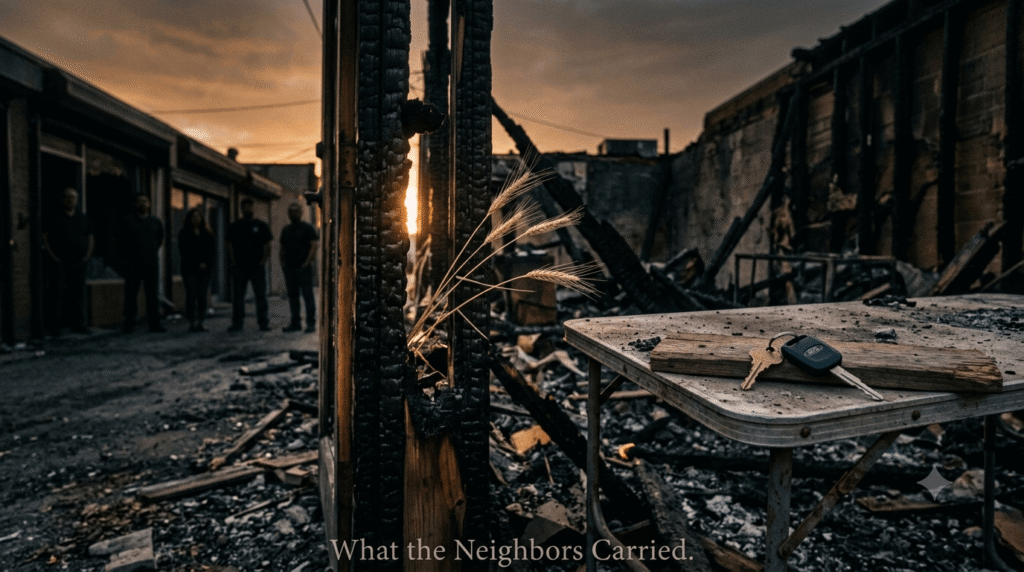
Witnesses told local reporters they saw an electrical pole catch fire on a Tuesday afternoon in Las Vegas, and by the time the flames reached a storage shed and then the buildings beyond it, five structures along the Arts District were already lost or beyond saving (Fox5 Vegas, 2026).
Bobbie Mullins owned two of those storefronts — Raw Remedies and The Analog Dope Store — at 203 E. Colorado Ave. She had spent sixteen years there, long enough that other business owners on the block don’t just know her name. They know her as a community activist, the kind of person other shopkeepers had already leaned on before they ever needed her to lean back (News3LV, 2026).
Sixteen years of inventory and signage disappeared in under an hour.
What didn’t disappear was what the block did next — and that response is the part worth sitting with.
What Robert Taylor Already Knew
Down the block, Robert Taylor owns the Foreign Exchange Lounge. Ten years before Mullins’s fire, his own photography studio burned to the ground. He didn’t need anyone to explain what watching years of work disappear in an afternoon feels like. He’d already lived the specific arithmetic of it (News3LV, 2026).
That history separates two different reasons people help each other. One is compassion: someone sees suffering and responds to it. The other is closer to recognition: someone sees suffering and understands, from the inside, that it was never entirely someone else’s problem to begin with. Taylor’s response reads like the second kind.
Compassion begins with feeling another person’s pain. Recognition may begin earlier — with the understanding that their exposure was never as foreign to us as we’d like to believe.
There’s a meaningful difference between charity and solidarity, even when both produce the same folding table and the same borrowed truck. Charity starts with a gap: I have something you lack, so I offer some of it. Solidarity starts somewhere else — with the recognition that your exposure was never really foreign to mine. Taylor’s history didn’t make him generous in the first sense. It made him aware, in a way no spreadsheet captures, that Mullins’s Tuesday afternoon could have been his own a decade ago, and might yet belong to someone else next year.
American disaster history has tested this instinct at a larger scale before. The Great Chicago Fire of October 1871 destroyed roughly three and a half square miles of the city and left an estimated 100,000 residents — close to a third of the population — without shelter within a day and a half. What historians studying the aftermath have found notable isn’t only the scale of loss. It’s how quickly merchants who’d been undercutting each other in price wars the week before began extending credit, storage space, and borrowed storefronts to one another, well ahead of any insurance settlement.
Researchers who study disaster recovery have a term for what both cities were running on before anyone called it charity: social capital, the accumulated trust and reciprocity that becomes a resource exactly when formal systems are overwhelmed. Chicago in 1871 and Las Vegas in 2026 share almost nothing except this — a neighborhood is an economy of relationships before anyone gets around to noticing it’s also a community.
None of this makes institutional aid irrelevant. Government assistance typically arrives with forms, eligibility windows, and processing timelines that exist for good reasons. Neighbors tend to arrive with a key, a truck, a folding table, or a place to work in the meantime. Both matter. They simply don’t move at the same speed. As Taylor put it, describing the block he’s worked for years, “the downtown environment is like a family environment” (News3LV, 2026).
What Scripture Means by “Neighbor”
Scripture doesn’t treat this instinct as an optional accessory to faith. In several distinct contexts, it treats weight-sharing as something closer to structural.
Bear ye one another’s burdens, and so fulfil the law of Christ. (Galatians 6:2, KJV)
Paul isn’t narrowly describing money here. Some burdens are financial. Others are emotional, social, or simply the burden of having to begin again from nothing at forty, or fifty, or sixty. The “law of Christ” he names covers all of it.
And whether one member suffer, all the members suffer with it; or one member be honoured, all the members rejoice with it. (1 Corinthians 12:26, KJV)
And let fall also some of the handfuls of purpose for her, and leave them, that she may glean them, and rebuke her not. (Ruth 2:16, KJV)
The contexts behind these three passages differ. Galatians addresses a Christian community’s internal obligations; Corinthians describes the church as a single body; Ruth describes agricultural law for ancient Israel. They aren’t identical commands. But they share a moral intuition worth naming plainly: ownership, in each case, comes bundled with obligation rather than released from it.
Boaz’s instruction to his workers is easy to read past. He isn’t simply feeling generous toward a poor widow. He is changing how his own employees handle grain that remains, by every legal measure, still his. Gleaning law wasn’t charity in the sentimental, modern sense. It was a structural admission, written into agricultural policy, that a harvest was never quite as private as the person who grew it. In plain terms, ancient Israel built a safety net directly into its harvest laws, centuries before anyone used that phrase — not as an act of individual kindness, but as policy. Ownership always came with someone else’s name quietly attached to it.
The Math Neighbors Don’t Run
FEMA’s widely cited estimate holds that roughly forty percent of small businesses never reopen after a disaster, and of the ones that do, another twenty-five percent close within the following year. That is the arithmetic. It is cold, precise, and entirely indifferent to who Bobbie Mullins is or how long she has run her stores.
Colorado Avenue didn’t answer with better arithmetic. It answered with a truck, a lounge two doors down, an open door, and a decade-old memory that no spreadsheet could have filed under assets. Call it incalculable, if a word is needed for it. The block didn’t seem to need one.
Taylor didn’t run that accounting. He recognized the fire.
There’s a real question underneath that distinction, worth asking directly: when does another person’s loss become partly our responsibility? Not legally — no one sues a neighbor for staying on his own side of the block — but morally, in the sense Scripture keeps returning to. Galatians doesn’t ask believers to assess a neighbor’s risk profile before deciding whether to help. Ruth’s harvesters weren’t auditing whether she deserved the grain left behind for her.
It’s worth resisting the temptation to romanticize this too quickly. Neighborhoods aren’t automatically generous. Plenty of blocks watch a competitor’s shop burn and feel mostly relief at one fewer competitor. What made Colorado Avenue different wasn’t proximity. It was a habit of trust and reciprocity built up long before anyone smelled smoke — the kind of habit Ruth’s story assumes rather than commands, and the kind Taylor had already practiced once, from the other side of it.
What the Fire Couldn’t Take
Sixteen years of a business can burn down in under an hour, and no amount of neighborly response changes that arithmetic. Mullins still lost what she lost. Whatever gets rebuilt on Colorado Avenue will be, in some real sense, a different place than the one that existed before the pole caught fire.
But what the fire couldn’t take was the fact that Taylor had already decided, ten years earlier and without knowing it yet, how he would respond when it was someone else’s turn. That decision didn’t arrive as a doctrine. It arrived as a memory that refused to stay private.
Scripture doesn’t ask believers to erase ownership. It asks something narrower — that ownership never be allowed to fully release one person from another. Ruth’s harvesters kept their fields. They also left part of them standing on purpose.
A disaster doesn’t create a neighborhood. It reveals whether one was already there.
A Note on Sources: The account of the August 2026 Las Vegas Arts District fire and the response from neighboring business owners, including Robert Taylor and Bobbie Mullins, is drawn from reporting by Fox5 Vegas and News3LV. The small business disaster-recovery estimate is a widely cited FEMA figure. Historical background on the Great Chicago Fire of 1871 draws on Karen Sawislak’s Smoldering City: Chicagoans and the Great Fire, 1871–1874 (University of Chicago Press, 1995); the concept of social capital in disaster recovery draws on Daniel P. Aldrich’s Building Resilience: Social Capital in Post-Disaster Recovery (University of Chicago Press, 2012).
New essays every week. Delivered quietly.