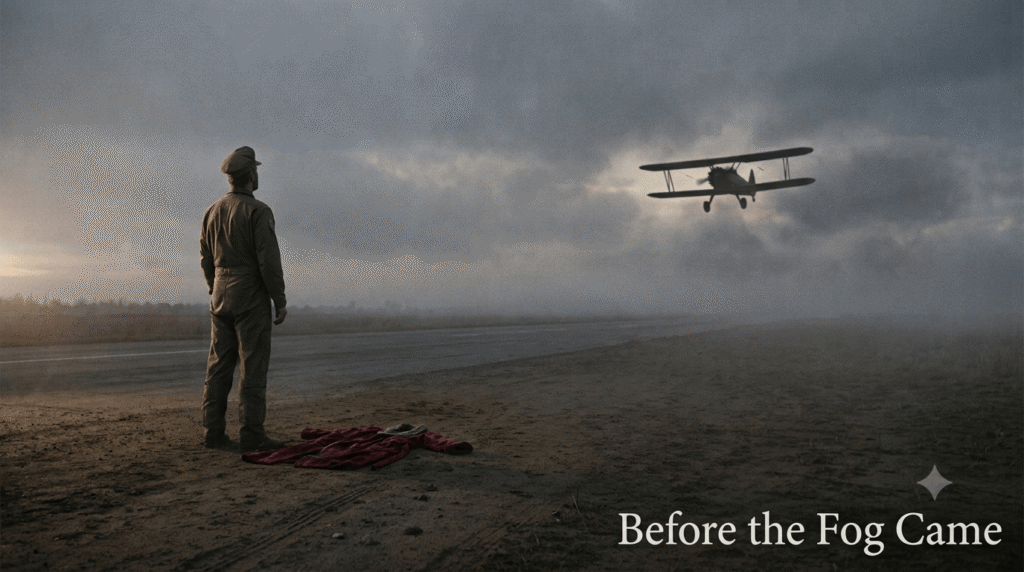
Reels and Rumors of Truth
In the previous installment, we examined how inherited consequence differs from inherited guilt in The House We Did Not Build.
The Lightning Twice
On June 3, 2026, CBS News reported a detail about an American F-15E pilot that seemed almost too precise to be true: he had been shot down twice in the same war, thirty days apart.
The second time was the kind of story that gets told. An Iranian surface-to-air missile, a night ejection, a rescue crew spending hours to bring him home. Retired Air Force Lt. Gen. David Deptula, who once planned the air campaign for Desert Storm, called it “like getting hit by lightning twice.”
But the first strike is the one worth sitting with. Thirty days earlier, the same pilot had been shot down by a Kuwaiti air defense unit — an ally, flying on his own side, that looked at his jet and decided, in the half-second such decisions get made, that it was looking at an enemy.
The doubt evaporated the moment there was time to look twice. It only existed in the half-second there wasn’t.
The Plane He Couldn’t Recognize
There’s a scene in Wings (1927) that runs on exactly that half-second. The film is generally remembered as the first winner of the Academy Award now known as Best Picture, though at that inaugural ceremony the category carried a different name and a different shape entirely.1
Two young pilots, Jack and David, spend the story as rivals for the same woman and end it as something closer to brothers, bound by a war neither of them chose. David is presumed dead behind enemy lines. He escapes in a captured German aircraft, trying to make it home. Jack, who believes his friend already gone and is flying with a grief he hasn’t had time to process, sees a German-marked plane rise out of the clouds and does the one thing his training has prepared him to do.
He fires.
Identification asks what something is. Recognition asks who someone is. Jack’s cockpit only ever gave him the first question, and the war had trained him to answer it fast. By the time the second question was even available to ask — by the time the two men were close enough on the ground for Jack to see a face instead of a silhouette — it was already too late for anything but grief.
Director William A. Wellman had flown combat missions himself, and the scene carries a plausibility that’s hard to fake: at altitude, an aircraft is a shape long before it’s a person, and the shape of an ally and the shape of an enemy are, mechanically, the same shape.
Both the pilot over Kuwait and Jack in his cockpit were caught by the same shortage: no time at all. A jet or a biplane crosses the distance between friend and enemy faster than doubt can catch up to a first guess. What makes the next story different isn’t a better set of eyes. It’s that the man in it had the opposite problem — too much time, not too little — and made his decision anyway, long before he needed to.
The Robe Before the Battle
Centuries earlier, someone solved the mistaken-identity problem by refusing to wait for a crisis to force the question.
“The soul of Jonathan was knit with the soul of David, and Jonathan loved him as his own soul.” (1 Samuel 18:1)
Jonathan was heir to the throne of Israel. David was the shepherd who had just killed Goliath and, by every political calculation available to a king’s son, was the most obvious threat to Jonathan’s own future. Saul, Jonathan’s father, would spend years trying to have David killed for exactly that reason.
None of that stopped Jonathan from doing this:
“Jonathan stripped himself of the robe that was upon him, and gave it to David, and his garments, even to his sword, and to his bow, and to his girdle.” (1 Samuel 18:4)
The text doesn’t explain the gesture as a political statement, and it would be too tidy to call it one outright. But the sequence is hard to miss: the future king’s own son hands David the robe off his back before Saul’s hostility has fully surfaced, before anyone could say for certain how the rivalry would end.
Recognition becomes meaningful precisely when the person you recognize is someone you had reason not to. Jonathan could have let politics classify David first — rival, threat, variable to be managed — and decided how to feel about him later, once the outcome was clearer. He did the opposite. He decided who David was to him before the fog of the succession crisis ever had the chance to answer that question for him instead.
None of this claims that a single act of recognition settles what a covenant will cost later. It only suggests that a person’s readiness to know someone — or their refusal to — tends to surface eventually, whether in a robe handed over three thousand years ago or in the half-second above a battlefield this spring.
Years later, after Jonathan died in battle, David’s lament didn’t let the earlier gesture go quietly.
“Thy love to me was wonderful, passing the love of women.” (2 Samuel 1:26)
Read against everything that came before it — the robe, the years of Saul’s hunt, a crown that never passed to Jonathan’s own line — the line sounds less like a comparison between kinds of love than a final confirmation of a decision made once, in a courtyard, before either man knew what it would cost. The text doesn’t resolve the relationship into a tidy moral lesson. It simply records the price of a loyalty that had already been declared, long before the battlefield asked anything further of it.
What the Numbers Still Can’t Fix
War has spent a century trying to make Jack’s mistake impossible. It hasn’t succeeded, and the record of trying is more precise than the folklore around it.
Army Lieutenant Colonel Charles R. Shrader’s 1982 review of 269 documented friendly-fire incidents across three American wars concluded that fratricide accounted for under two percent of U.S. battle deaths overall.2 For years, that number was treated as close to settled.
It wasn’t. A decade later, an Office of Technology Assessment report prepared for Congress in 1993 re-examined the Gulf War specifically and found that friendly fire had caused somewhere between fifteen and twenty percent of American combat deaths in that particular conflict — not a constant across all of modern warfare, but a figure tied to one kind of war: fast, fought at long range, with weapons that could kill before anyone had time to look twice.
The gap between two percent and twenty percent isn’t only a disagreement about arithmetic. It’s a hundred years of militaries discovering, one war at a time, that better weapons close distance faster than better eyes close doubt.
Technology can make identification more reliable. It cannot make recognition infallible, because recognition was never a hardware problem to begin with. Transponders and radio codes answer “is that aircraft friendly?” They have nothing to say about who that is, to me — which was the only question Jonathan was ever actually trying to answer.
When a Person Becomes a Category
Most of us will never fly beside someone who mistakes our aircraft for an enemy’s. But there’s a smaller, quieter version of the same failure available most days of the week — the moment a coworker becomes a rival, a neighbor becomes a demographic, a stranger online becomes a stand-in for some larger group instead of a person typing at a kitchen table. Some of us hand the job of noticing us at all to the manufactured company of something that never tires of us, because it asks less than a person would.
It doesn’t take a battlefield to make this happen anymore. A newsfeed, a credit model, a demographic tag — none of them were built to answer who someone is. They were built to answer what they are, quickly, and sort accordingly, and quickly is usually all anyone has time for.
The category isn’t wrong, exactly. It’s just faster to read than the person underneath it, the way a silhouette is faster to read than a face.
There are moments when the category is all anyone has time for. There are other moments when it becomes the only thing anyone bothers to reach for, even with time to spare. The second kind sits closer than most of us would like to the half-second above the Kuwaiti desert.
What the Robe Already Knew
The rescued pilot over Iran is alive because people who knew his exact shape refused to stop looking for him. That’s a different story, and a good one. It doesn’t erase what happened thirty days earlier, when the people flying nearest him didn’t know it in time.
Jack gets his answer on the ground, holding a friend he has already killed. Jonathan never has to. He answered the question about David before there was a battlefield to ask it on, and paid for the answer with a robe that once marked him as the next king of Israel. It is, in its way, the opposite of an unclaimed grave with only a year and a number on the marker — a life that was known, on purpose, before it needed to be.
The deepest form of recognition may not be the ability to identify someone correctly in a moment of crisis. It may be the decision to know who they are before the crisis has a reason to make you doubt it.
That is the whole distance between a robe given away too early to matter, and a shape recognized too late to help.
1. At the first Academy Awards ceremony in 1929, Wings received the award then called “Outstanding Picture”; a separate, since-discontinued award for “Unique and Artistic Production” went to Sunrise. Film historians and the Academy itself now treat Wings as the lineal first Best Picture winner. See Mason Wiley and Damien Bona, Inside Oscar: The Unofficial History of the Academy Awards (Ballantine Books, 1986).
2. Charles R. Shrader, “Amicicide: The Problem of Friendly Fire in Modern War,” U.S. Army Command and General Staff College, 1982.
New essays every week. Delivered quietly.