Susan Rorke has attended the same ceremony every December for ten years. No one on the list of names being buried that day is her relative, or even her acquaintance. She has never explained herself in more than a sentence, and the sentence she gives isn’t quite an explanation at all.
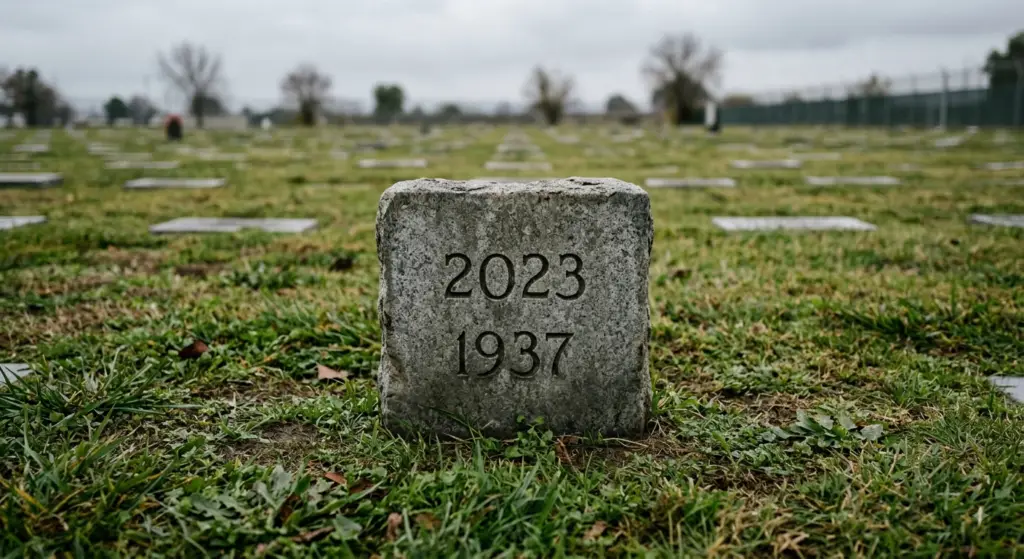
The ceremony is Los Angeles County’s annual burial of the unclaimed — men and women whose bodies sat in the coroner’s custody for months or years because no family came forward, or none could be found. Workers dig a trench fourteen feet deep. Into it go more than nineteen hundred plastic boxes, each holding cremated remains that no one arrived to claim. The headstone marking the trench carries no names. Only a year.
Why a woman with no connection to any of them would keep showing up is not obvious. It isn’t grief, exactly — she didn’t know them. It isn’t civic duty in any official sense; no one requires her presence. Whatever it is, it has kept her coming back for a decade, to a grave that belongs, this year, to strangers.
In the previous installment, we examined what happens when achievement stops being enough — when the applause keeps coming but nothing underneath it quiets down. This one starts further out on the same road. It isn’t about someone who accomplished too much and still felt hollow. It’s about what happens when a person’s name simply stops being carried by anyone still living — and about a debt paid, quietly, two thousand years ago, for exactly this condition.
A Field Bought for People No One Would Come For
Matthew’s Gospel tells a strange coda to the story of Judas. After identifying Jesus for thirty pieces of silver, Judas tries to return the money, and the temple authorities refuse to take it back into the treasury — it is, in their own accounting, blood money, unfit for sacred use (Matthew 27:6). So they use it instead to buy a plot of land: a potter’s field, worn out from the potter’s trade, repurposed as a burial ground for strangers.
It’s worth being precise about what that story does and doesn’t claim. Matthew presents the field as something purchased with the returned silver; whatever the exact historical mechanics behind the account — and scholars have long debated how literally to read the transaction — the Gospel gives the field a specific theological function regardless. Money tied to betrayal becomes ground where the unclaimed are laid to rest. There’s a harsh symmetry the Gospel never spells out for the reader: the price of the most remembered betrayal in the story becomes the ground for the least remembered dead in the city — the one transaction everyone still talks about, paying for the graves no one ever talked about at all.
Cities have always needed a place for the dead whom no one came to claim. Rome had one. Medieval London had one. Almost every American county still runs one today, under duller names — indigent burial program, decedent affairs, county morgue backlog — and the population inside them has shifted with the economy over centuries. For most of American history, ending up there meant a person had lived in poverty from birth: no property, no listed next of kin, often no fixed address.
That is no longer the whole picture, and the change matters more than the continuity does. The problem has not disappeared. Only its institutions have changed.
Three Geographies of Absence
Scripture returns to this condition more than once, and the three moments worth holding together are not really making the same point three times. Each names a different way a person’s world can come apart.
The potter’s field is about what happens to social recognition after death — a body with no one to say, publicly, “this one was mine to bury.”
The second moment is about what happens to companionship during life, and it is the harder of the three to sit with. Psalm 88 is often called the bleakest psalm in the collection, because unlike almost every other lament in the book, it never turns toward hope. The psalmist writes:
“Lover and friend hast thou put far from me, and mine acquaintance into darkness.” (Psalm 88:18, KJV)
The psalm simply stops there. No pivot toward praise in the final verse, no reassurance folded in at the end. Commentators have puzzled over this for centuries — why the editors of the Psalter would leave a prayer this unfinished sitting permanently inside a book about a God who answers. The likelier reading isn’t that the editors forgot to add resolution. It’s that biblical faith, at least as this psalm practices it, does not require every human disappearance to be narratively closed. The dead in the potter’s field don’t get a resolving epilogue either. Neither, this psalm insists, does the person still breathing.
The third moment is about the loss of family, future, and name together. Naomi, returning to Bethlehem after burying her husband and both her sons in a foreign country, tells the women of her hometown not to call her Naomi — “pleasant” — but Mara, “bitter,” “for the Almighty hath dealt very bitterly with me” (Ruth 1:20). She isn’t performing grief for an audience. She is renaming herself because the name she was given no longer describes the woman standing in front of them.
Held together, these three aren’t a proof. They’re closer to a map of the different ways a person’s belonging can fail — after death, during life, and at the level of identity itself.
What Vanishes Before the Body Does
There’s a distinction worth making before the numbers arrive, because the numbers will otherwise flatten it. A person can be unloved. A person can be unknown to any institution. A person can be uncontacted by the people who once knew them. A person can be, formally, unclaimed. These four things sound like synonyms, and they aren’t.
The state may know a body’s name from a driver’s license. A hospital may hold a full medical history. A neighbor may have exchanged pleasantries for years. None of that produces a person who can say, when the coroner’s office calls, “that’s my person, I’ll come.” The gap between being known and being claimed is exactly where this problem lives, and it’s a narrower, colder gap than “nobody loved them.”
It’s also worth pausing on an uncomfortable possibility before treating unclaimed status as a diagnosis of a life. Perhaps some of the nineteen hundred and thirty-seven weren’t isolated at all. Perhaps everyone who loved them had already died first. Perhaps a family lived three states away and never got the call in time. Perhaps someone had, by their own choice, stepped back from everyone who might have claimed them. The data can’t sort these cases apart from a distance, and this essay shouldn’t pretend otherwise.
But even granting all of that, one question survives the complication intact: what kind of society only notices a missing person once a body needs claiming?
This is where a concept worth naming enters: relational attrition. It’s rarely one event. Parents die. Siblings move away. A marriage ends, or a spouse dies first. Children build lives elsewhere and the calls space out. A congregation that once tracked absences closes or merges. A workplace that structured a person’s week for thirty years lets them go at retirement and, with it, releases the daily contact that had quietly stood in for friendship. No single loss causes disappearance. The network simply gets thinner, year after year, until the thread holding a name to a living person breaks without anyone having watched it happen.
What the Records Can and Cannot Hold
The scale in the United States is larger than one December ceremony suggests, though the figure deserves more care than a single headline number usually gets. Pamela Prickett and Stefan Timmermans, the sociologists behind The Unclaimed: Abandonment and Hope in the City of Angels, estimate — based on local data compiled across major U.S. counties, since no federal agency tracks the figure nationally — that roughly two to four percent of American deaths now go unclaimed each year, as many as 148,000 people.[1] That number describes local record-keeping stitched together, not a single national census, and it should be read with that caveat attached rather than repeated as settled fact. It’s also worth separating two measures that get blurred together in casual reporting: dying alone — with no one present at the moment of death — is not the same fact as dying unclaimed, where the question is whether anyone came forward afterward. A person can die surrounded and still go unclaimed if the people present have no legal standing, or no willingness, to take the body. The trench in Los Angeles counts the second measure, not the first.
A separate, earlier study by the same research tradition looked specifically at who ends up unclaimed. Analyzing Los Angeles County decedent records dating back to 1896, sociologist Heeju Sohn and colleagues found that unclaimed status correlated less with poverty on its own than with isolation from kin.[2] Financial hardship mattered. Having no one left willing, or able, to call mattered more. Poverty remains a major pathway into social disappearance — it always has been — but the research suggests poverty is no longer sufficient by itself to explain it.
A wider pattern, tracked separately, points the same direction without proving the same thing. AARP’s Public Policy Institute, drawing on Cigna and Evernorth’s 2025 loneliness survey, reports that self-described loneliness among U.S. adults has risen from 35 percent in both 2010 and 2018 to roughly 40 percent today, with the sharpest increase concentrated among adults in their forties and fifties — the decades when an original support network commonly thins, and no replacement network is guaranteed to form in time.[3]
These two findings shouldn’t be collapsed into one causal story. Loneliness and unclaimed death may simply be different expressions of the same underlying erosion of social connectedness, tracked by different researchers using different methods, rather than one phenomenon proven to cause the other.
Held next to the historical pattern, though, something does emerge. The potter’s field existed for people the ancient economy had already discarded. What the more recent research suggests is that a meaningful share of today’s unclaimed dead are people the economy never discarded at all — people who worked, paid into systems, raised families — but whose relational thread frayed faster than any institution was built to track. A grave with no name on it has never been, at bottom, primarily a financial category. It has always been a relational one.
An Ordinance of Noticing
None of this resolves into “go to church and this stops happening.” A congregation cannot guarantee that no one within it will die without a claimant. It cannot repair, on its own, decades of relational attrition happening at a national scale. Any conclusion promising otherwise would be selling something Scripture itself doesn’t sell — the same Scripture that leaves Psalm 88 unresolved.
What Hebrews 10:25 offers is smaller and, for that reason, sturdier. “Not forsaking the assembling of ourselves together” wasn’t written for an age where physical proximity had become optional in almost every part of life, but it speaks directly into one. The instruction isn’t really about attendance as a metric. It’s a discipline of remembering — noticing when someone who used to show up has stopped, calling instead of assuming a silence means nothing, keeping in touch with someone after the institutional reason for contact has ended.
None of that is dramatic. Knowing someone’s full name, not just their first. Noticing an absence within a week rather than a year. Visiting someone who has stopped appearing, rather than waiting for them to explain themselves. Keeping a relationship alive across a move, a retirement, a divorce, a diagnosis — the ordinary hinge points where a network quietly loses a member and no one marks the moment it happened.
Christian community, at its best, is one of the few institutional practices built specifically to resist that quiet loss — not a guarantee against it, but a standing discipline of refusing to let a name slip out of anyone’s mouth for good.
The Fourteen Feet, Again
Susan Rorke’s decade of showing up to strangers’ burials starts to look different by the end of the story than it did at the start. She isn’t rehearsing her own death, exactly. She’s doing in advance what the county is only ever forced to do afterward — showing up because a person matters, before there’s any institutional obligation requiring it.
That’s the actual distance between a potter’s field and a church: not geography, not abstract theology, but the plain difference between a place built to process what’s left once no one comes, and a practice built so that, as often as it can be managed, someone still does.
Fourteen feet is not a metaphor. It’s the measured depth of the trench a Los Angeles crew dug last December for nineteen hundred and thirty-seven boxes that would otherwise have gone unmarked. The number will be different next year.
Naomi asked to be called by a different name so her grief would have something accurate to attach to. The trench doesn’t even get that much. It gets a year, and a count. What won’t change, whatever the count turns out to be, is what each of those boxes once was: a name someone, somewhere, used to say out loud.
1. Pamela Prickett and Stefan Timmermans, The Unclaimed: Abandonment and Hope in the City of Angels (University of Chicago Press, 2024); national estimate cited in Prickett and Timmermans, “Why Are More Americans Dying Alone?,” syndicated opinion, 2024–2026.
2. Sohn, H., et al., “Loneliness in Life and in Death? Social and Demographic Patterns of Unclaimed Deaths,” PLOS ONE, 2020.
3. AARP Public Policy Institute, “Loneliness and Social Connections,” updated 2026, citing Cigna/Evernorth Loneliness in America 2025 survey.
New essays every week. Delivered quietly.