Before dawn, in underground rooms scattered beneath southern England, young women were already at their stations — moving wooden counters across gridded maps that would decide, in a few hours, where British pilots flew and which of them came back. Eighty-six years later, women still make up most of the global health workforce while occupying a much smaller share of its formal emergency leadership.[1] This gap is not merely about representation. It is about a harder question that outlives any one statistic: when a crisis arrives, who actually has authority — the person holding the title, or the person whose judgment everyone, without quite saying so, has already decided to trust?
In the previous installment, we traced the architecture of the Book of Judges — a cycle of forgetting, apostasy, oppression, outcry, and deliverance that runs through all twenty-one chapters, and a warning about what fills the space once legitimate authority stops commanding trust.[2] This installment stays inside that cycle, at one of its rare high points. Judges 4 opens with a woman already presiding, already the address Israel comes to for judgment — before the crisis that would make her famous has even begun.
The distance between an underground operations room in wartime Britain and a palm tree in the hill country of Ephraim is enormous. The question both places pose about authority is not.
The Balcony and the Table
By the summer of 1940, Britain’s air defense depended on information moving fast enough to matter. Radar stations along the coast fed raw signals to a Filter Room at Fighter Command, where the readings were checked, corrected, and turned into a single trusted picture — then sent on to Sector Control Rooms, where that picture became the orders that sent squadrons up to meet specific raids at specific altitudes and specific minutes.
Picture the room itself. A gridded table lit from below. Colored wooden blocks pushed across it by hand, each one a raid, each one somebody’s estimate of how many aircraft and how far out. Telephones ringing constantly with updates from radar crews miles away. Overhead, on a balcony, senior officers watched the table and issued the commands the table made possible. On September 15, 1940 — the day now remembered as Battle of Britain Day — a plotter newly posted to RAF Uxbridge tracked every raid that crossed the coast that afternoon, while Winston Churchill, visiting the operations room, watched from that same balcony.[3]
No plotter held a command rank close to what her judgment, hour by hour, actually shaped. She did not decide which squadron flew. She decided what the men who did decide believed was true. The system worked because both kinds of authority functioned — but only one of them came with a rank insignia attached, and that one belonged to a modern military bureaucracy built to keep them separate.
Judgment Before the War
Deborah’s authority was not issued by any comparable chain of command. Ancient Israel in the period of the judges had no standing bureaucracy to commission her; what it had was a tribal confederation in which a person’s standing was something closer to earned recognition than assigned rank. Judges 4 introduces her without qualification:
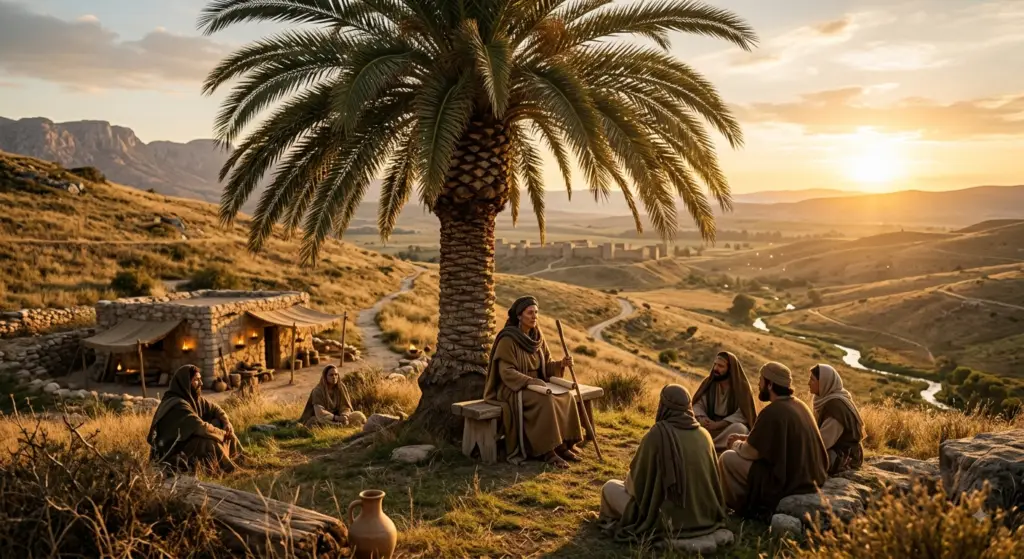
“And Deborah, a prophetess, the wife of Lapidoth, she judged Israel at that time. And she dwelt under the palm tree of Deborah between Ramah and Bethel in mount Ephraim: and the children of Israel came up to her for judgment” (Judges 4:4–5).
The war does not create Deborah’s authority. It reveals it. She is already judging Israel, already the one people travel to for a ruling, when the crisis with Sisera’s army begins — and the text simply turns that pre-existing authority toward a military problem instead of a civil one.
Barak’s response complicates the picture the moment it appears:
“And Barak said unto her, If thou wilt go with me, then I will go: but if thou wilt not go with me, then I will not go. And she said, I will surely go with thee: notwithstanding the journey that thou takest shall not be for thine honour; for the LORD shall sell Sisera into the hand of a woman” (Judges 4:8–9).
The text does not explain Barak’s condition. It simply records it. Some readings of the passage take his insistence as less about Deborah personally than about what her presence guaranteed — a visible sign that the LORD’s word was actually in the camp, not merely reported secondhand. That reading is plausible without being required by the text, and Judges is content to leave a commanding officer refusing to move without a prophetess beside him, for reasons the narrative never quite settles.
The song in Judges 5 gives Deborah’s own retrospective on the whole episode:
“The inhabitants of the villages ceased, they ceased in Israel, until that I Deborah arose, that I arose a mother in Israel” (Judges 5:7).
The Tripartite Authority
Set the two rooms beside each other — the operations room under Fighter Command, the palm tree between Ramah and Bethel — and the same structure appears in both, arranged in the opposite order. The WAAF plotters carried enormous functional weight without the institutional recognition to match it: authority the system depended on, filed under a job title that undersold it. Deborah carried the recognition first, arriving with a title — prophetess, judge — attached before the crisis had given her anything to prove. One story is about competence outrunning its title. The other is about a title that was already load-bearing before anyone needed to lean on it.
Judges 4–5 goes further than that single contrast, because it will not let the honor of the story settle on either Deborah or Barak. That honor belongs to Jael — the wife of Heber the Kenite, a foreigner attached to Israel only by treaty, standing outside both the military chain of command and the religious office Deborah occupied. She acts alone in her own tent, with a tool no army ever issued her. Trace where the narrative’s authority actually moves across these three figures and it travels, deliberately, from the center of Israel’s institutions toward their furthest edge: Barak, formal command; Deborah, formal recognition predating the crisis; Jael, no office at all, and no expectation attached to her — only the willingness to act when the moment required someone to.
Crisis does not just reveal who already had authority. It reveals that authority was never one thing to begin with. A title can be genuine and still not be where the decisive action ends up happening. Competence can be indispensable and still not carry a title that matches it. And sometimes, as with Jael, neither the title nor the prior competence is present at all — only a willingness the text refuses to explain away as coincidence.
None of this should be flattened into a claim that whoever proves useful in a crisis has thereby earned authority; competence and legitimacy are not the same thing, and Judges never lets Israel’s human hierarchy off the hook long enough to license that equation. What the book keeps returning to instead is less an organizational claim than a theological one: deliverance in Judges is not something Israel’s existing chain of command reliably produces on its own terms. It arrives, chapter after chapter, through whoever is positioned to carry it — judge, general, or a foreign woman alone in a tent — regardless of where that person sat in the hierarchy anyone else would have consulted first.
A Mother in Israel, Named Before the War Began
Deborah is not a twentieth-century plotter, and Fighter Command was not a biblical judgeship. One belongs to a tribal confederation narrated through theology; the other to a modern military bureaucracy built on radar and centralized command. The comparison was never about equivalence. It is about a problem that keeps recurring regardless of century: what an institution does with judgment when the person carrying it does not occupy the seat where judgment is officially supposed to sit.
Institutions tend to recognize authority only after someone has already proven indispensable — after the crisis, after the outcome, after the title finally catches up to what had been true the whole time. Judges 4 does something more unsettling than that. It names Deborah’s authority under the palm tree, in advance, before Sisera’s army was ever a problem she had to solve. And when the decisive act of the story finally arrives, it does not even go to her — it goes further out, to a woman the text never once calls a leader, as if to insist that whatever was delivering Israel that day was never fully contained by anyone’s title, Deborah’s included.
The text gives her the title before it gives her the war. What the Battle of Britain’s underground rooms and the hill country of Ephraim share, across every distance separating them, is not a lesson about who deserves to lead. It is the far more unsettling possibility that the authority already sitting in the room, under whatever palm tree it happens to occupy, is very often exactly the authority an institution — or a reader — has spent years failing to call by its right name.
1. Christine Sadia, “Why women should be at the helm of health emergency leadership,” World Economic Forum, weforum.org, July 8, 2026.
2. On the Deuteronomistic framing of the Judges cycle, see Martin Noth, The Deuteronomistic History, JSOT Supplement Series (Sheffield, 1981).
3. Confederation of Service Charities, “WAAF Plotters and Tellers at Fighter Command” (veteran account archive), cobseo.org.uk; Imperial War Museums, “Support From The Ground In The Battle of Britain,” iwm.org.uk.
4. On the poetic structure and theology of Judges 4–5, see Daniel I. Block, Judges, Ruth, New American Commentary (Broadman & Holman, 1999).
5. On female judgeship and prophetic authority in the period of the Judges, see Susan Niditch, Judges: A Commentary, Old Testament Library (Westminster John Knox, 2008).
New essays every week. Delivered quietly.