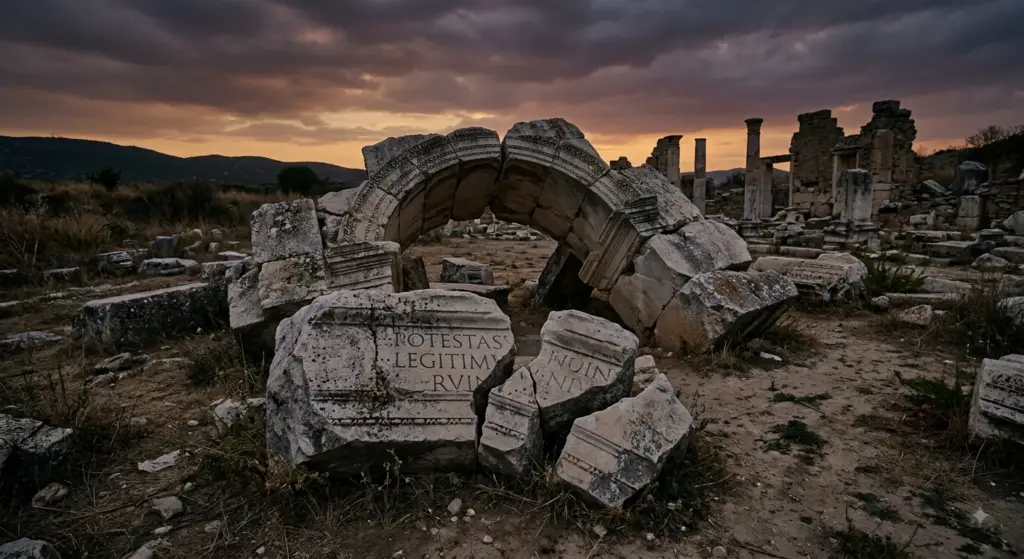
Institutional trust can erode long before the institutions themselves do. In June 2026, Gallup closed its annual measure of American confidence in national institutions at 27 percent — one point above the record low it had set three years earlier, and the fifth consecutive year the average has stayed under 30 percent.[6] Congress and television news drew confidence from roughly one in ten Americans. Distrust of this kind is not automatically irrational; sometimes it is the first honest signal that an institution has stopped earning what it once assumed it was owed. The harder question sits one step further in: once legitimate criticism curdles into permanent delegitimation, what actually occupies the space the institution leaves behind?
In the previous installment, we followed the tribes of Israel to Shiloh, watching a nation receive an inheritance it had not fully earned, and a farewell speech at Shechem insisting that receiving land and living faithfully inside it were two different achievements.[1] The book that follows Joshua answers that warning with a case study, not a prediction. Judges is not a coded description of any particular nation, ancient or modern. It is a conceptual vocabulary — one of the oldest on record — for a narrower and more durable problem: what happens when legitimate authority becomes difficult to trust, and people still need authority regardless.
Twenty-one chapters trace that problem from its first symptoms to its most severe form. Understanding the shape of that trace says less about ancient Canaan than it might first appear.
What a Vacuum Actually Produces
Around 1200 BCE — the same general period the Book of Judges narrates — a wave of upheaval moved through the eastern Mediterranean. The palace economies of the Hittites, Mycenaeans, and much of coastal Canaan broke down within a few decades of each other. Archaeologist Eric Cline has argued that no single cause explains it; rather, a set of interlocking systems — trade routes, tribute networks, centralized authority — failed together, and once they did, smaller raiding groups and displaced populations filled the resulting space.[2] The historical relationship between this archaeological picture and the biblical chronology of Judges is genuinely contested, and nothing here depends on resolving that dispute. What the Late Bronze Age collapse offers is not confirmation of the biblical narrative but a useful parallel to it: a comparable political texture, produced by comparable conditions, in the comparable absence of centralized authority.
The instinct is to assume that removing a flawed central authority produces freedom. The Late Bronze Age collapse — like the tribal fragmentation Judges depicts for Israel across the same general window — suggests something less comfortable. A vacuum does not stay empty. It gets filled, and the terms of that filling are rarely written down or agreed to in advance.
That is the backdrop against which Judges has to be read: a history claim (regional fragmentation occurred), giving way to a literary claim (Judges narrates a comparable fragmentation in its own idiom), giving way to the political question underneath both — what fills the space once centralized legitimacy weakens.
The Cycle Does Not Repair Itself
Judges 2 lays the pattern out almost like a diagram before the narrative proper even begins.
“And there arose another generation after them, which knew not the LORD, nor yet the works which he had done for Israel. And the children of Israel did evil in the sight of the LORD… And the anger of the LORD was hot against Israel, and he delivered them into the hands of spoilers… Nevertheless the LORD raised up judges, which delivered them out of the hand of those that spoiled them… And it came to pass, when the judge was dead, that they returned, and corrupted themselves more than their fathers” (Judges 2:10–19, selected).
Five beats, repeating: forgetting, apostasy, oppression, outcry, deliverance — then a return to the start, each time a little further from where the cycle began. The generation that “corrupted themselves more than their fathers” is not an isolated remark. It is the engine of everything that follows.
Notice what happens to the deliverers themselves across that engine’s twelve turns. Othniel, first in the sequence, is almost administratively clean — apostasy, oppression, a cry, forty years of rest, told in a handful of verses with no moral complication attached to the man himself. By Gideon, the deliverer hides in a winepress to thresh wheat away from raiders’ eyes, and his victory is followed by a gold ephod the text itself calls a snare to his household. By Jephthah, the deliverer is a rejected outcast admitted back only because the elders need his sword — his rash vow is not a private lapse but the price a man with no standing institution behind him pays to convert raw military skill into recognized authority, and his daughter is the collateral of that conversion. By Samson, the last and longest judge story, the deliverer’s appetites are braided through the entire narrative of a Nazirite whose vow was meant to restrain exactly what his story keeps indulging — and the final image the book leaves us with is not triumph but a blinded man, arms outstretched between two pillars, achieving in one collapsing act of personal vengeance what an absent rule of law never supplied him: a verdict, delivered by his own hand, on his own terms, for his own reasons.
The instrument of deliverance increasingly resembles the disorder it was supposed to overcome. Gideon’s victory produces a new idol. Jephthah’s victory produces a private tragedy purchased for public standing. Samson’s victories are inseparable from appetites no institution was left to restrain. Deliverance in Judges never resets the underlying condition; it interrupts it, and each interruption buys less time than the one before, because the deliverer’s own character has already absorbed something of the crisis he was raised up to end.
When the Violence Turns Inward
Chapters 17 through 21 are the part of Judges most readers skip. There is no judge presiding over these final chapters — the cycle has, in effect, stopped producing one. A Levite’s household idols are stolen by the tribe of Dan on their way to a territory the text describes them taking with more ambition than legitimacy. A concubine is brutalized in Gibeah in a scene the narrator refuses to soften. The remaining tribes go to war against Benjamin, nearly annihilating an entire tribe of Israel, then engineer a mass abduction to solve the demographic problem their own war created.
Track the shape of that sequence rather than just its content. Everywhere earlier in the book, the threat comes from outside Israel — Midianites, Ammonites, Philistines. In these final chapters, every source of harm is internal: the corruption is religious and internal, the violence is communal and internal, the war is civil and internal, the legitimacy crisis belongs entirely to Israel’s own institutions. External threat has given way to internal fragmentation, and internal fragmentation has given way to internal violence. That progression is what makes the ending function less like an epilogue than a controlled demonstration of what remains once even the judges stop coming.
Twice in these closing chapters, the narrator supplies the sentence that functions as the book’s verdict on itself.
“In those days there was no king in Israel: every man did that which was right in his own eyes” (Judges 17:6; repeated, with slight variation, at 21:25).
It would be easy to read that line as pure political commentary — a case being built for the monarchy that 1 Samuel will eventually install, and the text does not entirely discourage that reading.[3] But the phrase carries a second, more exacting claim. The problem it names is not that individuals possess a conscience. It is that private judgment has become sufficient authority for public action — that the space where a shared, external standard used to sit has been filled, quietly and without a single dramatic decision, by each person’s own verdict on themselves. That drift has a name older than Judges. Genesis 3 already describes moral autonomy — the desire to determine good and evil on one’s own authority — as the first act of self-rule humanity chose. Judges does not need to cite that scene to inherit its logic; it simply narrates what the logic looks like once it becomes a nation’s operating system rather than one man’s choice in a garden.
What Institutions Actually Do
It helps here to separate three things routinely blurred together: power, the raw capacity to make people comply; authority, the recognized right to command; and legitimacy, the belief that an authority deserves the obedience it claims. Institutions matter because, functioning well, they let a society convert individual power into impersonal procedure. A court works because the judge does not have to be anyone’s friend. An election works because the winner does not have to be personally trusted by everyone who lost. A legislature works because disagreement does not have to be treated as existential betrayal. Sociologist Max Weber distinguished authority resting on established rule from authority resting on the extraordinary qualities of a particular person — what he called charismatic authority, the kind institutions exist partly to make unnecessary.[4] Judges’ answer to what fills a legitimacy vacuum is, in Weber’s vocabulary, precisely this: not chaos, not freedom, but charisma — power re-personalized, attached to whoever is compelling enough to wield it, for exactly as long as that person survives and not one day longer. The modern versions of this rarely wear armor; they show up as followings built around a single compelling figure, loyalties that outrun any party platform, or influence that answers to no editor and no electorate — different costume, same underlying transaction.
The comparison to any modern society has real limits, and naming them is part of taking the argument seriously rather than merely applying it. Ancient Israel was a tribal confederation without a standing court system; a modern constitutional republic is neither. Judges is theological narrative, not political science, and its author was not building an argument about institutional design. Low public confidence does not translate automatically into collapse — institutions can retain considerable capacity even when badly trusted, and historical cycles never repeat mechanically enough to license direct prediction from one era to another. None of that weakens the underlying question, though; it only means the question has to be asked as a question about a recurring human temptation, not a forecast. When legitimate authority becomes difficult to trust, people do not stop needing authority. They tend, instead, to replace the institution with a person.
Right in Their Own Eyes
Judges does not resolve that tension inside its own pages — the resolution, such as it is, belongs to the books that follow, and even 1 Samuel will treat the monarchy it introduces as a mixed inheritance rather than a solution.[5] What Judges leaves the reader with is narrower: a mechanism precise enough to recognize wherever it reappears. A cycle that accelerates rather than repairs. Deliverers whose own character absorbs the disorder they were raised up to end. Private judgment standing in for a public standard nobody has agreed to any longer. And a threat that, once external pressure eases, does not disappear but migrates inward.
Relief and repair are not the same event, though Judges keeps letting its people mistake one for the other. Relief ends the current crisis. Repair changes the condition that produced it. Every judge in the book supplies the first without ever quite reaching the second — which is precisely why the book needs twelve of them instead of one, and why the last chapters, judgeless, read like the moment the supply of relief finally ran out ahead of any repair.
The judges kept coming, one after another, because the underlying condition was never addressed — only interrupted, again and again, by whoever was strong enough to interrupt it that season. What a society does with that same recurring choice, once its own institutions stop commanding the trust they once assumed, is not a question Judges answers. It is the question the book leaves standing in the room, unresolved, for every reader who has ever mistaken relief for repair.
1. On the covenantal structure of Joshua’s closing chapters and the transition into Judges, see Richard D. Nelson, Joshua: A Commentary, Old Testament Library (Westminster John Knox, 1997).
2. On the Late Bronze Age collapse and its political aftermath, see Eric H. Cline, 1177 B.C.: The Year Civilization Collapsed (Princeton University Press, 2014; rev. ed. 2021).
3. On the Deuteronomistic framing of the Judges cycle and its editorial relationship to the monarchy narratives, see Martin Noth, The Deuteronomistic History, JSOT Supplement Series (Sheffield, 1981).
4. On charismatic versus rational-legal authority, see Max Weber, Economy and Society, eds. Guenther Roth and Claus Wittich (University of California Press, 1978).
5. On the ambivalence toward monarchy in the transition from Judges to Samuel, see Daniel I. Block, Judges, Ruth, New American Commentary (Broadman & Holman, 1999).
6. Gallup, “Confidence in U.S. Institutions Remains Near All-Time Low,” news.gallup.com, July 2026.
New essays every week. Delivered quietly.