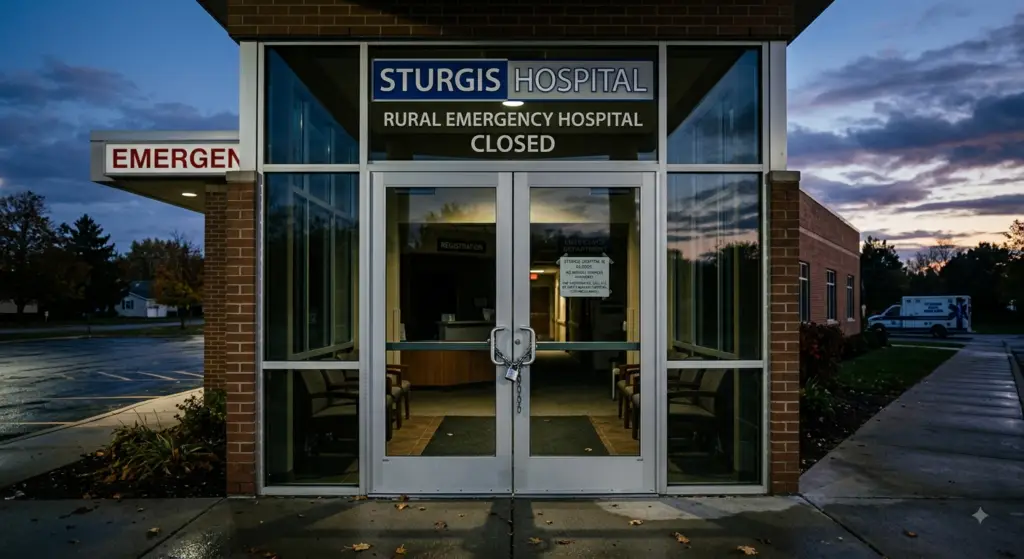
On June 16, staff at Sturgis Hospital were called into a room and told the hospital would close in roughly seventy hours. By Friday, June 19, it had — emergency department, surgery, imaging, laboratory, physical therapy, all at once, after more than a hundred years of continuous operation in this corner of southwest Michigan.
What changed that Friday can be stated in two numbers. Before, an ambulance carrying a patient in crisis traveled about two miles to reach a hospital bed. Now the same trip runs closer to twenty-five. For a patient whose situation fits the blunt arithmetic doctors use for a heart attack — where minutes of delay measurably change the odds — that difference is not an inconvenience. It is, roughly, the gap between a ten-minute wait and a thirty-minute one, and no amount of skill in the back of an ambulance fully closes it.
“It’s unusual to walk down the hall and not recognize somebody,” said Beth Kelley, a nurse who had worked at Sturgis Hospital for thirty-two years, describing what the place had been before it wasn’t. The town’s public safety director later put the operational cost more plainly: a transport that once took a few minutes now ties up an ambulance and its crew for the better part of an hour, one call at a time.
What the Program Was Built to Do
Sturgis Hospital did not close for lack of trying, and it did not close in a policy vacuum. In 2023, it became one of the first hospitals in the country to convert into a new federal model — the Rural Emergency Hospital designation — built specifically to keep facilities like it alive by trading full inpatient care for guaranteed federal support and a narrower, emergency-focused mission.
For a while, the trade held. Then, according to state-level data, use of the hospital’s own emergency department began to fall — down roughly thirteen percent over the two years after conversion — even as its underlying costs kept climbing. Why emergency-department use fell is not something any of the available reporting settles. It may be that patients needing more than emergency stabilization began driving straight to hospitals that could admit them. It may be simple population decline, or a wider erosion of trust in the model itself. The honest answer is that no one has published the data to say which.
What is clearer is that Sturgis is not the common case. Of the fifty-six hospitals nationwide that have converted to this model, researchers at the University of North Carolina’s Sheps Center count two full closures — Sturgis among them. Most conversions have held. That makes this less a story about a failed program and more a story about what happens at the edge of a program that mostly works.
It would be simpler, and less accurate, to call this a policy that failed. The Rural Emergency Hospital model was never built to guarantee that every small-town hospital would survive; it was built to preserve access to emergency care in places too small to sustain a full hospital on patient volume alone — a narrower and more honest goal than “saving hospitals,” and one Sturgis’s own numbers suggest the surrounding region may, in some technical sense, still be meeting, just three counties away instead of two miles down the road.
That distinction matters more than it sounds. A program can function almost exactly as its designers intended and still leave one particular town without what it needs. The harder question here isn’t whether anyone broke a rule. It’s whether any rule was ever written to protect a town this size specifically — and if not, whose responsibility that protection was supposed to be.
An Older American Arrangement
Rural America has faced a version of this problem before, though the institution wearing it changes with the century.
In the nineteenth-century mill town, the rhythm of daily life ran on the mill’s clock — the whistle that opened and closed each shift, the company store, the row houses built close enough to walk to work in ten minutes. A single employer built the clinic in that same rhythm and paid the company doctor, not from civic obligation but because a workforce that could not be treated could not be worked. When the mill closed, the doctor usually left within a season, and the town discovered that its medical care had never really been its own. It had belonged to whoever found it profitable to provide.
The twentieth century replaced the mill owner with the hospital itself, funded less by any single employer’s ledger and more by a shifting mix of Medicare, Medicaid, and private insurance reimbursement. The institution changed. The dependency didn’t: a town of roughly eleven thousand people — enough to form a genuine community, but rarely enough on its own to sustain every institution that community needs — remained one funding formula away from losing whatever kept it whole.
Call it the structural thesis underneath this whole story: infrastructure that depends on someone else’s balance sheet disappears exactly when the balance sheet says it should, regardless of who still needs it. Sturgis Hospital’s balance sheet said so in June. Nobody had to intend the outcome for it to happen anyway.
What a Number Does Not Say
The Sheps Center has tracked 154 rural hospital closures and conversions since 2010 — eighty-six of them complete closures, the rest converted into leaner models like the one Sturgis briefly held.1 So far, Sturgis is the only complete rural closure the center has logged for all of 2026.
A closure count like that tells you how many doors disappeared. It does not tell you how many miles were added to an ambulance run, how many longtime employees spent their last shift updating résumés instead of charts, or how many families quietly began treating distance itself as a reason not to seek care at all. The number is real. It is also the smallest part of what actually happened here.
It is tempting, looking at a chain of decisions this defensible — a hospital that converted in good faith, a program that mostly does what it was designed to do, a board that pursued every buyer it could find — to conclude that no one is responsible for what the town lost. That conclusion moves too fast. Closure is not automatically abandonment. But abandonment can happen anyway, assembled quietly out of a series of individually reasonable choices, none of which anyone involved would call cruel.
What doesn’t disappear, in any of this, is the cost. It only moves — onto ambulance crews now off the road longer per call, onto families driving farther for follow-up visits they might otherwise have kept close to home, onto the three hospitals now absorbing patients they didn’t budget for. A market can explain, convincingly, why a single hospital in a single town stopped being financially sustainable. It cannot, by itself, answer the separate question of whether a community should be left without one.
The Shepherds Who Fed Themselves
This is not only a claim for readers who already share its assumptions. Long before it was a devotional text, this passage functioned as one of the oldest surviving arguments that power obligates the powerful — a claim later echoed, in different vocabularies, across most serious traditions of Western ethical thought. It is worth reading on its own terms first.
Ezekiel 34 opens as a rebuke, but not of the flock. It is aimed at the shepherds — those who held the authority to feed, strengthen, heal, and bind up, and who used that authority on themselves instead, while the weak went unstrengthened, the sick unhealed, the injured unbound, until the flock scattered for lack of anyone watching where it went.
The passage is not really a manual on pastoral technique. Its deeper claim is that authority creates responsibility as a structural fact, not a moral preference — that the same power which lets a shepherd feed a flock is the power that lets him starve it instead, and that the text holds him to account for which one he chose, regardless of his stated intentions. Nothing here requires that any single administrator, regulator, or hospital board be read as one of Ezekiel’s negligent shepherds. The passage is less useful as a finger pointed at a person than as a lens turned on a system — one that asks not who is guilty, but what a community owes the people it cannot reach through its ordinary mechanisms for distributing care.
Proverbs 3:27 narrows the same idea to something closer to a rule of thumb: withhold no good from those to whom it is due, when it is in your power to act. Read carelessly, that verse turns capacity into an unlimited debt, as if having power to help even a little obligates a person or an institution to solve everything. Read more carefully, it says something smaller and truer: capacity does not make anyone omnipotent, but it does make indifference considerably harder to defend. Nobody in this story had the power to make Sturgis’s patient volume larger, or its reimbursement keep pace with its costs. Someone, somewhere in the chain — hospital, state, federal program — likely still had more room to act than got used before the doors closed.
Luke’s account of the man beaten and left on the road to Jericho is often read as a story about two men who deliberately turned away. The text itself is quieter than that. Luke doesn’t explain the priest’s or the Levite’s reasoning; he only records that they passed on the far side, and that a Samaritan — a man under no institutional obligation at all — stopped instead.
What the parable actually rewards isn’t the absence of a good excuse. It’s the presence of someone who stopped without needing one.
Twenty-Five Miles, Not Two
Nothing here answers whether Sturgis Hospital could have stayed open under different terms, or whether some other town, years from now, will be spared this same math. Rural hospitals close for reasons that are frequently real: too few paying patients, staffing that’s hard to recruit and harder to keep, fixed costs that don’t shrink just because a county’s population did. None of that is in serious dispute.
What the closure doesn’t explain is simpler, and it sits underneath everything that is in dispute. It doesn’t tell us whose job it was to keep this particular gap from opening. It doesn’t tell us why a program that works for fifty-four of fifty-six hospitals still let this one town’s access shrink by twenty-three miles. And it doesn’t tell us why that outcome should be treated as final rather than as one data point in a longer argument about what small-town America is owed.
Sturgis was not owed an impossible rescue. It was owed the ordinary, unglamorous kind of faithfulness that keeps vulnerable people from quietly becoming invisible to the systems meant to notice them — the kind that has nothing to do with miracles and everything to do with someone continuing to show up long after showing up stops being efficient.
The building on the old site is still standing, dark now on a street that otherwise looks the way it did in May. The ambulance still runs. It just runs twenty-five miles now, where it used to run two — carrying, on every call, the same question this passage has been asking long before anyone thought to measure the distance in miles: not whether help exists somewhere in the system, but whether it still reaches the people who can no longer reach it themselves.
1 Cecil G. Sheps Center for Health Services Research, University of North Carolina at Chapel Hill, rural hospital closure and conversion tracking data, cited in KFF Health News and Healthcare Finance News, Aug. 2026.
2 ER volume and conversion figures: KFF Health News, “Earlier Lifeline for Rural Hospitals Faces Test Under ‘Big Beautiful’ Law,” Aug. 3, 2026; Michigan Health & Hospital Association.
3 Distances to alternate facilities and closure timeline: Healthcare Finance News; Bridge Michigan; CBS Detroit, July–Aug. 2026.
New essays every week. Delivered quietly.