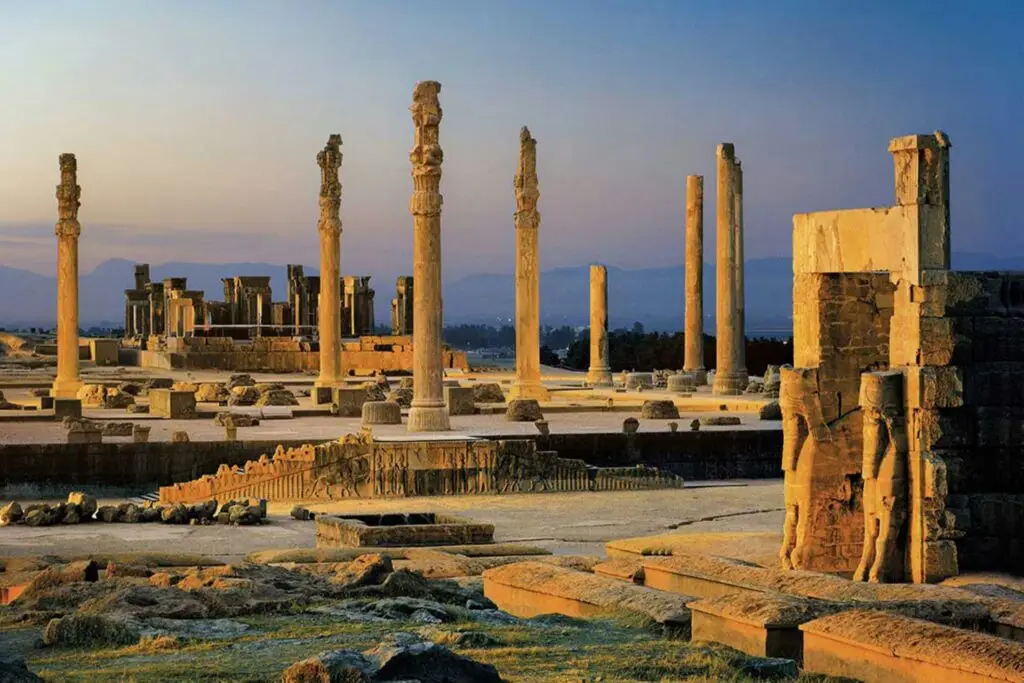
From the ruins of the Iran-Iraq War to the shadow of nuclear confrontation — ancient history and present tensions echo with unsettling continuity. What might biblical prophecy, and Ezekiel 38 in particular, suggest about Iran’s place in the unfolding drama of the Middle East?
Interpretive Essay | Updated: 2026 | SEO Keywords: Iran war Bible prophecy, Ezekiel 38 modern Iran, Persia in scripture, biblical interpretation Middle East
· INTRODUCTION ·
Iran, Biblical Prophecy, and a Nation That Has Known No Rest
Few nations in the modern world have been drawn into sustained, overlapping armed conflicts with the frequency and ferocity of Iran. The biblical interpretation of Iran’s wars — and its recurring role in Middle East conflict — has occupied theologians, historians, and attentive readers of Scripture for decades. From the eight-year catastrophe of the Iran-Iraq War (1980–1988), which claimed over one million lives on both sides (United Nations, Report of the UN Secretary-General on the Iran-Iraq War, 1988), to the Anglo-Soviet occupation of 1941, to clandestine warfare with Israel, and now to heightened tensions with the United States, including direct military incidents reported since 2025 — Iran, historically known as Persia, occupies a uniquely turbulent position at the intersection of ancient prophecy and contemporary geopolitics.
For the student of Scripture, this pattern may not appear entirely coincidental. The biblical record speaks of Persia not as a peripheral nation but as a central actor in the drama of redemption and judgment. One who reads these conflicts with both a historian’s rigor and a theologian’s attentiveness may find it difficult to dismiss the resonances between ancient text and modern event — though wisdom demands that such resonances be held with interpretive humility rather than dogmatic certainty.
· HISTORICAL SUFFERING ·
The Iran-Iraq War: A Modern Echo of Ancient Carnage
The Iran-Iraq War stands as one of the most catastrophic conflicts of the twentieth century. Triggered in part by Saddam Hussein’s anxieties over the Iranian Revolution’s potential to inflame Shia populations across the region, and further entangled in the centuries-old dispute over the Shatt al-Arab waterway, the war devolved into a grinding stalemate reminiscent of the Western Front in the First World War (Hiro, Dilip, The Longest War: The Iran-Iraq Military Conflict, Routledge, 1991). The use of chemical weapons — including sarin, tabun, and mustard gas — by Iraqi forces against both Iranian troops and Kurdish civilians, most infamously in the Halabja massacre of March 1988, in which approximately 5,000 civilians perished within minutes (Human Rights Watch, Genocide in Iraq: The Anfal Campaign Against the Kurds, 1993), placed this conflict among the gravest humanitarian atrocities of the modern era.
“Nation will rise against nation, and kingdom against kingdom. There will be famines and earthquakes in various places. All these are the beginning of birth pains.”
— Matthew 24:7–8 (NIV)
Whether one regards these words as eschatological forecast or as a timeless observation about human nature and political ambition, the texture of the Iran-Iraq War can be seen as reflecting what the New Testament describes as the “beginning of birth pains.” The image of ten-year-old boys — Iranian child soldiers given plastic “keys to paradise” and sent across minefields in human-wave assaults (Wright, Robin, In the Name of God: The Khomeini Decade, Simon & Schuster, 1989) — calls to mind not merely the violence of war but something deeper: a profound moral rupture within human society. The prophet Ezekiel, writing in a context saturated with violence and imperial ambition, lamented not merely physical destruction but the spiritual conditions that make such destruction possible (Ezekiel 7:23).
· PROPHETIC RESONANCE ·
Ezekiel 38, Persia, and the Biblical Imagination
The biblical relationship with Persia is neither simple nor uniformly adversarial. Cyrus the Great, founder of the Achaemenid Empire, is named explicitly in Isaiah as the Lord’s “anointed” (Isaiah 45:1, ESV) — a startling designation applied to a pagan king — and was credited with issuing the decree that permitted Jewish exiles to return to their homeland (Ezra 1:1-4). This historical memory establishes Persia in the biblical imagination as a nation capable of both profound cruelty and unexpected redemptive agency.
“See, I will stir up the Medes against them, who do not care for silver and have no delight in gold.”
— Isaiah 13:17 (NIV) — referring to the fall of Babylon at the hands of the Medo-Persian alliance
More pertinent to the contemporary moment, the prophecy in Ezekiel 38-39, commonly known as the “Gog and Magog” passage, names “Persia” (Hebrew: Paras) explicitly as one of the nations aligned in a future coalition against the land of Israel (Ezekiel 38:5). Biblical scholars differ widely on the interpretation of this text — whether it describes a literal future military conflict, a symbolic representation of recurring patterns of hostility, or an already-fulfilled historical event. Respected academic commentaries, such as Daniel I. Block’s magisterial treatment in the New International Commentary on the Old Testament (The Book of Ezekiel, Chapters 25–48, Eerdmans, 1998), caution against over-literalized readings while nonetheless affirming the text’s seriousness as a theological statement about divine sovereignty over the nations.
What is difficult to ignore, however, is that modern Iran — ancient Persia — is presently engaged in sustained, multi-front hostility with Israel, through proxy forces including Hezbollah in Lebanon, Hamas in Gaza, and the Houthi movement in Yemen (International Crisis Group, Iran’s Proxies: A Network in Motion, 2024). The question of whether this constitutes a meaningful correspondence with Ezekiel 38 is one that the text itself does not resolve — and that intellectual honesty does not allow us to resolve prematurely.
· SHADOW WARS & DIRECT CONFLICT ·
From the Shadow War to Open Confrontation: Iran and the Biblical Interpretation of Middle East Conflict
For decades, the conflict between Iran and Israel operated in the shadows — a war of assassinated nuclear scientists, sabotaged centrifuges, and proxy militias. The dramatic escalation of April 2024, when Iran launched an unprecedented direct missile and drone barrage against Israeli territory (BBC News, Iran attacks Israel: What we know about the strikes, April 14, 2024), signaled a qualitative shift. What once seemed theoretical now appears increasingly plausible: that the region is moving toward a confrontation whose scale and character may exceed what any single geopolitical framework — whether diplomatic, strategic, or theological — can adequately contain.
The prophet Jeremiah, writing in another era of cascading geopolitical crisis, offered an image that resonates uncomfortably with the present:
“A sword upon the Chaldeans, declares the Lord… a sword upon all the foreign troops in her midst”
— Jeremiah 50:35–37 (ESV)
Whether or not one believes such ancient words possess specific predictive content regarding twenty-first-century events, the interpretive framework they offer — of divine sovereignty operating through the chaotic movements of nations — remains a structuring lens for many communities of faith as they watch events unfold across the Middle East.
“For nation will rise against nation, and there will be wars and rumors of wars… but the end is not yet.”
— Mark 13:7–8 (ESV)
· OPEN CONCLUSION ·
Reading the Present with Ancient Eyes — Without Claiming Too Much
It would be intellectually dishonest to claim that the conflicts surrounding Iran conclusively fulfill any specific biblical prophecy. The history of such interpretive overreach is long and cautionary: each generation has found in its own geopolitical crises what it believed to be the final convergence of prophetic themes. What can be said with more integrity is this: the pattern of events — a nation bearing the ancient name of Persia, situated at the strategic heart of the Middle East, engaged in existential conflict with Israel and embroiled in confrontation with the Western powers — is, at the very least, the kind of pattern that the prophetic literature imagined and that the New Testament writers believed would characterize the period leading toward history’s culmination.
Whether those patterns are approaching their denouement, or whether they represent one more iteration of the recurring cycles of empire and resistance that have characterized human history since Cain raised his hand against Abel (Genesis 4:8), remains an open question. It is a question that honest theology does not rush to resolve — and perhaps that very openness, that refusal to foreclose the mystery, is itself a form of faithfulness to the complexity of both Scripture and history.
As war continues to reshape the Middle East in 2026, the ancient question endures: Is history moving toward something, or simply moving? The prophets believed the former. Whether we are now witnesses to the fulfillment they described — echoing, in unexpected ways, the scrolls of yesterday — remains, as it perhaps must, an open horizon.
Tags: Iran war Bible prophecy · Ezekiel 38 modern Iran · Persia in scripture · biblical interpretation Middle East · Iran-Iraq War history · Iran Israel conflict prophecy · Middle East conflict biblical · biblical geopolitics 2026