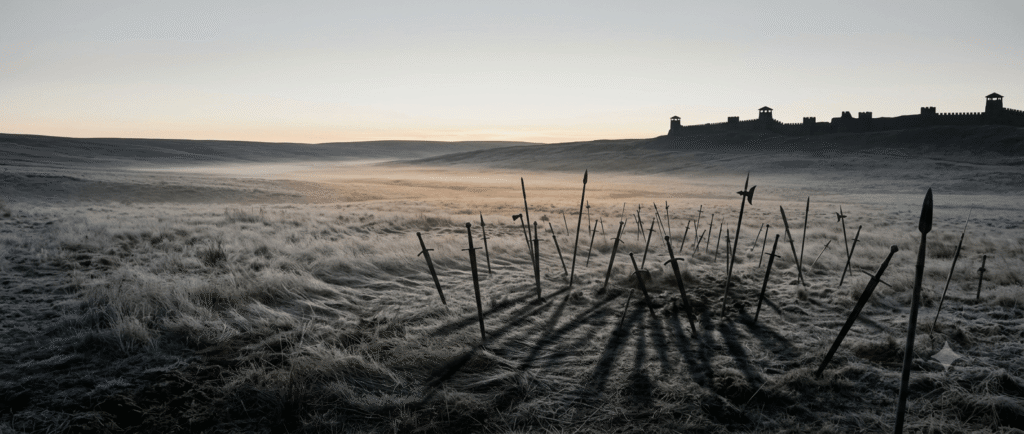
A Ring No One Inside Can Verify
On September 4, 2026, reports from the war in northeastern Ukraine produced the kind of claim that modern warfare makes almost impossible to verify in real time: a large Russian encirclement, thousands of soldiers reportedly cut off, and competing accounts within hours over whether the ring had actually closed. Ukraine’s own command disputed it before the day was out. Armies change their instruments every generation, but this particular vertigo — a claim nobody trapped inside the ring can verify, a fate depending entirely on someone else’s word — repeats with almost no variation.
Encircled is a word soldiers hear long before they understand what it will ask of them. It doesn’t mean surrounded and finished. It means surrounded and still deciding — whether to run, whether to dig in, whether to trust whatever terms the other side is offering, if any terms are offered at all. Twenty-two centuries before Kharkiv, on a stretch of high ground in what is now China’s Shanxi province, a Zhao army made that decision inside a single valley, and the ground there still has not finished telling the story.
The Decision Made in a Palace
In the summer of 260 BC, the state of Zhao held a defensive line at Changping against the armies of Qin. The general in command, Lian Po, had chosen the only strategy that made sense against a larger, hungrier enemy: wait. Fortify the ridgelines, ration the grain, let Qin’s supply lines stretch thin over months of siege. It was not a glamorous plan. It was, by most modern military judgment, the correct one.
It did not survive contact with politics.
Qin’s chancellor, Fan Ju, ran the counter-operation personally — gold for informants inside the Zhao court, a rumor sized precisely to the king’s growing impatience: that Lian Po was a coward, and that the general Qin actually feared was a young officer named Zhao Kuo, a gifted student of military theory whose own father had once said, privately, that his son could recite strategy but had never had to bury a man because of it. The King of Zhao, tired of a siege with no end date, replaced his general. Zhao Kuo’s own mother petitioned the court against the appointment, on record, warning that her son mistook books for battlefields. She was overruled.
He was not simply arrogant. He was the answer to a throne’s impatience — handed a war his own mother had begged the king not to give him, inheriting an army that trusted him only because the court had told it to. What he could not see was that the moment his appointment was announced, Qin had quietly replaced its own commander with Bai Qi, the one general in the empire actually built to exploit a young man’s confidence. Zhao Kuo turned his strategy from defense to attack, exactly as Qin had gambled he would. His forces advanced into open ground. Qin cut the supply road behind them.
For forty-six days, encircled and starving, the Zhao army held. When Zhao Kuo finally led a breakout charge, he was killed, and his leaderless troops did the only thing left to men without food, without a commander, and without a way out: they laid down their weapons and surrendered, on the understanding — the promise, more or less — that surrender meant survival.
Bai Qi accepted that surrender. Then, according to the fullest surviving account, written by the historian Sima Qian roughly a century later, he judged the captured men too numerous and too dangerous to hold or feed, and ordered all but the youngest killed where they had laid down their arms.1 The written tradition puts the number of the dead at roughly four hundred thousand — a figure ancient armies had every political incentive to inflate, and modern historians treat with real caution.3 What excavations near Yonglu village have confirmed since 1995 is narrower and, in its way, more certain: organized, violent death at scale, in exactly this valley.2
The decision that ended those lives was never made by any of the men who died. It was made in a palace, by a king tired of waiting, weeks before those men ever knew their general’s name.
The Valley at Ai
Scripture records a smaller version of the same structure, and it does not soften it.
After the fall of Jericho, Israel marched on the small city of Ai expecting an easy victory. Instead:
“So there went up thither of the people about three thousand men: and they fled before the men of Ai. And the men of Ai smote of them about thirty and six men… wherefore the hearts of the people melted, and became as water.” (Joshua 7:4–5, KJV)
The army did not know, as it marched, that the defeat had already been decided — not on the field, but earlier, in a tent, where a man named Achan had quietly kept spoils that belonged to God alone. The text is blunt about where responsibility lands:
“Israel hath sinned… for they have even taken of the accursed thing, and have also stolen, and dissembled also, and they have put it even among their own stuff.” (Joshua 7:11, KJV)
The soldiers at Ai were exposed to the consequences of a choice most of them had neither made nor known about. Changping’s failure moved from the top down — a throne’s impatience, passed along until it reached men who never got a vote. Ai’s failure moved from the bottom up — one man’s hidden greed, rising until it reached everyone who trusted the camp around him. The direction reverses. The outcome does not: in both valleys, people with no relevant choice absorbed the whole of the consequence.
Scripture is strangely uninterested in letting individuals opt out of a community’s exposure to its own hidden failures. That is not a comfortable doctrine. It is, however, a consistent one.
The People Who Pay
The people who pay for a decision are often not the people who made it. Ai shows the shape of that pattern in miniature. Changping shows it at scale — and shows, too, what happens when the cost isn’t only defeat, but a second betrayal layered on top of the first.
That second betrayal is worth separating out. A field death, in battle, against an armed enemy, is one category of loss. A death administered afterward, to men who had already put their weapons down and were waiting on someone else’s word, is a different category entirely — one built not on force but on broken trust deployed as strategy. Trust, looked at closely enough, turns out to be a wager almost no one examines until after it is lost — placed not really in a person, but in the fiction that power, once it has secured what it wanted, has no further use for cruelty.
The soldiers who surrendered at Changping did the only rational thing available to starving, leaderless men: they gambled on mercy because mercy was the only offer on the table. It is easy, from a safe distance, to call that decision weak. It is harder to name what else tens of thousands of encircled men without food or a living commander were supposed to do differently.
A rumor in a palace. A claim in a ministry statement. A supply line cut somewhere upstream from the people who depend on it. Different centuries, different technologies, the same moral geometry.
What the Ground Remembers
The Line That Held, the title of this space’s ongoing series on war and the human scale inside it, is a promise this particular essay cannot quite keep. At Changping, the line did not hold. It broke, exactly as Fan Ju had gambled it would, months before a single arrow was loosed.
Two days ago, this space traced what it looks like when people deliberately choose to turn away from violence — a choice made in daylight, with options still on the table.† Changping asks the colder version of that same question: what a surrender is worth when it is not a moral stance but the last card left in a losing hand, and what happens to the people who trusted that card would still be honored.
1. Sima Qian, Records of the Grand Historian (Shiji), compiled c. 91 BC.
2. Shanxi Provincial Institute of Archaeology, Yonglu Village excavation, Gaoping, Shanxi, 1995.
3. Modern historians treat Sima Qian’s casualty figures, recorded over a century after the event, as an order of magnitude rather than an exact count.
† Previous installment: watchmaninsight.com/turning-from-violence-bible
New essays every week. Delivered quietly.