Hook
The Warning That Arrived on Time
The leaked document was dated July 29 — one day before more than eighty thousand people crossed into the Spanish enclave of Ceuta from Morocco. It warned, reportedly, of an “extreme risk” of a coordinated arrival (Euronews, 2026). That much appears in the reporting as a claim, not a settled fact; Madrid disputes the document’s implications, and Prime Minister Pedro Sánchez has pointed instead to smuggling networks and, he alleges, foreign disinformation. Opposition leader Alberto Núñez Feijóo has said plainly that the government “knew it — and covered it up” (Euronews, 2026).
Whichever account eventually holds up, the dispute itself points somewhere useful. A system — a government, a household, doesn’t much matter which — reveals itself less in whether a warning arrives than in what it does with the warning once it has. Ceuta is simply the version of that question currently in the news. David’s household ran the same question three thousand years earlier, at a much smaller table.
In the previous installment, we examined David and Bathsheba — a private failure managed rather than confessed. What follows is what happens to that same failure one generation later, inside the same house.
Historical Case
A Different Century, the Same Room
Eight centuries before Ceuta, Henry II of England met a smaller version of the same problem inside his own family: a crown given in name, with none of the authority behind it. The historian W.L. Warren, in his standard biography of the king, describes a court that let that imbalance sit for years rather than resolve it.1 It hardened. By 1173, three of his sons had risen against him, in a revolt that pulled in the kings of France and Scotland.
It wasn’t sudden. It rarely is.
Biblical Lens
What the Text Refuses to Resolve
The first wound in this story was not Absalom’s.
It belonged to his sister Tamar, assaulted by their half-brother Amnon. David heard of it and, the text says, was very angry. Nothing else is recorded — no trial, no consequence, no word spoken to the son who did it or the daughter it was done to. Into that silence, Absalom built one of his own:
“And Absalom spake unto his brother Amnon neither good nor bad: for Absalom hated Amnon, because he had forced his sister Tamar.” (2 Samuel 13:22)
Two years pass inside that sentence. Then Absalom has Amnon killed, and flees the country his father rules.
Years later, after a long exile, father and son are finally brought face to face — not by David’s initiative, but by an intermediary’s arrangement. What happens next is worth watching slowly, because the text gives it to us as a sequence of small, physical acts:
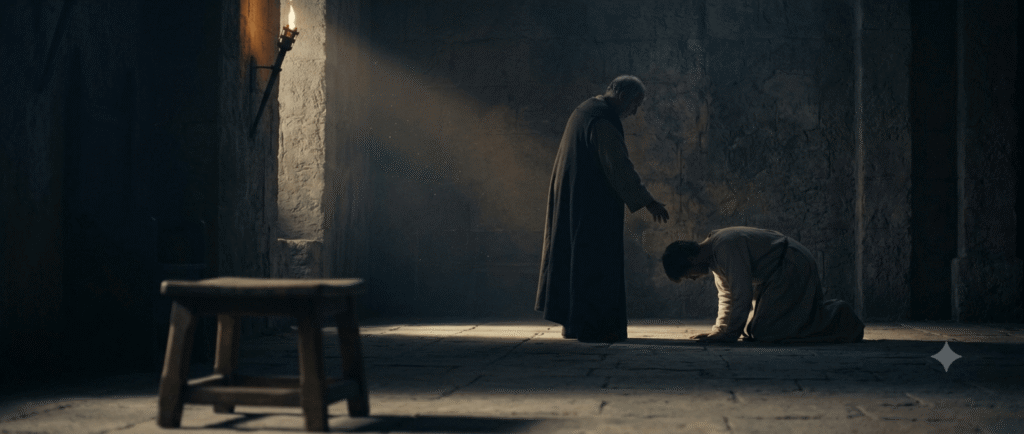
“So Joab came to the king, and told him: and when he had called for Absalom, he came to the king, and bowed himself on his face to the ground before the king: and the king kissed Absalom.” (2 Samuel 14:33)
Absalom bows. David receives him. David kisses him. And Tamar’s name is spoken by no one in the room. Amnon’s death goes unaddressed. The exile is never explained. Nothing about what happened, or why, is settled between them — only performed.
Read that verse beside the one that follows a chapter later:
“And on this manner did Absalom to all Israel that came to the king for judgment: so Absalom stole the hearts of the men of Israel.” (2 Samuel 15:6)
A kiss received. Hearts stolen. The reconciliation was visible. The reckoning was not — and it is in exactly that gap that Absalom starts building something his father never saw coming, because his father had stopped looking for it the moment the ceremony ended.
Pattern Insight
The Arithmetic of Silence
Absalom’s household is ancient. The mechanism inside it is not.
In the first large national survey of its kind, the Cornell sociologist Karl Pillemer found that twenty-seven percent of American adults report having cut off contact with a family member — an estimated sixty-seven million people (Pillemer, 2020). We’ve looked at this pattern before from a different angle; what’s worth adding here is what Pillemer’s research team has since described as a recurring shape behind that number — an early incident quietly managed rather than resolved, resurfacing years later as something far larger and far less negotiable.
A palace in Jerusalem and a living room in Ohio are not the same scale. But they run the same arithmetic.
A wound that is never named does not disappear. It relocates — into a holiday table, an inheritance, a succession, and, when the household in question happens to govern something larger than itself, a kingdom.
Closing
What a House Decides to Carry
The coup did not begin when Absalom declared himself king in Hebron. It began earlier, in a reconciliation that looked complete.
That distinction is where the category this essay sits under — Family & Forgiveness — earns its second word, not just its first. Forgiveness is not the same transaction as forgetting. Reconciliation is not the restoration of appearances. And peace, in David’s house as in most others, is not the same condition as healing; it can simply be the name given to a silence both sides have agreed to keep.
The theologian Dietrich Bonhoeffer had a phrase for a related counterfeit — “cheap grace,” forgiveness extended without the cost of repentance or truth attached to it. David’s kiss was not cheap in the sense of being easy; exile, grief, and years of estrangement had preceded it. But it was cheap in Bonhoeffer’s deeper sense: a grace granted without an accounting of what it was covering. Common grace can hold a family or a nation together for a long time. It cannot, by itself, do the work that only truth-telling does.
The harder Christian question underneath Absalom’s story is not whether David should have punished someone. It is what forgiveness actually requires us to do with the truth — whether a wrong can be released without first being named, or whether release without naming is just another kind of cover. Scripture does not hand us a clean answer here so much as a long, unfinished argument about it, one this text belongs to rather than concludes.
A kiss can reopen a door. On its own, it has never once told the truth about what happened in the room behind it.
1. W.L. Warren, Henry II (Berkeley: University of California Press, 1973), on the succession arrangements preceding the 1173–74 revolt.
New essays every week. Delivered quietly.