THE WATCHTOWER FILES
A soda nobody had to buy
I keep returning to one detail that never makes it into the headlines.
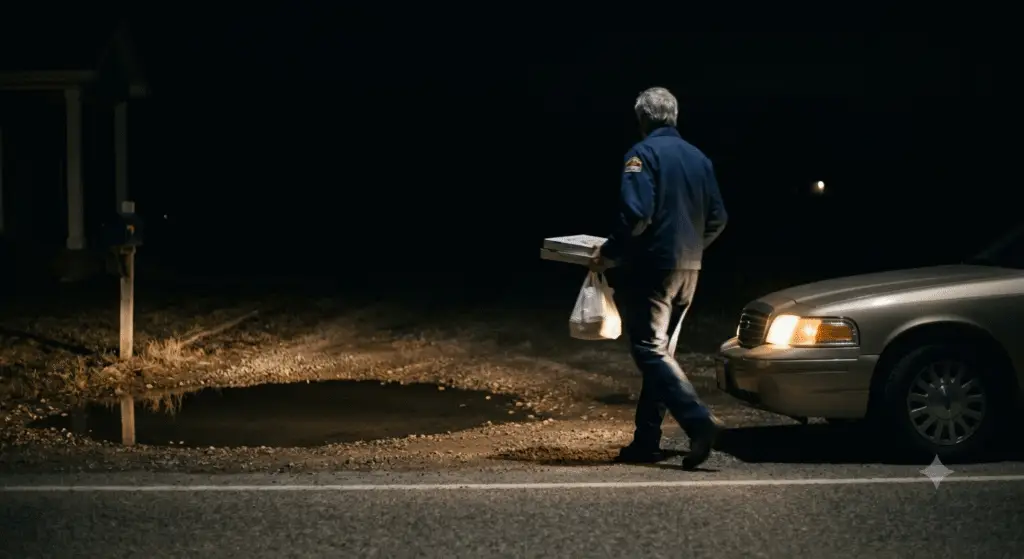
It isn’t the doorbell footage, and it isn’t the number that eventually appeared on a fundraising page — a number large enough to retire on. It’s this: by the time the Diet Coke ran out, Dan Simpson had already done his job. Sixty-eight years old, fourteen years into a part-time delivery route he’d kept up alongside his full-time work as a seed analyst, a few weeks from his last shift — by any reasonable measure, his responsibility ended when the restaurant told him they were out of stock (Wilson, 2026). Nobody was filming the parking lot. Nobody would have known if he’d simply apologized at the door and driven on.
He turned the car around anyway. Drove across the street to a different store. Paid for the soda himself. Delivered it to Brian and Katey Wilson, a Boise couple who are both visually impaired and depend on delivery drivers for the kind of after-dark errand most of us don’t think twice about (Wilson, 2026). It cost him maybe three minutes. He mentioned neither the minutes nor the money. When Wilson tried to hand him extra cash at the door, Simpson waved it off — the tip he’d already gotten, he said, was plenty (Simpson, 2026). Asked about it afterward, he still couldn’t quite explain why he’d bothered; it wasn’t a decision he remembered making so much as something he’d apparently already decided, years earlier, without noticing.
The Wilsons’ doorbell camera happened to catch the exchange. It exists for an ordinary reason: because both of them are visually impaired, a camera at the door does something for them their own eyes can’t — it lets them know who’s outside before they have to guess. The device installed to compensate for what a couple couldn’t see ended up showing several million strangers something the rest of us also don’t usually see. They posted it, not expecting much. It found an audience within days, and people who would never meet Simpson raised well over a hundred thousand dollars toward his retirement (Hawkinson, 2026).
That’s the part everyone shares — the part with a number in it, a redemption arc in it. But it’s worth asking a harder question underneath the warm one: the internet didn’t find Dan Simpson because he was unusually kind. It found him because, for once, an ordinary kindness happened to be visible. Fourteen years is not a figure of speech. It’s thousands of individual deliveries, most of them unremarkable, completed by a man who drove pizzas at night because the extra income mattered in the plain way it matters to a great many people past sixty — nearly one in five Americans over 65 are still in the labor force, part-time or full (LendingTree/U.S. Census Bureau, 2026). What the camera caught was one night. What it missed was the several thousand that came before it — not hidden, exactly, just never observed. That distinction is going to matter more than it sounds like it should.
THE WATCHTOWER FILES
What a country chooses to remember
There’s a chapter of American military history that gets a paragraph in most textbooks, if it gets anything: the summer of 1944, when the Allied advance across France was in danger of stalling for the dumbest possible reason — not a shortage of soldiers or resolve, but a shortage of trucks moving fast enough to keep the front supplied.
The Army’s answer was the Red Ball Express — a continuous, round-the-clock convoy of nearly 6,000 cargo trucks running a loop from the Normandy beachhead to the front, drivers rotating through shifts that left almost no room for sleep (National WWII Museum, 2021). Over roughly eleven weeks that fall, some 23,000 American truck drivers and loaders — about seventy percent of them Black soldiers — moved more than 400,000 tons of ammunition, fuel, and rations to the men advancing toward Germany (Delmont, 2024). They were assigned to supply and transport almost exclusively; the segregated Army of that era generally doubted Black soldiers were fit for combat, and it was that same doubt, born of Jim Crow rather than of strategy, that placed them in the one role without which the advance those commanders were so proud of could not have moved at all. Historians describe the broader shape of the U.S. Army in that war in similar terms: only about a fifth of American personnel were classified as front-line combat troops; the rest kept them fed, armed, and moving (McGrath, 2007).
None of it was heroic in the way a war film usually means the word. It was repetitive, exhausting, mechanically monotonous — performed by men most of the country would never learn the names of. Colonel John D. Eisenhower, the supreme commander’s own son, said flatly that his father-in-law’s celebrated dash across France simply couldn’t have happened without them (Delmont, 2024). One armored division commander, describing the drivers under fire, put it more bluntly still: “Damned if I’d want their job” (Smithsonian Magazine, 2022).
It would be tidy to say the monuments went up for the generals instead. The truer version is quieter and stranger: American memory has generally found it easier to preserve command than maintenance — the order rather than the delivery that made the order possible. And there’s a harder edge underneath that. A country can depend, structurally and completely, on people it has otherwise decided not to fully see. That was true of the Red Ball’s drivers in 1944, assigned to the work precisely because no one thought to look at them for anything else. It’s a milder, everyday version of the same arrangement every time a delivery driver, a night-shift aide, or a warehouse picker keeps something running that the rest of us only notice when it stops.
THE WATCHTOWER FILES
What the parable calls small
There’s a definition worth pausing on before going further, because the word doing the real work in this essay isn’t kindness — it’s faithfulness, and the two aren’t quite the same thing. Kindness is a single act. Faithfulness is what happens when nobody is around to notice whether the act repeats. It’s the unseen accumulation of ordinary, unwitnessed choices into something that eventually has a shape — a shape nobody, including the person living it, can usually see from the inside.
“He that is faithful in that which is least is faithful also in much: and he that is unjust in the least is unjust also in much.” (Luke 16:10, KJV)
What if the “little” in that verse isn’t a category of minor virtue at all — what if it’s precisely the category of thing we’ve already decided is too small to count? The parable doesn’t ask what a person did with the large, visible things. It asks what they did with the amount nobody was going to check.
“His lord said unto him, Well done, thou good and faithful servant: thou hast been faithful over a few things, I will make thee ruler over many things.” (Matthew 25:21, KJV)
It would be easy to fold this into a familiar script — be faithful in secret, and secret rewards eventually surface, as though Simpson’s ledger came due because it had been earned and was now owed. That’s not quite what either verse claims, and the difference matters. The commendation in both isn’t for scale, and it isn’t a transaction. It’s a description of what a person already was in the years no one was grading — faithfulness as a mode of being rather than a performance staged for an eventual audience. Read that way, the two verses reverse the order most retellings of a story like Simpson’s default to. We tend to treat the viral night as the test — the moment his character was finally revealed. Scripture, read on its own terms, says the opposite: the unwitnessed years were the actual test, and the visible night afterward was only ever a report on a decision already made.
THE WATCHTOWER FILES
The economy of being noticed
There’s a strange asymmetry in how people estimate the value of their own small acts of generosity, and researchers have measured it directly rather than merely observed it anecdotally. In a series of field and laboratory experiments, psychologists Amit Kumar and Nicholas Epley found that people performing small, unprompted acts of kindness — handing a stranger a cup of hot chocolate on a cold day, giving away an unclaimed gift — consistently predicted their gesture would land as far less meaningful than recipients actually reported it felt (Kumar & Epley, 2023). The gap wasn’t small, and it wasn’t explained by surprise alone; givers, the researchers found, tend to focus on how competent their gesture was, while recipients respond mainly to the warmth behind it — two different measurements of the same act, one of which the giver is structurally bad at judging.
Simpson’s own account of the night fits the pattern almost exactly: a few minutes, a short drive, nothing he thought should have gone anywhere near a news cycle. That’s not false modesty. It’s the ordinary blind spot the research describes.
It’s the same blind spot this column has traced before in the quiet arithmetic of ordinary vocation — the sense that most working life happens well outside anyone’s spreadsheet. We live, increasingly, inside a structure that makes this blind spot worse rather than better. Likes, follower counts, engagement metrics, performance dashboards, fundraising totals — different names for the same underlying machine, one that quietly converts what can be measured into what appears to matter. A camera, in any of its modern forms, can only ever record an event. It has no lens for the thing that actually produced the event — character isn’t the kind of object a camera, a metric, or a dashboard was built to capture. None of that machinery caused Simpson’s fourteen years. It did decide, almost entirely by accident, which single night out of several thousand would ever be seen. That’s worth sitting with longer than the warm version of this story usually allows: a culture that has gotten very good at measuring visibility can start mistaking it for value, simply because visibility is the only one of the two it knows how to count.
There’s a harder question hiding underneath the parable, and it deserves to be asked plainly rather than smoothed over: what happens to the person whose faithful work is never discovered — who stays reliable for fourteen years and never gets a doorbell camera, a fundraising page, or a headline? Most of the Red Ball’s drivers never did. Most delivery drivers who go a little out of their way never will either — a question this series has sat with before in a piece on the isolation of unseen labor. If faithfulness only made sense as a strategy that eventually gets noticed and repaid, it would collapse the moment it went unnoticed for good — which is, for most people who practice it, most of the time.
THE WATCHTOWER FILES
When the camera finally looked
Simpson didn’t need the money to retroactively become a good employee — he already was one. What that night did was closer to what happens when a private ledger, kept without an audience for years, gets read aloud once, by accident. The reading doesn’t create what’s in it. It only makes visible a total that was already true.
Which is the whole point of the one detail that started this. Nothing about those fourteen years was hidden — Simpson wasn’t withholding a private virtue for some future audience he was quietly hoping for. It was simply unobserved, and the gap between those two words is the hinge this entire story swings on. Hidden implies a secret. Unobserved just means nobody happened to be looking — which describes almost everything that ever mattered before it mattered, and almost certainly describes something in the reader’s own week that no camera is ever going to catch.
Almost everything that eventually matters was built by people no one was watching at the time.
The advance across France wasn’t won by the names on the monuments alone. The kindness that finally got seen in Boise wasn’t performed for an audience; it was simply what fourteen years of unrecorded Fridays had already made ordinary, until one of them, almost by accident, got recorded. Human cameras — the literal kind, and the metric-driven kind we’ve all built our public lives around — record moments. They were never built to record character. That is a different kind of ledger, kept by different means, over a much longer stretch of unwitnessed time than any doorbell camera was ever running.
Notes:
Wilson, B. GoFundMe statement, reported via ABC News/Good Morning America, April 2026.
Hawkinson, K. “Domino’s delivery driver went viral for a kind gesture — and strangers sent him $133k in tips.” The Independent, 2026.
Simpson, D. Interview statements, KTVB/KGW/King5 local news coverage, April 2026.
National WWII Museum. “‘Keep ’em Rolling’: 82 Days on the Red Ball Express.” 2021.
Delmont, M. “The forgotten story of Black soldiers and the Red Ball Express during World War II.” The Conversation, 2024.
Smithsonian Magazine. “The Black WWII Soldiers Who Spirited Supplies to the Allied Front Line.” 2022.
McGrath, J. J. The Other End of the Spear: The Tooth-to-Tail Ratio (T3R) in Modern Military Operations. Combat Studies Institute Press, 2007.
LendingTree (U.S. Census Bureau CPS ASEC analysis). “Nearly 1 in 5 Retirement-Age Americans Are Working.” 2026.
Kumar, A., & Epley, N. “A little good goes an unexpectedly long way: Underestimating the positive impact of kindness on recipients.” Journal of Experimental Psychology: General, 152(1), 236–252, 2023.
New essays every week. Delivered quietly.