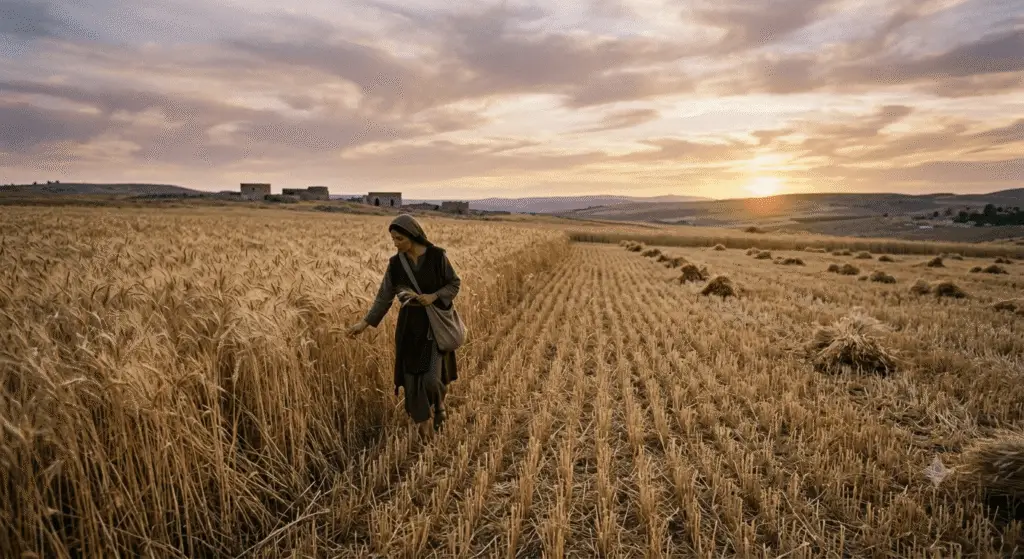
A Nutrition Center on the Edge of Mogadishu
She had walked two days from a district the drought had already emptied of most of what grew there, carrying a son too small for his age, to a nutrition center on the outskirts of Mogadishu where she hoped there would still be enough to weigh him against. On August 19, in a building not far from where she was standing, the head of the World Food Programme told a reporter that his agency now had roughly a tenth of the resources it held in 2022 — the year that same funding helped Somalia avoid a declared famine.1 Six million Somalis currently face acute food insecurity. That number was not an abstraction to her. It was the reason the line she was standing in existed at all.
One woman. One famine. One sentence, written three thousand years earlier, that begins a different story the same way: there was a famine in the land. A family from Bethlehem — a name that literally means “house of bread” — packs up and walks east, into Moab, because the house of bread has nothing left to give.
The distance between a Judean famine and a Mogadishu nutrition center is enormous. Agricultural technology, state capacity, global markets, transportation, humanitarian institutions, the entire modern architecture of what “food security” even means — none of it existed in anything like its present form when the Book of Ruth was written. What has traveled across that distance mostly unchanged is not the mechanism of scarcity. It is the moral question scarcity forces on whoever is not the one starving.
That question does not wait for famine to finish. It shows up the moment scarcity meets a decision — a budget line, a border, a landholding contract — because famine, once it moves past the soil that failed, becomes a story about what people with something do about people with nothing.
What changed for Somalia between 2022 and now was not the underlying vulnerability. Drought years have followed drought years there for most of the past decade, and the country’s dependence on rain-fed farming and pastoral herding has not shifted in that time. What changed was the resourcing behind the response — a tenth of what it had been, against a population whose need had not shrunk to match. The gap between those two lines, need and resourcing, is where the woman in the nutrition center is currently standing.
The Country That Kept Exporting Grain
The clearest modern echo of what opens the Book of Ruth is not a famine in the ancient Near East. It is the one that struck Ireland between 1845 and 1852. A blight destroyed the potato crop a large share of the rural population depended on, but the blight alone does not explain what followed. It met a tenancy system that had pushed subsistence farmers onto smaller and smaller plots, a relief policy shaped by an ideology reluctant to interfere with markets, and a landholding arrangement that kept grain, cattle, and butter moving out of the country under standing contracts even as people starved inside it.2 Roughly a million people died. A million more left, a meaningful share of them on vessels so overcrowded that they earned the name “coffin ships,” not all of whom survived the crossing.
The tenancy system deserves a moment of its own, because it is the part most easily lost in a story that reads, at a distance, as simply “the potatoes failed.” Under a landholding arrangement dominated by largely absentee landlords, subsistence farmers had been pushed generation over generation onto smaller plots, with the potato adopted precisely because it could feed a family on far less land than grain could. That dependency was already a structural vulnerability before the blight ever arrived. When it did, evictions accelerated rather than slowed — tenants unable to pay rent were removed from the land at the exact moment leaving it meant near-certain starvation — while disease, spread through crowded workhouses and coffin ships alike, killed alongside hunger rather than instead of it.2 None of that erases the blight as the triggering event. It does mean the deaths that followed cannot be blamed on potatoes alone.
What happens when a starving outsider crosses a border and the receiving society decides that scarcity has made generosity unaffordable? It is not a rhetorical question. The answer, for a large share of famine-era Irish immigrants, was several decades of exclusion before the answer changed. The Irish who survived the Atlantic did not arrive to open arms. Historians debate exactly how widespread any single posted sign really was, but the underlying pattern is not in serious dispute: employment discrimination against Irish Catholic immigrants, housing exclusion, and a durable nativist suspicion that treated famine survivors as a burden rather than a people. It took a generation, and considerable political organizing, before that stigma loosened.
Naomi’s family did not sail anywhere; Moab was close enough to reach on foot. But the underlying shape is the same — a household leaves the place that stopped feeding it and enters a country that owes it nothing, in a region with its own long history of hostility toward Israel. Ireland’s famine offers no comfortable answer to the question its migrants forced on the countries that received them. Whether Moab answered differently, three thousand years earlier, is the question the next chapter puts under real pressure.
Three Verses, and a Woman Who Chooses First
In the days when the judges ruled, there was a famine in the land, and a man from Bethlehem in Judah went to sojourn in the country of Moab, he and his wife and his two sons. (Ruth 1:1)
But Ruth said, “Do not urge me to leave you or to return from following you. For where you go I will go, and where you lodge I will lodge. Your people shall be my people, and your God my God.” (Ruth 1:16)
Boaz answered her, “All that you have done for your mother-in-law since the death of your husband has been fully told to me… The Lord repay you for what you have done, and a full reward be given you by the Lord, the God of Israel, under whose wings you have come to take refuge.” (Ruth 2:11–12)
The text itself makes no claim about why the famine happened. It does not say Israel was being punished or that Moab was rewarded for taking in the family. It is worth remembering, too, that Moab was not a neutral destination — Deuteronomy bars Moabites from the assembly of Israel for ten generations over an old history of hostility (Deuteronomy 23:3–6), which means the welcome Ruth eventually receives runs directly against the letter of a law that would have excluded her by birth. The rabbinic tradition, in Ruth Rabbah, preserves a reading that treats the famine as one symptom of a chaotic period the book itself names in its opening line — and separately, a reading of Ruth’s declaration in 1:16 as a formal statement of belonging, breaking her words into clauses distinguishing people from God. Both are later interpretation layered onto a spare text that resists deciding the question on its own.
It is worth noticing how much of that spare text is built around what Ruth does rather than what is done to her. She is the one who chooses not to return to her own people, at the exact point in the narrative where returning would have been the reasonable choice — Naomi tells both daughters-in-law to go home, and one of them does. She is the one who crosses into an unfamiliar economic system and asks permission to glean, rather than waiting to be offered anything. She works a full field, for weeks, before Boaz says a word to her beyond granting that permission, and the text is careful to note that she works from morning until evening with only a brief rest. She is the one who returns to Naomi carrying what her labor produced, and later, the one who acts on Naomi’s instructions at the threshing floor with a boldness the text never fully explains. The story’s moral center is not simply a generous landowner; it is a foreign widow who kept choosing, at nearly every point where choosing was optional, to stay attached to a woman and a people she had no legal obligation to.
Her character does not go unnoticed — Boaz has already heard what she did for Naomi before he ever speaks to her (Ruth 2:11) — but it is worth being precise about what that means and does not mean. Ruth’s loyalty becomes visible to Boaz; it does not first have to be proven or certified before the field’s basic provision applies to her. Any gleaner, known or unknown, virtuous or not, was owed the edge of that field under the law. What Boaz adds beyond the law — instructing his workers to leave extra grain on purpose, inviting her to his own table — is generosity layered on top of an entitlement that did not depend on it.
Naomi does not receive that record calmly. Arriving back in Bethlehem, she tells the women of the town to call her Mara — bitter — because, in her words, the Almighty has dealt bitterly with her. The narrator does not correct her. Her grief is allowed to stand, unresolved, for an entire chapter, with no one stepping in to explain what it was supposedly for.
The Field Kept a Margin Before Anyone Needed It
Boaz’s welcome of Ruth is not, strictly, an act of charity. Charity depends on a giver’s mood; it can be withheld without anyone breaking a rule. The gleaning law behind it asks a different question: what has to be built into a community, ahead of time, so that provision does not depend on anyone’s mood at all. Landowners were commanded, not merely encouraged, to leave the edges of their fields unharvested (Leviticus 19:9–10), so that a stranger with nothing would already have somewhere to stand before anyone decided whether she deserved it. Justice, in this framing, is not a feeling gestured toward the needy once the need becomes visible. It is a boundary line drawn short of the property line, on purpose, before anyone specific needs it. Gleaning was the immediate layer of that provision — food for the day the need appeared. A second, deeper layer existed in Israelite law for the harder problem of restoring a household’s standing altogether, through a kinsman’s obligation to redeem land or family a widow could not hold on her own; that mechanism sits just beyond the edge of these two chapters, waiting for the harvest to end before it becomes relevant.
That distinction — between food existing and food being reachable — runs underneath both stories already told here. Ireland exported food throughout its famine; the crisis was never purely a production failure. Somalia’s current shortfall is driven by drought, but it is deepened by a funding decision made in rooms nowhere near a field. A society can have enough, in aggregate, while the particular people standing at its margins cannot get to it. Scarcity and access are not the same failure, even when they produce the same hunger.
The margin the field left standing has modern analogues, and they are worth naming plainly: a humanitarian budget set before a crisis is declared rather than scrambled together after; an immigration or asylum system that does not require proof of exceptional worth before offering basic safety; a public attention span willing to notice a famine that has not yet been formally confirmed. Each is a margin drawn short of full ownership — of a field, of a budget, of a border, of what a society is willing to look at. Famine can be natural in its origin and political in its consequence at the same time, and the margin is where a society decides how much of that consequence it will absorb before the emergency forces its hand.
Recognition itself carries weight here. Sudan and the Gaza Strip both had famine formally confirmed within roughly the same period — the first time in the ten-year history of the Global Report on Food Crises that two famines were confirmed in a single year.3 Somalia and South Sudan currently sit one classification below that threshold, in territory the Integrated Food Security Phase Classification system labels catastrophic rather than famine. The classification system exists for defensible technical reasons — it takes structured evidence, not sentiment, to declare that people are dying of hunger in measurable numbers, and a system that declared famine too loosely would eventually be trusted by no one. It is not simply a matter of institutions deciding, at will, what “counts.” But recognition still determines how urgently a response is funded, and a threshold crossed late is still a threshold that arrived after the suffering did.
None of this was simple even in an agrarian economy where a landowner could see the person standing at the edge of his own field. It is considerably less simple across sovereign states, competing emergencies, donor budgets, and armed conflict, where no single actor owns the equivalent of Boaz’s field, and where a dozen agencies, governments, and armed factions can each plausibly claim the margin was someone else’s responsibility to leave standing. Corruption diverts aid before it reaches a field. Conflict makes a field impossible to reach at all — South Sudan’s current crisis includes aid workers killed or abducted while trying to deliver exactly the kind of provision the gleaning law assumed a landowner could simply grant. The honest question is not whether the ancient principle transfers perfectly onto a system this fractured.
It is what a margin drawn “on purpose, before anyone specific needs it” would actually require of a modern aid budget — funded ahead of the crisis rather than during it, sized for the famine that has not yet been declared rather than the one that already has, protected enough from year-to-year donor mood that a nutrition center’s capacity does not fall by ninety percent between one drought and the next. Ruth’s field required one landowner to leave a margin he could see. A famine spread across four continents requires that same margin to be built into institutions no single person can see the edges of — which is a harder problem than Boaz’s, not a smaller one.
What Naomi Called Herself, and What the Field Answered
The Book of Ruth does not describe a society that had solved this problem. It describes a society in which ownership was deliberately kept from becoming absolute — where a field belonged to Boaz and, at the same time, did not entirely belong to him. That is a smaller claim than a perfect system, and a more honest one. Vulnerability in Ruth’s world was real; widows without sons had no reliable claim on anyone’s provision, foreigners had no standing in Israel’s courts, and nothing in the law guaranteed that any particular landowner would follow it. The law’s response to that vulnerability was not to erase inequality but to put a limit around it, at the one point — the edge of the field, the margin of the harvest — where a limit could actually be enforced.
Naomi left Bethlehem with a husband and two sons and came back with neither, only a daughter-in-law from the country that had taken her in when her own could not. The restoration that follows does not come from Naomi’s own initiative — she arrives home with nothing to offer, still calling herself bitter — and it does not come from Boaz deciding, unprompted, to rescue her. It comes through Ruth, choosing and working and asking, inside a field that had already been required to leave her something before she ever set foot in it.
Naomi leaves Bethlehem full and comes back, in her own description, empty — a line she says almost accusingly, to women who have not asked for an explanation. Her own restoration, by the book’s final chapter, does not erase what came before it. The narrator does not go back and reframe her bitterness as premature, or her grief as a misunderstanding corrected by a happier ending. Both are simply allowed to have been true at the time, alongside what came later. That refusal to tidy the story backward may be the most theologically serious thing about it — a record that lets suffering remain suffering, even inside a book that eventually turns toward provision.
The book does eventually turn, though, and it is worth naming where it lands. By its final lines, the women of Bethlehem place a child in Naomi’s arms — Ruth’s son — and tell her she has a restorer after all, one born from the very field where the margin was first left standing. Empty becomes full again, but not by way of Naomi’s own effort, and not on the timeline she would have chosen.
1. Associated Press, “Somalia faces another hunger crisis and the U.N. food agency head says it has far less funds to help,” August 2026.
2. Cormac Ó Gráda, Black ’47 and Beyond: The Great Irish Famine in History, Economy, and Memory (Princeton University Press, 1999).
3. Global Network Against Food Crises, Global Report on Food Crises, 10th ed. (2026).
New essays every week. Delivered quietly.