A Phone Call to No One
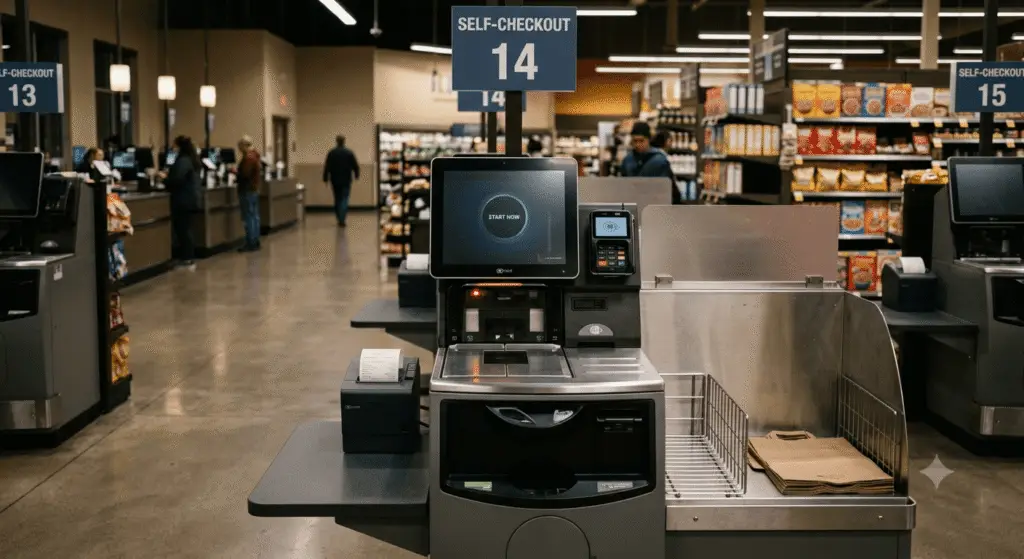
The beep of a self-checkout scanner has a rhythm to it now, almost liturgical — item, pause, beep, item, pause, beep. Somewhere in that rhythm, a woman near the front of the line lifts her phone to her ear a full ten seconds before she needs to.
No one answers. No one is calling. She talks anyway, low and unhurried, until the cashier-less lane frees up and she can scan her own groceries without anyone asking how her day is going.
Behind her, the line moves the way lines like this always move now — quickly, quietly, each person’s eyes fixed on a screen or a phone or the middle distance, nobody quite looking at anyone else. It could be mistaken for efficiency, and in a narrow sense it is. It could also be mistaken for peace, which is a different thing entirely, and harder to verify from the outside.
A national survey commissioned by Talkspace in April 2026, covering 2,000 American adults, found that sixty-four percent choose self-checkout over a staffed lane specifically to limit contact with another person. Sixty-eight percent said the same of ordering food online instead of speaking to someone. Forty-two percent reach for a chatbot even when a human representative is available. And thirty-seven percent have done exactly what the woman in line did: staged a phone call that doesn’t exist, purely to avoid two minutes of small talk with a stranger.
None of this is happening in a vacuum. In 2023, the U.S. Surgeon General issued a formal advisory naming loneliness a public health concern, and used a comparison that circulated everywhere afterward: chronic isolation, the advisory argued, carries health risks comparable to smoking fifteen cigarettes a day. The comparison got repeated far more often than it got explained, because it described a condition without accounting for how ordinary people were arriving at it. The Talkspace numbers are a rarer thing — a glimpse at the mechanism itself, not people falling into isolation by accident but choosing pieces of it, several times a day, without ever reaching for that word to describe what they were doing.
Call it a quiet epidemic and the word does something useful and something misleading at once. Useful, because “epidemic” captures the scale — this is happening in checkout lines and call centers and doorways in every part of the country at once. Misleading, because an epidemic implies something caught rather than something chosen. Nobody catches a self-checkout preference the way they catch a cold. They select it, one line at a time, for reasons that usually feel entirely sound in the moment.
Two days ago, this space considered what happens when a person turns to a chatbot because the person they needed wasn’t there, or couldn’t be. This one turns the question around. What happens when the person is right there, close enough to speak to, and gets waved off on purpose?
That’s not really a question about self-checkout. Self-checkout is just where the pattern happens to be visible this year. The real question is older and larger: what happens to a society that becomes extraordinarily good at engineering away the encounters it never chose to have in the first place?
The Neighbors Who Heard and Did Nothing
In March of 1964, a young woman named Kitty Genovese was attacked outside her apartment building in Queens. The story that circulated afterward — that dozens of neighbors heard her cries and did nothing — was later shown to be overstated; some people did call, one did come out. But the exaggerated version outlived the correction, because it named something researchers went on to document with more rigor: the bystander effect, the measurable tendency for any one witness to feel less responsible to act the more other witnesses share the moment with them.1
That’s a fact about crowds. It doesn’t map cleanly onto a person choosing a self-checkout lane, and it would be a mistake to pretend it does. But it points at something adjacent and useful: humans have always found ways to let a moment of possible contact pass without anyone having to decide, out loud, to let it pass.
What’s changed by 2026 isn’t the impulse. It’s the infrastructure built to serve it. A 1964 bystander needed a crowd to diffuse responsibility into. A 2026 avoider doesn’t need anyone else in the room — a kiosk, an app, or a fictional phone call does the diffusing alone. We have spent a couple of decades designing friction out of daily life: the friction of asking a cashier a question, of nodding at a neighbor in an elevator, of asking a stranger for directions. Some of that friction, it turns out, was the place where other people used to enter.
The 1964 crowd’s failure was inaction — nobody decided not to help, so much as everybody assumed somebody else already had. What happens in a self-checkout line is a different creature. Nobody there is failing to act. She built the fictional phone call before the moment for contact could arrive at all. Call the old cold shoulder inertia; call this one active exclusion — a decision made once, in advance, that then runs on its own every time she shops.
That’s not an accident of convenience. It’s architecture — physical, digital, and economic — built, mostly with good intentions, to remove the need for anyone to encounter anyone they didn’t already choose.
The pattern has precedent that predates any screen. American gas stations were almost entirely attendant-run through the 1960s — someone pumped the gas, checked the oil, washed the windshield, and usually said something while doing it. Self-service pumps spread through the following decade explicitly to cut labor costs, and nobody at the time framed the change as social. It was priced as speed. Only in hindsight is it obvious that something besides an attendant’s wage disappeared from that transaction: the small, entirely optional exchange that used to happen while the tank filled.
Self-checkout followed the same arc. Retailers rolled it out to shorten lines and cut payroll, and for years shoppers used it exactly the way it was marketed — as the faster option, nothing more. It’s worth noticing how recently the second use caught up with the first. The same lane built for speed has quietly become, for a large share of the people standing in it, a tool chosen for its silence. Nobody designed it as an escape hatch from conversation. It simply turned out to work as one, and a use like that doesn’t need marketing to spread once it exists.
The same shape now runs through digital life at a much larger scale. Food delivery apps route an order through a kitchen and a driver without requiring a word to reach anyone directly. Video calls replaced business trips, and some video calls have since been replaced by asynchronous messages that require no simultaneous presence from anyone at all. Each step removed a genuine cost — time, money, the awkwardness of shared silence — and each step also removed, without anyone voting on it, one more place where a stranger’s face might have entered someone’s day.
None of this was engineered by any single villain worth naming. Every business that ever removed a step between a customer and a human employee did it to save money, and saving money is not, on its own, a moral failure. But costs shift instead of disappearing, and this one shifted onto something no invoice tracks: the number of times an ordinary day still requires a person to reckon, even briefly, with someone they didn’t choose.
The Ones Who Crossed to the Other Side
The pattern is old enough that it shows up as a parable rather than a statistic.
“Now by chance a priest was going down that road, and when he saw him he passed by on the other side. So likewise a Levite, when he came to the place and saw him, passed by on the other side.” (Luke 10:31–32)
The verse doesn’t say either man failed to notice. It says the opposite — he saw him — and crossed anyway. We tend to imagine indifference as a failure of attention, as if the priest and the Levite simply didn’t see the man in the road. The harder reading is that they saw him clearly, and the seeing itself didn’t obligate them to stop. That gap between seeing and stopping is exactly what a fictional phone call is built to manufacture on a smaller, lower-stakes scale.
There’s a detail worth sitting with a moment longer. A priest and a Levite were both bound by purity laws that made contact with a corpse — even an accidental brush against one — a serious ritual problem, costly to resolve. A man lying still and bloodied at the roadside could easily have looked dead from a distance. It’s entirely possible both men had a defensible professional reason to keep walking, a rule they could point to that had nothing to do with indifference. The parable doesn’t spend any time on their reasons. It simply records what they did, as if the reasons stopped mattering the moment the choice was made.
Scripture doesn’t resolve that ambiguity for us, and that’s likely deliberate. A parable that explained away the priest’s and the Levite’s reasons would let every reader who has a good reason of their own quietly file themselves under “exception.” Instead it just shows two men walking, seeing, and continuing to walk — and leaves the reasons for the reader to supply, along with whatever discomfort supplying them produces.
To be clear about what kind of comparison this is: nobody in a self-checkout line is a priest walking past a wounded man, and it would cheapen both the parable and the moment to say so. The comparison isn’t equivalence. It’s analogy — small, repeated choices and one dramatic failure share a shape, even at wildly different weights.
“Do not neglect to show hospitality to strangers, for thereby some have entertained angels without knowing it.” (Hebrews 13:2)
In the world this instruction was written for, taking in a stranger was expensive — it cost food, risk, and a spare room. Efficiency, in the ancient sense, would have argued against it every time. Hospitality begins where efficiency ends; the instruction only makes sense in a world where the easier path was already the one that avoided the stranger.
Hospitality codes across the ancient Near East were often stricter toward strangers than toward kin, precisely because a stranger had no other claim to invoke — no family tie, no shared history, nothing except the fact of having arrived. Extending welcome under those terms cost something real: a meal that might not stretch further, a night’s peace traded for an unknown guest, a household’s safety wagered on a person about whom nothing was known. The instruction in Hebrews isn’t asking its readers to feel warmly toward strangers. It’s asking them to absorb a cost on behalf of someone who has no other way to ask for it.
The law that let Ruth glean in that field at all — leaving its edges and its dropped stalks unharvested for the poor and the foreigner (Leviticus 19:9–10) — was itself a piece of built-in inefficiency, a deliberate refusal to bring a harvest all the way home. It existed so that someone with no standing and no local name would have a legal reason to be standing in that field in the first place.
Ruth, a foreign widow gleaning leftover grain in a field she didn’t own, was noticed by its owner, Boaz, who chose to speak to her rather than let her remain a detail at the edge of his property (Ruth 2:4–10).
Boaz didn’t just notice Ruth. He moved from attention to recognition — seeing her not as scenery but as a person with a story worth asking about — and from recognition to protection, instructing his workers to leave her alone and leave her grain. Attention that stops at noticing costs nothing. Attention that continues into recognition and provision costs something, every time.
Boaz’s story never uses the word love, and it doesn’t need to. What it records instead is closer to a habit of attention repeated until it became a way of running a farm — noticing who was at the edges of his fields and choosing, apparently as a matter of course, not to leave them there.
What the Screen Cannot Carry
It’s worth saying plainly: solitude isn’t the problem here. Wanting five quiet minutes in a checkout line is not a moral failure, and treating every avoided conversation as a missed opportunity for grace would flatten something real — the difference between chosen solitude, which people need, and habitual avoidance, which slowly narrows what a person can tolerate. The Talkspace numbers don’t prove a country has gone cold. They describe one clear preference among a large, real sample of Americans, and that’s a more limited — and more useful — claim than a verdict on the national character.
The two are also easy to mistake for each other from the outside. A person standing quietly at a self-checkout kiosk looks identical whether she’s resting or retreating; nothing about her posture announces which one it is, and she may not fully know herself. That ambiguity is part of why the shift is so easy to miss while it’s happening — it wears the same face as something perfectly healthy, right up until it isn’t.
There’s also a less flattering explanation than convenience. Unplanned contact carries a small tax that convenience doesn’t: the person behind the register might have a bad day and put it on you, might ask a question with no easy answer, might simply be unpredictable in a hundred small ways a kiosk never is. Avoiding a stranger isn’t laziness so much as a bid for predictability in a day that already asks a great deal of a person’s patience. What gets quietly removed isn’t just friction. It’s the chance that another person might surprise you.
The same survey found forty percent of respondents would rather cross the street than stop for five minutes with someone they already knew, and thirty-eight percent had gone entirely “no contact” with a friend or family member in the past year, most often citing the relationship’s toll on their mental health rather than any single rupture. Read together, the numbers describe something less dramatic than a collapse of American intimacy and more unsettling in its own quiet way: a preference, increasingly normalized, for controlling exposure to other people down to the minute.
The distinction is easiest to see over time rather than in any single choice. A person who occasionally wants a quiet checkout line is exercising a preference. A person who has arranged an entire week — groceries delivered, calls screened, meetings kept virtual whenever possible — to guarantee that quiet, has built something closer to a wall, one brick small enough that no single day’s choice ever felt like construction.
The same caution applies to the chatbot. A chatbot answering a question at 2 a.m., helping someone rehearse a hard conversation before having it with a person, or lowering the bar for someone with social anxiety to speak at all — that’s not decline, that’s supplement. The trouble starts when a supplement quietly becomes a substitute: not “this helps me connect,” but “this lets me stop needing to.”
A 2026 review by Roy Baumeister (University of Queensland), Brad Bushman (Ohio State University), and colleagues, examining 1,158 studies comparing face-to-face and technology-mediated communication, found that remote interaction consistently produced less emotional impact and engagement than being physically present with another person, published in Perspectives on Psychological Science.2 Bushman’s own summary was blunt: technology is better than nothing, but a poor substitute for presence when presence is available.
One detail from that review stuck with the researchers enough to make it into their public remarks afterward: they found substantial evidence that laughing out loud carries measurable health benefits, and found nothing comparable attached to typing the letters L-O-L. The joke and the laugh can both travel through a screen. Something else, apparently, cannot.
A separate 2026 study out of the University of Queensland asked a more direct version of the same question — whether generative AI could function as a genuine stand-in companion for people navigating loneliness — and found real short-term comfort in the exchange, alongside a caution that comfort without another consciousness on the other end may ease a symptom without touching whatever produced it.3
The distinction worth drawing from that finding isn’t information versus no information. A screen transmits information just fine. What it struggles to transmit is recognition — the small, involuntary evidence that another person registered you specifically, not as a task to complete but as someone in the room. A cashier’s five idle seconds sometimes carry that. An efficient chatbot exchange, by design, doesn’t need to.
Recognition doesn’t require warmth, or even competence at conversation. It requires only that the exchange, however brief, contained evidence that the other party knew you were specifically you and not simply the next transaction in a queue. A kiosk, by design, treats every user identically. That’s precisely what makes it efficient, and precisely what it cannot offer.
That’s the same gap the priest and the Levite left on the road. Their failure wasn’t a failure of information — they had all the information a wounded man in front of them could provide. What they withheld was recognition continuing into action, and no circumstance or convenience could have supplied that in their place.
Every generation manages this gap differently, and every generation has convenient language for managing it well. Priests had purity law. We have a fictional phone call and an app that promises to have someone else handle it. The vocabulary changes. The maneuver — noticing enough to justify not stopping — has stayed remarkably stable for two thousand years.
The Line We Actually Stand In
What we repeat starts to feel normal. What feels normal eventually stops being something we question at all — which is a quieter way of saying that habits become character, one unremarkable choice at a time. The question the Talkspace numbers actually raise isn’t whether technology will keep offering us ways to avoid each other. It will. It’s whether convenience gets to decide, in advance and without our noticing, which encounters counted as worth having.
None of the numbers this piece opened with describe a crisis in the dramatic sense. No single self-checkout choice ends a friendship or breaks a community by itself. What they describe, added together, is closer to a skill — the quiet, well-practiced ability to reduce, hour by hour, the number of moments in a day when another person might interrupt with an agenda of their own. From the inside, that skill rarely feels like avoidance. It feels like competence.
It would be simple enough to end here with an instruction — talk to the cashier, meet the neighbor’s eyes, let the phone stay in a pocket. Simple, and probably useless, because instructions rarely survive contact with a genuinely inconvenient moment. What survives, if anything does, is closer to what changed for Boaz somewhere before the text picks up his story: a settled expectation that the stranger at the edge of the field was always going to be there, and that the question of whether to notice her had already been answered before he ever looked up.
The woman with the phone to her ear will finish her fictional call in a few more seconds. The lane will free up. She’ll scan her own groceries, bag them herself, and walk out having spoken to no one — not because anyone stopped her, but because she made sure no one had the chance to try. Multiply her by sixty-four percent, by sixty-eight, by forty-two, and the shape of something becomes visible that no single choice would show on its own.
The kiosk will keep humming, ready either way. What it can’t decide is who stops.
1. The bystander effect, first documented by John Darley and Bibb Latané in the late 1960s, remains the framework researchers use to study diffusion of responsibility in the Genovese case’s aftermath and beyond.
2. Baumeister, R. F., Bibby, M. T., Tice, D. M., & Bushman, B. J. (2026). Socializing while alone: Loss of impact and engagement when interacting remotely via technology. Perspectives on Psychological Science, 21(2), 154–172.
3. Crawford, J., Allen, K.-A., Baumeister, R. F., & Cowling, M. (2026). Is generative artificial intelligence a social other for parasocial support in a loneliness epidemic? Journal of University Teaching and Learning Practice, 23(1), 63, 1–15.
New essays every week. Delivered quietly.