Hook
The Undrawn Boundary
I keep returning to one detail that never makes it into the headlines.
On August 14, the UN’s refugee agency and the World Food Programme said in a joint statement that more than 650,000 refugees and asylum seekers in South Sudan were at risk of losing what food assistance remained.[1] The rations, the agencies noted, were already down to half.
Without new funding, the last round of food assistance for the most vulnerable 240,000 would go out in September — and after that, UNHCR’s deputy representative said plainly, no refugees in South Sudan would be receiving food assistance from October on.
These are people who had already left their homes and their land behind once, fleeing a war that has displaced millions since 2023, only to find the next country’s ability to feed them running out too. Half a ration isn’t a policy detail. It’s the edge of a field, redrawn smaller than it was last season, and someone has to decide who still stands inside it.
I thought about that image three days later, sitting in a theater watching Ridley Scott’s new film, The Dog Stars. The screen in front of me was a long way from a food distribution line in Juba, and I don’t want to collapse that distance into a tidy metaphor. But both scenes, in their own register, were staging the same arithmetic — a supply that doesn’t stretch to everyone who needs it, and someone deciding where it stops.
Historical Case
The Arithmetic of the Fence
The film is set years after a virus has emptied most of the world. Hig, a widowed mechanic and pilot, shares a fortified compound with Bangley, an ex-Marine who has turned survival into a working system: patrol the perimeter, shoot anything that crosses it, ration what’s left between the two of you. It works. That’s the uncomfortable part. Bangley’s math keeps them both alive.
Hig runs supply flights out past the fence line to a nearby community of Mennonite survivors — mostly children born after the outbreak, immune to whatever wiped everyone else out. He brings them food he could just as easily keep. This isn’t background color; it becomes a real fault line between the two men.
When Hig pushes to bring the groups closer together, to let the compound’s resources stretch further than Bangley’s accounting allows, Bangley blocks it outright. Not cruelly. Correctly, by his own numbers. Every meal that leaves the compound is a meal the compound doesn’t have anymore.
Bangley isn’t wrong about the danger at the fence. What he’s wrong about — or at least incomplete about — is what the fence is actually for.
The film doesn’t resolve this by making Bangley a villain. By its final stretch, even its most guarded characters are pushed toward something closer to an open hand than a closed one — not because the danger stops being real, but because holding the line completely stops being livable. Nobody in The Dog Stars gets to stop rationing. What changes, for some of them, is who the ration is allowed to reach.
Biblical Lens
Unclaimed Margins
Subsistence economies have faced this exact test before — not as an abstract virtue to admire, but as policy, written directly into how a harvest was allowed to be taken. In the middle of Israel’s agricultural law, in the section that reads like a farming manual rather than a moral one, comes this instruction:
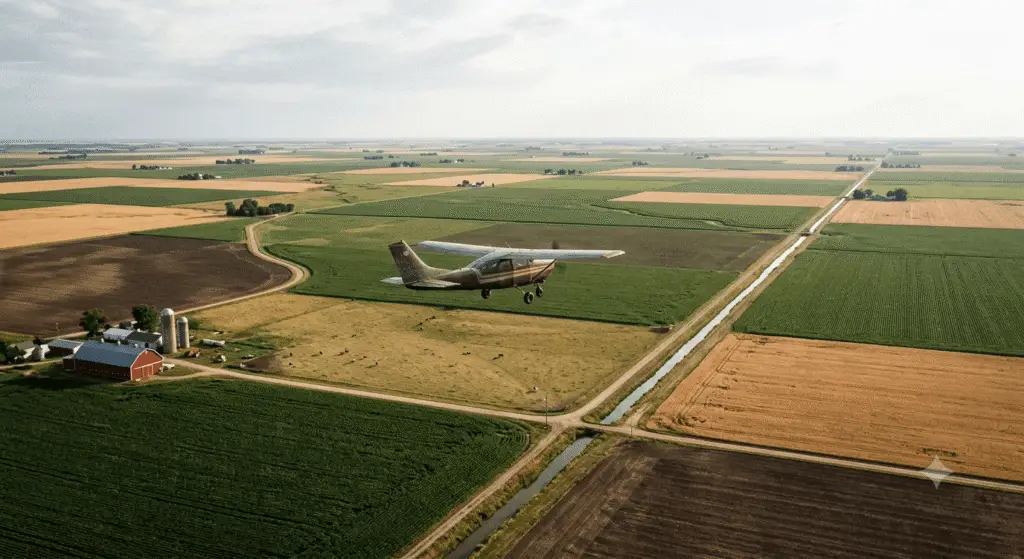
“When you reap the harvest of your land, do not reap to the very edges of your field or gather the gleanings of your harvest. Leave them for the poor and for the foreigner.” (Leviticus 19:9–10)
This isn’t charity tacked onto the end of production. It’s restraint built into production itself — a margin the harvester is required to leave unclaimed before the accounting even starts.
What looks like inefficiency from one accounting system turns out to be the whole point of a different one.
In the rabbinic tradition, this margin carries its own vocabulary: peah, the corner of the field a landowner had to leave standing, and leket, the grain that fell during harvest and could not be gathered back up for himself. These weren’t read as gestures of generosity extended after the fact. In the rabbinic reading, they were limits placed on ownership itself — a ceiling on how much of the field a person was ever entitled to call entirely his own. The poor didn’t receive peah as a gift; they gathered it as something closer to a right.
The beneficiary named in the text is specific, too: “the foreigner.” Not a neighbor with an existing claim, but someone with the least secure footing in the community — the person furthest outside the circle a harvester would naturally protect first.
Deuteronomy names the mechanism even more precisely, going after the hand’s motive rather than the hand itself:
“If anyone is poor among your fellow Israelites… do not be hardhearted or tightfisted toward them. Rather, be openhanded and freely lend them whatever they need.” (Deuteronomy 15:7–8)
The command isn’t really about the hand. It names the heart first — the hardening that happens before a hand ever closes.
Scarcity’s real danger may not be the shortage itself. It’s what shortage does to how one person looks at the next one: neighbor, then burden, then, eventually, threat. Bangley’s fence line runs on exactly that progression.
The Gospels push the same word — stranger — into its most demanding form: “I was hungry and you gave me something to eat… I was a stranger and you invited me in” (Matthew 25:35). The question underneath all three texts isn’t really whether you should be generous. It’s narrower and harder to dodge: who belongs inside the circle your provision is drawn around, and on what basis do you decide?
A brief note on how to read this: none of these texts treat scarcity itself as judgment, or plenty as proof of righteousness. What they insist on is smaller — that whatever a household, or a nation, decides to do with a shrinking supply eventually becomes visible, whether or not anyone announces the decision out loud.
Pattern Insight
When Shortage Becomes Selection
Hig’s compound and South Sudan’s refugee population are not the same situation. One is a fictional homestead run by two men; the other is an international humanitarian system straining under a funding shortfall, and the people at its center are not the ones doing the rationing — they’re the ones the rationing is being done to. Treating those as equivalent would flatten something real.
But they raise a related question, and it’s the same one Leviticus is legislating for: what happens when there isn’t enough to give everyone what they need, and someone still has to draw the line? WFP’s own August figures make the shape of that line concrete — a $37 million gap for refugee operations alone, and UNHCR sitting at 28 percent of the funding it says it needs.[1] That’s not a metaphor. It’s an actual edge, with actual people on both sides of it.
The Dog Stars doesn’t pretend generosity erases the shortage either. Hig’s flights to the Mennonite community don’t make the world less dangerous. If anything, the film suggests they make him more exposed, not less — a cost Bangley is never shy about naming. What the film refuses to accept as complete is Bangley’s accounting on its own terms: correct about the danger, silent on who gets counted inside the boundary being defended.
This pattern is not new. In an earlier piece on this site, we traced how cycles of harm hold their shape until someone inside them absorbs a cost the system never asked them to carry — the same tension, in miniature, that governs every boundary line of provision, whether it’s drawn at a compound fence or a funding spreadsheet.
Closing
The Geometry of Worth
There’s a particular numbness that sets in the moment a person becomes a percentage — 28 percent funded, half a ration, one of 240,000. The math isn’t dishonest. It’s just missing something a number was never built to hold: a face.
Leviticus doesn’t pretend the margin is free, and neither, in its own quieter way, does The Dog Stars. Both simply insist that the decision is never purely logistical, however much it might look that way from inside the spreadsheet.
What stays with me isn’t the 650,000, or the 240,000, or even the half. It’s the smaller fact underneath the numbers: someone, somewhere, has already decided where the edge of the field gets cut, and who ends up standing on which side of it. Scarcity doesn’t just measure what’s left to give. It measures who we’ve already decided is close enough to count.
[1] WFP and UNHCR, joint news release, August 14, 2026, “Refugees in South Sudan Face Extreme Hunger as Funds Run Out.”
New essays every week. Delivered quietly.