Eleven Marks on Broken Clay
In a climate-controlled case at the Israel Museum in Jerusalem, eleven pieces of broken pottery sit under glass. Each one is scratched with a single name, in a hand that clearly wasn’t practicing calligraphy — just marking something down, once, in a hurry. Visitors walk past the case the way people walk past most museum cases: a glance, a photo maybe, a step toward the next room. Almost none of them stop long enough to wonder what those names might have been for.
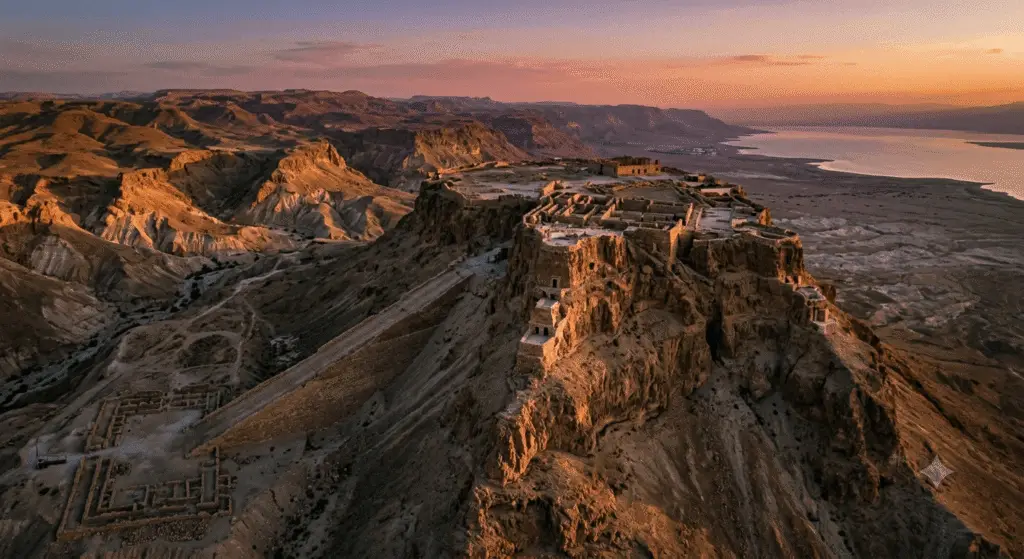
The shards were pulled from the ruins of a mountaintop fortress called Masada, on the western edge of the Dead Sea, where in the year 73 of the Roman era a community of resistance fighters spent months watching a foreign army build a ramp toward their walls. Archaeologist Yigael Yadin, who excavated the site in the 1960s, found these ostraca scattered near what may have been a communal gathering point, eleven fragments with no explanation attached (Yadin, 1966). One of them reads simply “ben Ya’ir.” The historian Josephus, writing a generation later, describes a different scene: on the final night, the defenders drew lots to determine who would carry out what needed to be done, so that the decision wouldn’t rest on any one person.
Whether these particular shards are those lots, no one can say with certainty. What can be said is narrower and, in its own way, more interesting: someone, facing an outcome they could not escape, still thought a name needed to be written down. This is a story about why.
The Geography of Inevitability
By the time the Roman Tenth Legion arrived at the base of Masada, the war was effectively over everywhere else. Jerusalem had fallen three years earlier, the Temple had burned, and the revolt against Rome had been crushed in every populated center of Judea (Magness, 2019). What remained was one final holdout — a natural plateau fortress, originally built up by Herod the Great as a palace-retreat a century before, now occupied by a militant faction the sources call the Sicarii.
The geography did most of the early work. Masada rises roughly thirteen hundred feet above the surrounding desert, reachable in antiquity only by a narrow path along the eastern cliff face that a small number of defenders could hold against a much larger force almost indefinitely. Herod had stocked it with cisterns and storerooms decades earlier, anticipating a siege of his own — though against very different enemies, for very different reasons. What he built as insurance against his political rivals became, two generations later, a refuge from a war he never lived to see.
Unwilling to wait out a fortress with its own water supply, Roman engineers under Flavius Silva built an enormous siege ramp of packed earth and timber up the western slope — a project that took months of continuous labor by thousands of soldiers and conscripted workers. It didn’t need to be fast. It only needed to be inevitable.
What happened next, we know almost entirely through one man who wasn’t there. Josephus was a Jewish commander who had surrendered to Rome earlier in the war and wrote his account of Masada decades later, under Roman patronage, drawing — by his own admission — on the testimony of two women and several children said to have survived by hiding in a cistern. He records two long speeches delivered by the group’s leader, Eleazar ben Ya’ir, arguing for collective death over capture and slavery — speeches almost certainly reconstructed or stylized in the rhetorical conventions common to ancient historiography rather than transcribed from memory (Magness, 2019). This raises a question that matters more than it first appears: how does a civilization come to know an event whose only narrator was not present to witness it?
The archaeology can confirm the setting — the ramp, the storerooms, the fortress walls, a handful of human remains, and those eleven inscribed shards. It cannot confirm the speeches, the exact sequence of the final night, or whether the lots Josephus describes are the ones sitting under glass today. There are, in a real sense, three different Masadas: the one the stones can show us, the one Josephus narrated for a Roman readership two generations later, and the one later generations chose to remember. This piece is mostly interested in the third one — not because it’s the most accurate, but because it’s the one that lasted.
Scripture at the Edge of Control
Scripture has no narrative of a fortress community voting for collective death. But it returns, again and again, in very different books written centuries apart, to a related and narrower question: what does faithfulness look like at the exact moment control disappears? Three texts approach that question from three different angles, and it’s worth being precise about which is which.
The first is Esther, asked to approach the king uninvited on behalf of a people facing annihilation — an act carrying a death penalty unless he chooses to extend mercy. Her answer doesn’t promise a good outcome. It commits to the action regardless of one.
“Go, gather all the Jews who are in Susa, and hold a fast on my behalf… Then I will go to the king, though it is against the law, and if I perish, I perish.” (Esther 4:16, ESV)
The distinction matters. Esther risks a death she cannot foresee, in the name of saving others. What happened at Masada, whatever its shape, was not that — it was a procedure enacted once the outcome was no longer in doubt.
The second is Saul, mortally wounded on Mount Gilboa and surrounded by Philistine forces, who chooses to end his own life rather than be captured.
“Then Saul said to his armor-bearer, ‘Draw your sword, and thrust me through with it, lest these uncircumcised men come and thrust me through, and mistreat me.’… Therefore Saul took his own sword and fell upon it.” (1 Samuel 31:4, ESV)
It matters what this text does and doesn’t do. It narrates Saul’s death. It does not hold his choice up as instruction for how a faithful person should meet defeat. Recording an act is not the same thing as endorsing it, and the surrounding books make clear that Saul’s story is read as tragedy, not template.
The third is harder to place beside the other two, because it points in the opposite direction. In Gethsemane, on the night before his death, Jesus prays to be spared what is coming — and then submits anyway.
“My Father, if it be possible, let this cup pass from me; nevertheless, not as I will, but as you will.” (Matthew 26:39, ESV)
Where the ostraca, if they are what Josephus describes, represent an attempt to seize control of an ending through careful procedure, Gethsemane represents the opposite gesture entirely — not the taking of control, but its deliberate release. Christian theology does not resolve these into one lesson. It holds them in tension: courage that acts without guarantees, a tragic end that scripture narrates without recommending, and a submission that lets go of control entirely, including control over how the story closes.
The Weight a Procedure Carries
Here the story gets more complicated, and it’s worth resisting the easy version of the complication.
Josephus records that roughly 960 people died at Masada that night. Yadin’s excavation recovered only around two dozen human remains — a fraction of the number Josephus reports — along with the eleven ostraca (Yadin, 1966). It would be tempting to conclude that archaeology has caught Josephus in an exaggeration — but that conclusion moves faster than the evidence allows. Bodies left exposed on an open plateau for nearly two thousand years, subject to scavengers, wind, and erosion, would leave an incomplete record regardless of how many people actually died there. The absence of remains doesn’t confirm Josephus’s number, and it doesn’t disprove it either. What the physical evidence confirms is the setting the event happened in — not the shape of the event itself.
What the evidence does support, more confidently, is that some kind of procedure took place. And procedure is a stranger, more interesting idea than the deaths themselves.
Human beings build procedures — lotteries, juries, chains of command, triage systems, the drawing of straws — most often in exactly the moment when ordinary conscience becomes unbearable to carry alone. A lot doesn’t make a terrible decision good. It changes who has to own it. If the ostraca really were used to determine who acted and in what order, they represent an attempt to distribute an unbearable responsibility across a group rather than concentrate it in one person’s hands.
That’s worth sitting with, because it cuts in two directions at once. Distributing a decision can be an act of solidarity — nobody forced to bear the whole weight alone. It can also be a way of making the decision harder to resist. A group bound together by a shared procedure, under siege, with no way out and intense social pressure to conform, is not necessarily a group acting from free and equal conviction. Some of what looks like collective courage from a distance may have included fear of dissent, or the simple impossibility of leaving. The ostraca can’t tell us which was true at Masada, and it would be dishonest to pretend otherwise.
Whether that procedure should be read as a last act of order imposed against chaos, or as a structure that made the decision easier to carry out precisely because no one had to own it alone, is not a question the shards can settle. Both readings sit inside the same eleven names.
Eleven Names, Looked at Twice
In the world the ostraca came from, writing a name into clay was rarely a casual act. It was closer to testimony — a way of insisting, however briefly, that a person had been present, had chosen something, had existed inside a moment large enough to erase them. That impulse is what these eleven fragments still carry, whatever else about that night remains unrecoverable.
There’s a version of this story that turns Masada into pure resistance, and a version that turns it into pure tragedy, and a version that reduces it to a biblical parallel with a tidy lesson attached. This piece has tried to avoid all three.
What’s left, once the number 960 and the reconstructed speeches and the disputed archaeology are set beside each other rather than stacked into one confident account, is something more modest and harder to let go of: a group of people, facing an outcome they could not change, built some kind of structure so that the final decision would not belong to any single conscience alone. Whether that structure looked like solidarity, coercion, faith, exhaustion, or some mixture no observer could now separate, is a question the eleven shards were never going to answer.
Scripture’s three responses to an uncontrollable ending — Esther’s action without guarantees, Saul’s death narrated without being recommended, Gethsemane’s surrender of even the manner of the end — don’t settle what happened on that mountain nearly two thousand years ago. They do something more useful. They complicate the question people usually ask about a story like this, which is simply how did it end, and replace it with a harder one: what remained worth choosing, or worth entrusting to someone else, once the ending itself was no longer anyone’s to decide.
Yadin, Yigael. Masada: Herod’s Fortress and the Zealots’ Last Stand. Random House, 1966.
Magness, Jodi. Masada: From Jewish Revolt to Modern Myth. Princeton University Press, 2019.
New essays every week. Delivered quietly.