A name is the last thing a grave gives back
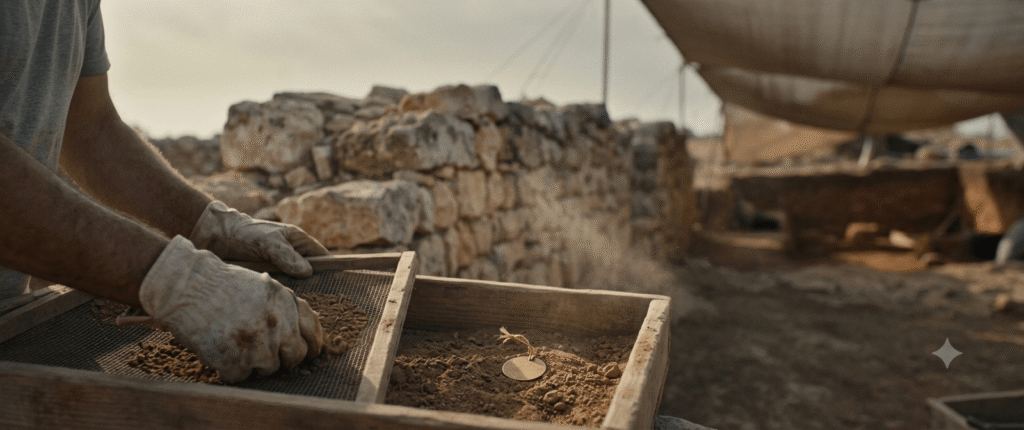
On September 20, 2026, a team in northern Iraq began a new twenty-day round of exhumations at the Sharaf al-Din mass grave near Sinjar, one site among dozens still being opened twelve years after the Yazidi genocide began.1 The work is slow and forensic: soil removed in layers, bone catalogued, DNA matched against samples families gave up hope of needing. Nadia’s Initiative, which coordinates the effort with Iraq’s national exhumation team, put the stakes in a single line: “Each identification returns a name to a family.”1
Twelve years is a long time to wait to be told who your dead actually were. It is longer still to have no one left who remembers, and no grave to open at all. Sinjar shows what a modern world can still do when it refuses to let silence stand. Antiquity had no such remedy.
In the previous installment, we watched a woman turn to look at a city she had already lost. The text gives her no explanation and no final word.2 The silence in this piece is different. It was not imposed in an instant. It accumulated over years, and it was never broken by anyone who lived inside the walls.
A siege built to make silence permanent
The Arevaci, one of the Celtiberian peoples of central Spain, had made Numantia the center of resistance to Rome by the time Scipio Aemilianus arrived in 134 BC.3
He did not attack the town. He surrounded it. Roman engineers dug a double line of trenches and walls around the entire settlement, connected seven fortified camps, and blocked the Duero River at both ends so that nothing, not a boat, not a swimmer, could pass without being seen.3 It was a siege designed to remove every option except the two the defenders were left holding: surrender or starve.
The blockade held through 134 and into 133 BC. What survives is difficult to separate from the Roman account of the siege. Appian, writing centuries later and drawing on earlier sources, records that as food ran out, families inside the town began taking their own lives rather than wait for the end the siege was built to force.4 When the remaining Numantines finally came out, Appian says they set what was left of the town on fire first.4
Appian records what came next in a single sentence: Scipio reserved fifty people for his triumph in Rome and sold the rest.4 The town itself was leveled, and the historians who later wrote about it were not from it. No Numantine account of the siege has come down to us. Every word we have describing what that choice felt like from inside the wall belongs to the people who built the wall.
Three verses about grief with nowhere to go
Scripture has a book built almost entirely around a city that has just gone through what Numantia went through, and it does something the Roman historians never managed: it lets the ruined city speak in the first person, and it does so inside a strict poetic order — chapters one, two and four each move through the Hebrew alphabet letter by letter, and the third runs through it three times over. Language this controlled, under grief this size, is not an accident.
Is it nothing to you, all ye that pass by? behold, and see if there be any sorrow like unto my sorrow, which is done unto me.
— Lamentations 1:12
This is Jerusalem speaking from the ruins of its own destruction. It is something Numantia never had: a ruined city speaking in its own voice.
The elders of the daughter of Zion sit upon the ground, and keep silence… the virgins of Jerusalem hang down their heads to the ground.
— Lamentations 2:10
Even here, where the city gets to speak, its own elders fall silent. Grief this size does not always announce itself. Sometimes its most accurate expression is simply stopping.
He sitteth alone, and keepeth silence, because he hath borne it upon him.
— Lamentations 3:28
None of this treats Numantia’s ending as a judgment handed down for some particular fault, or Jerusalem’s fall as anything less than a real catastrophe. What both texts share is simpler: a people under enough pressure eventually shows what conditions it had actually been living under.
The work of undoing a silence
Twelve years, dozens of grave sites, one team working in twenty-day rounds: the Sinjar excavations make visible how much labor it takes to reverse what a single act of destruction accomplishes in days. A name lost in an afternoon can take a decade of careful digging to recover, and even then, not every name comes back.
Set that labor beside Numantia. No exhumation is coming for a Roman siege two thousand one hundred and fifty-nine years gone. What we have instead is Appian, writing in Greek for a Roman audience, generations removed from anyone who stood inside that wall. The most that survives of the people who chose fire over surrender is a description of the choice, authored by the side that forced it.
Rome left Numantia a eulogy written by its executioner. Scripture left Jerusalem a liturgy written by its survivors. That is the whole distance between the two ruins, held in one sentence.
Lamentations refuses the arrangement Numantia was left with. Whoever wrote it — the tradition names Jeremiah, though the text itself does not — wrote from inside the wreckage, in the first person, in the voice of the people the disaster happened to. Lamentations preserves something Numantia did not: a sustained voice speaking from within the aftermath of destruction.
What outlives a wall is whoever got to speak
Numantia is a story about people who disappeared without leaving their own account. Lamentations shows what it looks like when the ruined are allowed to speak. Sinjar shows how much labor it takes when even a name has been lost. A siege can force a choice down to two options and still not control what gets said about it afterward.
Rome could level Numantia’s walls, sell its survivors, and reserve fifty people as trophies, but the one thing it could not manufacture was a Numantine voice describing what any of it meant. That silence has now outlasted the empire that caused it.
Twelve years into the work at Sinjar, a team is still opening ground because a name given back to a family is worth that much labor, even this late. Lamentations did the same work in a single book, three thousand years ago, by refusing to let a ruined city’s story be told only by the people who ruined it.
Every wall falls eventually. What determines how its story survives is not the wall, but who was allowed to speak after it fell.
Footnotes
1. Nadia’s Initiative, “Mass Grave Exhumations Resume in Sinjar” (Sept. 20, 2026).
2. Genesis 19:26, discussed in the previous installment.
3. Encyclopaedia Romana (University of Chicago), “The Celtiberian War and Numantia,” siege chronology and Roman military engineering details.
4. Appian, Roman History, Vol. I: The Spanish Wars (Iberica), §96–98, on the surrender and its aftermath.