Hook
A purpose left off the page
On Monday, August 10, six of the seven justices of the New Jersey Supreme Court held that a municipality need not name the particular public use for a property in the ordinance that authorizes taking it (New Jersey Supreme Court, 2026).1 The property was the Desert Palm Inn, a motel in Seaside Park that the borough had set out to acquire by eminent domain. The ordinance called the taking a public use and purpose; it did not say which one.
The majority found the statutes silent on the point, noted that the owner had been slow to engage, and still added that a four-year dispute could likely have ended sooner had the borough disclosed its intended use early. Justice Hoffman, dissenting, agreed that no statute required the ordinance to name a use, but would have ruled against the borough under the older duty to “turn square corners” with the people it takes from. In his account, the borough knew its intended use by March 2022 at the latest and left the owner’s April 27 question unanswered until a parking lot with electric vehicle charging surfaced in a later complaint. The majority read the same correspondence differently, noting that the borough replied within a day, though the reply spoke only of a “public project.”
Hoffman also set the case beside Township of Jackson v. Getzel Bee, decided unanimously three weeks earlier. There the court rejected a plan to condemn private lots and trade them to a developer in a land swap, and found that the township had not dealt forthrightly with the owners, its asserted public purpose having been, in the court’s words, “at times vague, inaccurate, and pretextual” (New Jersey Supreme Court, 2026).2
Nothing here suggests that either town resembles the palace at Jezreel. The courts are still doing their work, and both cases were argued in the open. Yet read together, the rulings circle a question the Bible asks without hurry: what does a government owe the person whose ground it wants, and does the answer include the truth about why?
In the previous installment, we followed Elijah to a broom tree, where he asked to be released from his work. The prophet who lay down there is sent back in 1 Kings 21, this time into a case about a vineyard.
Historical Case
How kingdoms have always taken land politely
Israel’s own tradition carried a warning. When the people first asked for a king, Samuel told them what kings do: they take the best fields, vineyards, and olive groves, and give them to their servants (1 Samuel 8:14). The warning is easy to skim, because it sounds like an administrative forecast and not a threat.
The wider world bore it out. In Rome, the proscriptions of Sulla in 82–81 BC named citizens on public lists, and the property of the named was forfeited. The procedure was public and written down.
Seizure has rarely arrived as a confession. It has usually arrived as a form. That habit is older than the Roman lists and outlasted them, and it is the habit 1 Kings 21 examines most closely.
Modern America keeps its own version of the question. In Kelo v. City of New London (2005), a 5–4 Supreme Court held that a city’s hope for jobs and tax revenue could count as a “public use” for taking homes that would pass to a private developer (Congress.gov, 2023).3 Justice O’Connor’s dissent put the worry in a single sentence:
“The specter of condemnation hangs over all property.”
Kelo v. City of New London, 545 U.S. 469 (2005) (O’Connor, J., dissenting)
The Institute for Justice, which represented the homeowners, counts 47 states that have since strengthened their protections (Institute for Justice, 2026). Whatever one thinks of the decision, the argument it set off was the argument of Jezreel: who decides what counts as a purpose, and who checks it? The Watchtower Files has a quieter version of that question, about a shared water supply.
Biblical Lens
Three verses, three stages of a taking
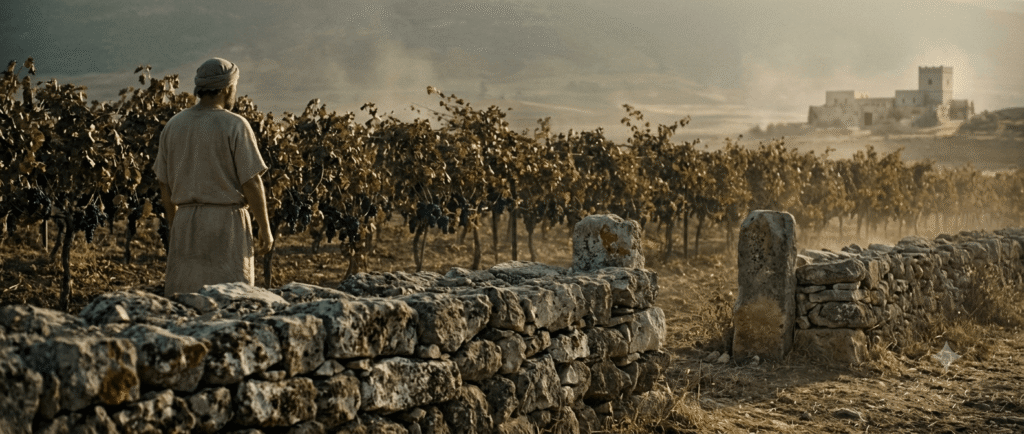
The chapter opens with a refusal. Ahab asks for Naboth’s vineyard, which sits beside the palace, and offers a better vineyard or a fair price. Naboth’s reply is short:
Naboth answered that the LORD forbid he should hand over what his fathers had left him.
1 Kings 21:3 (paraphrased)
The land was not, for Naboth, a commodity with an unusually stubborn seller. The word he uses for his fathers’ holding, nachalah, means an inherited share, and Leviticus 25:23 frames the land as belonging to God and held by families in trust. Ahab hears a price problem, and Naboth is speaking about a trust.
The second stage arrives through Jezebel, and it is the one that should unsettle a careful reader.
In Ahab’s name, and stamped with his seal, she wrote to the elders: proclaim a fast, seat Naboth in a place of honor, and set two worthless men across from him to swear that he cursed God and the king.
1 Kings 21:8–10 (paraphrased)
The plot borrows the furniture of law. There is a public fast, there are two witnesses, as Deuteronomy 17:6 requires in a capital case, and there is a charge that Leviticus 24:16 treats as a capital offense. The elders did exactly what the letters said, and a man who had done nothing was carried out of the city and stoned (21:11–13).
The prophets later described the same habit in general terms:
They lie awake plotting harm, and when morning comes they carry it out, because they can. They covet fields and seize them, houses and take them.
Micah 2:1–2 (paraphrased)
The text does not ask us to treat every ruin as a sentence handed down from above; it asks us to notice that what a people habitually permits will eventually show itself in public.
Pattern Insight
The vineyard changed hands through many careful hands
Consider what the chapter actually counts. Ahab wants the land and says so to no one, sulking with his face to the wall. Jezebel drafts the letters. The elders and nobles carry them out, two witnesses supply the perjury, and a whole town sits through a fast day that has become a stage.
Augustine asked what separates a kingdom from a band of robbers once justice is removed, and his answer was, in effect, very little.4 The force of the passage lies less in the word “robbery” than in the question underneath it: what distinguishes an ordered power from a predatory one. Read alongside 1 Kings 21, it suggests a further point. A power that keeps the paperwork and loses the truth has kept only the outline of justice, and the taking becomes theft not at the moment of the signature, but wherever the reason given stops matching the reason held.
That is where the modern rulings and the ancient story touch, with every difference left standing. In Seaside Park, the court found no statutory duty to name the use in the ordinance, while urging earlier disclosure; the matter in dispute was silence. In Jackson, the court rejected a condemnation built around a land swap and found the township’s asserted purpose, at times, pretextual. In Jezreel, the legal form itself became an instrument of false accusation.
These are not morally equal, and they should not be read as one offense. They mark three points on a line running from silence through pretext to fabrication. Along all of it, an ordinary person’s ground depends on someone in the machinery being willing to be honest.
Elijah’s arrival is abrupt. He meets Ahab in the vineyard, and the charge he delivers is that the king has murdered and also taken possession (1 Kings 21:19). A later passage about Jehu in the same field mentions the blood of Naboth’s sons as well (2 Kings 9:25–26), which some readers take to suggest that the family line, and with it any heir, was removed. The narrative leaves that as an implication and does not press it.
What follows may be the most surprising part. When Ahab tears his clothes and humbles himself, the judgment is delayed (1 Kings 21:27–29). The story keeps verdict and mercy in one scene, which is a reason to read it as a record of how power behaves, not only as a pronouncement on one king.
Closing
The reason given is part of what is taken
A stated purpose looks like the smallest thing in a taking. It is one line in an ordinance, one paragraph in a hearing, one sentence spoken to the person who owns the land. Yet in the story, the most careful part of the crime was the reason: a fast, a charge, a seal, a crowd.
Power strong enough to take the vineyard still went to the trouble of inventing a reason, which suggests it knows it needs one. That is why the argument in New Jersey belongs beside an ancient vineyard, in spite of everything that separates them. A society reveals the conditions it has chosen by what it lets be left off the page, and by what it lets be dressed up in its place. Naboth lost the vineyard and his life, and his refusal is still on the page.
In Jezreel, the purpose was buried with the man. In Seaside Park, the particular purpose was left out of the ordinance, though the court urged earlier disclosure. In Jackson, the court confronted a township that had not dealt forthrightly with the people whose land it sought. The vineyard remains in the text, refusing to be only a parcel.
- Borough of Seaside Park v. Shree Jyoti, LLC, No. A-2-25 (N.J. Aug. 10, 2026) (Noriega, J.; Hoffman, J., dissenting). See also New Jersey Monitor, “NJ Supreme Court sides with Seaside Park in eminent domain case,” Aug. 10, 2026.
- Township of Jackson v. Getzel Bee, LLC, No. A-3-25 (N.J. July 20, 2026). The quoted phrase and the “public project” reply are as reported in Justice Hoffman’s dissent in Seaside Park.
- Kelo v. City of New London, 545 U.S. 469 (2005); Congress.gov (CRS), The Takings Clause of the Constitution: Overview of Supreme Court Jurisprudence on Key Topics (2023); Institute for Justice, “Eminent Domain,” 2026.
- Augustine, City of God, IV.4.
New essays every week. Delivered quietly.