A name recovered one cleaning at a time
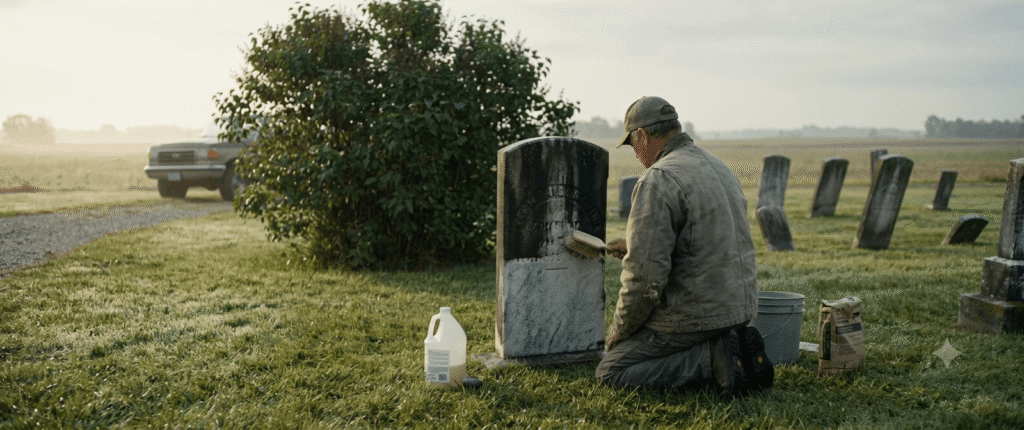
Orange Towsley’s headstone had gone black. It was not the soft gray of old marble but the black of a skillet left too long on a fire, and whatever had once been cut into it could no longer be read. Terry Hill, who found it that way, says Towsley and his wife, Prudence, were the first couple to come to Windsor Township, in Michigan’s Eaton County, somewhere around 1830 to 1835 (WILX, 2026).1
Hill is a truck driver. In a report published September 14, WILX in Lansing described how he has spent roughly two years cleaning stones in four township cemeteries, among them Courter-Pray Cemetery on Vermontville Highway. Towsley’s marker took eight to ten cleanings before it could be read again.
Hill pays for it himself. In his own words, “I don’t have a fishing boat. I have a cemetery.” He also says, without embarrassment, that finishing a stone leaves him satisfied with himself.
The Towsleys came, on Hill’s account, a few years before Michigan entered the Union in 1837. Frontier America was built by people like them, and it rarely kept their names.
Nothing in this story is a scandal, a verdict, or an emergency, which is part of why it deserves a slower look. It leaves a plain question standing in a Michigan field: when everyone who knew a name is gone, who is left to keep it?
In the previous installment, we looked at what the Bible means by forgiving a debt. This week’s story asks what, if anything, the living owe the dead, when no creditor remains to collect. Underneath it sits a second question: is remembering a person merely a matter of memory, or is it a form of honor?
What we do with the names of the dead
History has given at least three answers to what a society does with a dead person’s name. They run from the harshest to the loneliest: erase it, standardize it, or leave it to whoever shows up.
The first answer is erasure. After Caracalla had his brother Geta killed in 211, Geta’s name was chiseled from public inscriptions. Modern scholars call the practice damnatio memoriae, a phrase the Romans themselves never used (Flower, 2006).2
The erasures rarely worked cleanly. Harriet Flower has argued that a chiseled gap in a monument could itself direct a passerby’s attention to what had been removed, so that the punishment kept a shadow of the memory alive (Flower, 2006). A gap remembers only as long as someone is left who knows what filled it.
That is the paradox. A name deliberately cut away can leave a question behind, while a name simply left alone to weather leaves nothing to ask about. Erasure needs an enemy with a chisel; erosion needs only a long enough absence of anyone who cares.
The second answer is institutional, and the twentieth century gave it on a very large scale. When the Imperial War Graves Commission was established in 1917, it settled on a principle that every soldier of the empire, from general to private and of whatever race or creed, would receive the same headstone and the same honor (Imperial War Museums, n.d.).3 Rudyard Kipling chose the line for the Stone of Remembrance, “Their name liveth for evermore,” taken from Ecclesiasticus, a book many Protestants read as wisdom literature but not as canon.
The third answer is the one Michigan supplies, and it has no commission behind it. An ordinary township cemetery is kept by no empire, and its stones outlast the families who paid for them, lean, sink under lilac roots, and go black. Rome asked whom a state may erase, the War Graves Commission asked whom it must remember, and the township cemetery asks whether anyone must remember once the state has gone home.
Three verses about who remembers the dead
Scripture starts where the township cemetery ends, with the plain fact of forgetting. The Preacher states it without comfort:
There is no remembrance of the people of earlier days, and those who come later will not be remembered by the generations after them. (Ecclesiastes 1:11, paraphrased)
The line describes the human condition. It is not an argument against memory, and the rest of Scripture pays surprising attention to the people who interrupt the default. When the men of Jabesh-gilead went by night to take the bodies of Saul and his sons down from a city wall and bury them (1 Samuel 31:11-13), the text mentions no order behind it.
Saul was a rejected king whom few would have mourned in public. David later sent them word:
The LORD bless you for the loyal kindness you showed your lord Saul by burying him; may he show you steadfast love and faithfulness. (2 Samuel 2:5-6, paraphrased)
The word rendered “loyal kindness” is hesed, which Katharine Doob Sakenfeld’s study describes as help freely given to someone in need by a person who could have declined (Sakenfeld, 1978).4 Saul was dead and could offer nothing in return, and that is the point. A phrase preserved in the rabbinic tradition, hesed shel emet, names the burial of the dead as a kindness of truth, because the one receiving it can never repay it.
Hill’s brush is not a rabbinic rite, and he claims no such tradition. Yet the shape is familiar: help given where no repayment can come, by someone who could have stayed home.
Where Ecclesiastes describes the condition, Isaiah records a promise about God’s answer to it:
To those who hold fast to my covenant I will give, within my house and walls, a monument and a name better than sons and daughters, a name that will not be cut off. (Isaiah 56:5, paraphrased)
The promise is made to the eunuch and the foreigner, people with no children to carry a name forward (Isaiah 56:3-5). Its Hebrew phrase, yad va-shem, gave Israel’s Holocaust remembrance authority its name. A name that does not depend on descendants is exactly the kind a neglected cemetery is full of, and Scripture treats it as something one person can hold for another.
Scripture never requires us to read a neglected graveyard as a judgment from heaven; it does hold that a people eventually shows, in what it keeps and what it lets go, the moral terms on which it has chosen to live.
Care for the dead is work no one can audit
The numbers in the WILX report are plain: more than 300 stones, four township cemeteries, about two years. Hill spent more than $2,000 this summer alone, and he carries 700 pounds of cement in his van for repairs. One stone took eight to ten cleanings. Another, Candace Streeter’s, was found broken beneath the ground under a lilac bush, and Hill poured a concrete pedestal to hold it.
His methods, as the report describes them, line up with what conservators advise: a soft brush, a plastic putty knife, no harsh chemicals. Some stones need weeks or months, with sunlight doing part of the work. The National Park Service favors the gentlest means available, and it urges consulting a professional conservator before touching stones that are unstable or broken (National Park Service, n.d.).5
The report adds that Hill is now using epoxy on two more broken stones, and it does not say whether a conservator has weighed in. That is a fair caution to carry beside the admiration, and it does not cancel it. The rule exists so that the stones last, and Hill is working toward the same end.
Figures describe effort. They do not say why a man who drives a truck for a living spends his summer scrubbing the stones of strangers. Hill’s own account is unsentimental: finishing a stone satisfies him, and he reasons that whoever set those markers wanted to be remembered.
The bill is his alone, the sort of giving that costs the giver, a theme we followed in an earlier essay. A motive that mixes pride with obligation is more believable than a saintly one, and the biblical accounts of burial are just as unromantic about the people who do it.
No reward. No invoice. No audience. The dead cannot repay, so the work tests what a community means by memory.
The Bible has a figure whose whole story is this kind of unaudited care. After seven of Saul’s descendants were killed and left exposed, Rizpah, the mother of two of them, spread sackcloth on a rock and kept birds and animals away from the bodies from the start of the harvest until the rains came (2 Samuel 21:8-10). The narrator then reports that David was told what she had done, and he gathered the bones of Saul and Jonathan from Jabesh-gilead and buried them together with the seven (21:11-14).
The text does not say her vigil caused his action; it only places the two in sequence. That restraint is worth keeping. Hill is not Rizpah, and what the two share is only the plain fact of care: hers was kept over the bodies of her own sons, his is kept over the names of strangers. The pattern it records is modest and durable, that a community’s duty to its dead is met, when it is met at all, after one unglamorous person refuses to look away.
Why does such work matter beyond the person doing it? Robert Pogue Harrison, in The Dominion of the Dead, follows Vico in tracing the Latin humanitas to the verb for burying, and argues that a culture becomes human in part by keeping its dead among the living as a foundation rather than a burden (Harrison, 2003).6
Harrison’s argument also marks where memory and honor part ways.
Memory keeps a name from being lost. Honor keeps it when nothing can be gained by it.
That second thing is what Isaiah’s monument and Hill’s brush have in common.
A name is the one thing a graveyard can still return
The Preacher is right that names are lost by default. Lichen, mud, and time do it without malice, and no empire has to issue an order. Isaiah’s promise and Kipling’s chosen line, each in its own register, insist that a name is worth holding against that current. A community shows what it values in whom it still bothers to name.
Who is left to keep a name once everyone who knew it is gone? In Windsor Township, for now, it is a man with a soft brush and a van full of cement.
Candace Streeter’s stone was found broken beneath a lilac bush. It now rests on a concrete pedestal that a truck driver poured for it. Orange Towsley’s stone was black and unreadable, and it took eight to ten cleanings to bring the name back.
A stone remembers no one. It only holds the place until a hand comes to clear it, and this one had kept the name all along.
- WILX (Lansing), “Mid-Michigan man restores old cemetery headstones,” September 14, 2026. wilx.com
- Harriet I. Flower, The Art of Forgetting: Disgrace and Oblivion in Roman Political Culture (University of North Carolina Press, 2006).
- Imperial War Museums, on the Imperial War Graves Commission (1917) and equal treatment of the dead.
- Katharine Doob Sakenfeld, The Meaning of Hesed in the Hebrew Bible (Scholars Press, 1978).
- National Park Service, “Cleaning Grave Markers.”
- Robert Pogue Harrison, The Dominion of the Dead (University of Chicago Press, 2003).
New essays every week. Delivered quietly.