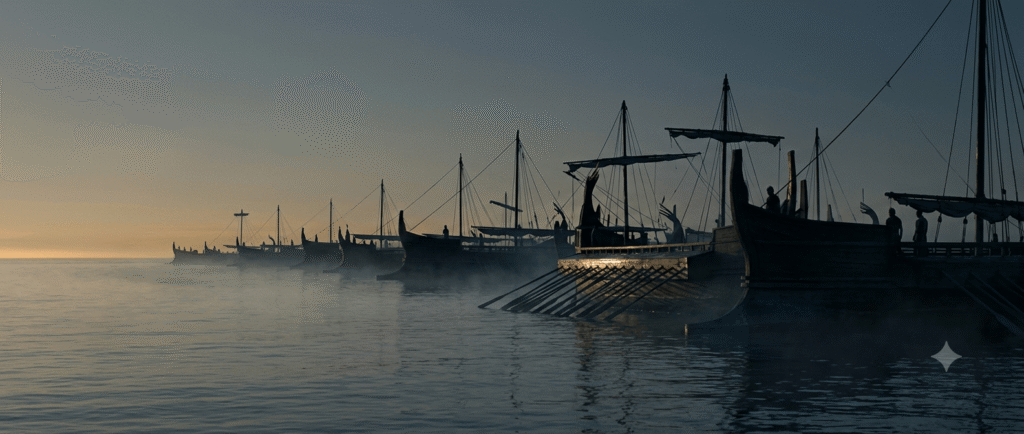
The Line That Held
Battle of the Aegates Islands, 241 BC · First Punic War
The Gap in the Ledger
In Moab, Utah, a small nonprofit called Community Rebuilds spent last year finishing homes for families who couldn’t otherwise afford one. Then the federal money that had helped fund the work thinned — ten positions gone, a funding gap of nearly two hundred thousand dollars by the start of this year (Moab Times, 2025).
It kept building anyway.
The model was never a straightforward handout. Future homeowners contribute hundreds of hours of their own labor before they ever hold a key — framing walls, hauling lumber, learning skills they didn’t have the month before. When the government money thinned, that arrangement didn’t change so much as it revealed what had quietly been doing the real work all along: not the grant, but the hours people were willing to put in themselves.
Every institution eventually runs into the gap between what it has promised and what it can actually fund — and it is in that gap, not in the balance sheet, that you find out who was really building the thing.
Two thousand, two hundred years earlier, an empire ran into that exact gap — and what its citizens did next decided the outcome of a twenty-three-year war.
Two Hundred Ships Made of Trust
By 242 BC, Rome had been fighting Carthage for twenty-two years. Hamilcar Barca held out at Mount Eryx in western Sicily with a force neither side could dislodge by land, and both sides understood the sea would eventually decide it. Rome had already lost fleet after fleet — to storms as often as to Carthage — and simply had no money left to build another.
So the fleet was not built by the state. Wealthy citizens came forward individually — not through a single decree, but one lender at a time — and advanced their own money to build two hundred quinqueremes. The arrangement was not charity: each loan was to be repaid from the war indemnity Carthage would eventually owe, if Rome won. Nothing was guaranteed. The two hundred ships weren’t simply purchased. They were entrusted, and somebody now had to be worthy of that.
The design itself came from a captured enemy vessel — a fast blockade-runner Rome had finally caught at Lilybaeum after it ran the siege lines more than once, owned by a Carthaginian remembered only as Hannibal the Rhodian. Roman shipwrights measured it and copied it plank for plank, since Rome’s own galleys had a well-earned reputation for being slower than anything Carthage put in the water.1
Command went to the consul Gaius Lutatius Catulus. And here is where the choice that matters actually happens — not on the day of battle, but in the months before it, while every lender in Rome was waiting to see if his money would come back.
Catulus did not rush to fight. For the better part of a year — through the sailing season, past the months when most fleets simply stood down, into the following spring — he kept his crews drilling, working untested rowers into a single, disciplined body. No one funding him was there to watch this happen; what he did with those unsupervised months was, in its own way, the whole test.
A fleet paid for by other people’s trust is not free to fail for the sake of looking bold.
By March of 241 BC, when Carthage finally sent a relief fleet under Hanno — loaded with grain and reinforcements bound for Hamilcar’s camp — its ships were undermanned. Carthage’s own treasury troubles meant many of its experienced rowers had been replaced with hastily gathered crews, a mirror of the very shortage Rome had just spent months solving.2
Catulus caught them off the Aegates Islands, west of Sicily, in a wind that favored the lighter, better-drilled Roman ships. The battle did not last long. Fifty Carthaginian ships were sunk, seventy captured, and the rest scattered. Carthage, unable to resupply Hamilcar or fund another fleet, asked for terms. The Treaty of Lutatius ended a war that had run for twenty-three years — decided, in the end, not by the side with more men, but by the side that spent the better part of a year getting ready before it spent a single denarius of borrowed money.
The Trowel and the Spear
Centuries before Rome built a fleet on borrowed trust, Jerusalem faced its own version of the same shortage. The city’s wall lay broken, the returned exiles were few, and the surrounding powers were not shy about saying the project would fail.
Nehemiah’s account does not describe a well-funded operation. It describes people who kept building anyway, under threat, with what they had.
“So built we the wall… for the people had a mind to work.” (Nehemiah 4:6)
That “mind to work” is doing more than it looks like it’s doing. Nobody had ordered the enthusiasm. Nobody could have.
“From that time forth… half of my servants wrought in the work, and the other half of them held both the spears, the shields, and the bows.” (Nehemiah 4:16)
“Every one with one of his hands wrought in the work, and with the other hand held a weapon.” (Nehemiah 4:17)
One hand carried a trowel or a stone. The other held a weapon, because the threat outside the wall was real and nobody was coming to remove it for them. It may be one of the oldest records we have of a community holding tool and weapon at the same time — not a devotional aside, but a plain account of how people survive a shortfall.
What Remains When the Grant Ends
Community Rebuilds isn’t an isolated case. Roughly a third of American nonprofits experienced some disruption to government funding — federal, state, or local — in the first several months of 2025, and about one in five lost government funding outright (Urban Institute, 2025). That number describes thousands of organizations discovering, all at once, that the ledger they’d been counting on had a hole in it.
What the number can’t describe is what fills the hole. Statistics track what was lost. They don’t track the unpaid Saturday, the four-hundredth hour of sweat equity, the Roman citizen who signed away part of his fortune on the strength of a battle that hadn’t happened yet.
Giving something away is the easy half of sacrifice. Staying responsible for what that sacrifice was supposed to buy is the harder half — and it’s the half most stories about generosity skip. It’s also the half this series keeps returning to, on the far side of what happens when that responsibility is abandoned instead.
That’s closer to what Catulus was doing all those months before the battle. His fleet wasn’t his to lose casually. Too many people had already paid for it.
What Gets Built With What Is Left
Catulus’s fleet is remembered, when it’s remembered at all, for the afternoon it won off a scatter of islands west of Sicily. It should probably be remembered for the months before — a nervous city training rowers it couldn’t afford to waste, because the people who’d paid for the ships needed them to come back.
Community Rebuilds isn’t fighting a war. But the shape of the problem is the one Rome faced, and the one the returned exiles faced at that broken wall: the official resources ran short, and something harder to measure — easier to overlook — had to carry the difference.
In the previous installment, we examined what happens when trust is broken outright — a different failure than this one, but a related question. This piece asks what trust looks like when it’s merely insufficient, and people extend it anyway, with their labor, their savings, their unpaid Saturdays.
1. Polybius, Histories, 1.47, 1.59.8 (trans. W. R. Paton, Loeb Classical Library, 1922) — on the captured vessel of “Hannibal the Rhodian” used as the design model for the new fleet.
2. Polybius, Histories, 1.61.
New essays every week. Delivered quietly.