A War That Keeps Almost Ending
Winter is arriving again, and so, it seems, is diplomacy — the kind that shows up every autumn to talk about ending a war that somehow isn’t over by spring. This week, in an interview with Axios, Ukrainian President Volodymyr Zelensky said the United States is exploring steps to de-escalate the war with Russia before or during the coming winter, alongside a restart of broader peace negotiations.
Axios reported that no ceasefire has been signed, and that U.S. officials aren’t certain a deal is possible before the cold sets in. Zelensky was specific about the shape of the effort — proposals touching energy infrastructure, grain shipments, oil and gas — and notably less certain about whether any of it will hold.
Perhaps the strange thing about long wars is not that they never approach an ending. It is that they approach one so many times.
I read the report twice, then went back to a film I hadn’t watched in years. It opens in a German classroom in 1914, where a schoolmaster tells a room of teenage boys that war will make men of them, that history is watching, that this is their moment. Every one of them enlists by the end of the period. None of them know yet that the moment will end with most of them dead, and the ones left alive unable to explain what happened to anyone who wasn’t there.
All Quiet on the Western Front is ninety-six years old this year. It is also, somehow, current events.
A Studio Gambles on the Losing Side
Erich Maria Remarque began the novel in the second half of 1927, working evenings, and by his own account finished it in six weeks. He gave it a German title that wasn’t really a title at all — Im Westen nichts Neues. The phrase came from the army’s own dispatch on the day his protagonist, Paul Bäumer, died: nothing new to report on the Western Front. A boy’s death, filed under nothing.
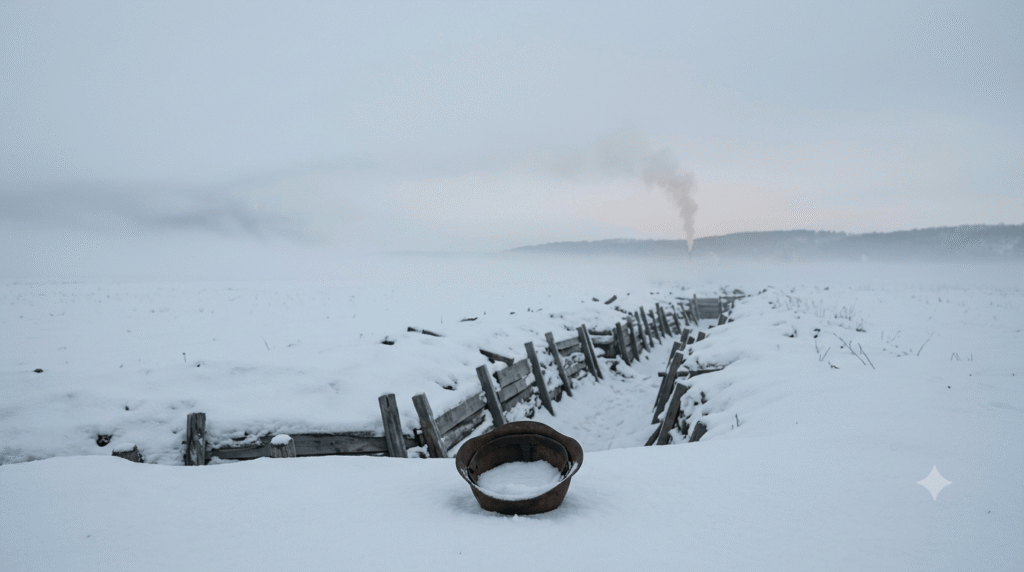
Universal Pictures adapted the novel in 1930. To film the battle sequences, director Lewis Milestone had a mile-long trench dug on a California ranch, with a concrete track built beneath it so the camera could move alongside advancing troops instead of standing still and watching them pass — a technique few directors were attempting in the earliest years of sound film. Milestone also understood that sound could do more than fill a scene; in his hands, a sudden absence of noise became its own kind of dread. What made the film unusual, though, wasn’t the technique. It was the choice to make German conscripts the protagonists — sympathetic, frightened, ordinary boys — barely more than a decade after a war that had cost over a hundred thousand American lives. Hollywood rarely asked American audiences to grieve so directly for the soldiers of the opposing side.
The Academy gave it Best Picture and Best Director. Three years later, Remarque’s books were among those burned in the Nazi book-burnings of 1933, and the film had already been banned in Germany after brownshirts organized by Joseph Goebbels disrupted its Berlin screenings — releasing mice into the aisles and throwing stink bombs to shut the theater down. A story built around the refusal to glorify war turned out to be dangerous enough that a government needed to physically stop people from watching it.
Nothing New Under That Particular Sun
The Old Testament has its own line on this, written some three thousand years earlier by a different kind of veteran — one who had tried power, wealth, and pleasure and found all of it wanting.
“One generation passeth away, and another generation cometh: but the earth abideth for ever.” (Ecclesiastes 1:4)
Another essay here looked at what one generation actually manages to hand the next when the crown, or the blame, changes hands — David, power, and inheritance. The pattern in Ecclesiastes is the same one underneath that story: what gets passed down is rarely what anyone intended to leave.
“The thing that hath been, it is that which shall be; and that which is done is that which shall be done: and there is no new thing under the sun.” (Ecclesiastes 1:9)
“There is no remembrance of former things; neither shall there be any remembrance of things that are to come with those that shall come after.” (Ecclesiastes 1:11)
The word translated “vanity” throughout this book has a physical meaning before it has a philosophical one — something closer to breath, or mist. The thing you can feel on your hand for a moment and never hold. Read that way, “no new thing under the sun” isn’t only about events repeating. It’s about how even our most determined efforts — to end a war, to learn from one — carry that same vapor-like quality: real while we’re inside them, gone the moment we try to grip what they proved.
It leaves an uncomfortable question sitting in the room: whether people who have felt a tragedy up close are actually any less likely to walk toward its shape again, or whether the felt lesson simply doesn’t transfer between generations the way we assume it should.
The Data Behind the Déjà Vu
It isn’t only a literary observation anymore. Researchers at the Uppsala Conflict Data Program recorded 65 active state-based conflicts globally in 2025 — the highest number since they began tracking in 1946 (Uppsala University, 2026).1 Within that total, conflicts fought directly between states reached eight, doubling for a second consecutive year and marking the highest level of interstate warfare since the Second World War.
That is more than a single-year spike. It is a pattern worth noticing.
The weapons have changed almost beyond recognition — satellite-guided missiles, autonomous drones, tools no one drafting boys in 1914 could have imagined. The fear inside an eighteen-year-old holding a rifle for the first time, as far as anyone can actually tell, has not changed at all. The specifics change. The shape of the story, old enough that a book of wisdom literature could describe it accurately without ever hearing the word “trench,” does not.
What the Trenches Already Knew
Near the end of Lewis Milestone’s 1930 film, in a quiet lull between shelling, Paul notices a butterfly resting just beyond the trench wall. He reaches for it — an instinct so ordinary, so unrelated to war, that it barely registers as a decision. It is the last thing he does.
The comparison is imperfect. Diplomacy is not innocence, and a negotiated pause is not a butterfly beyond a trench wall. But both images hold the same fragile wish underneath them: for something ordinary to stay possible, inside a world organized around violence — the same wish behind learning to forgive someone who took everything, which is its own kind of reaching toward the ordinary after a war of one’s own.
Paul reaches anyway — not because he expects to survive it, and not because the gesture changes anything about the war around him, but because something in a person keeps reaching toward the ordinary even where ordinary things have been made impossible. There may be more dignity in that than in whether the reaching succeeds.
1. Uppsala University. (2026). UCDP: Record number of conflicts between states. Uppsala Conflict Data Program press release.
New essays every week. Delivered quietly.