S1 — HOOK
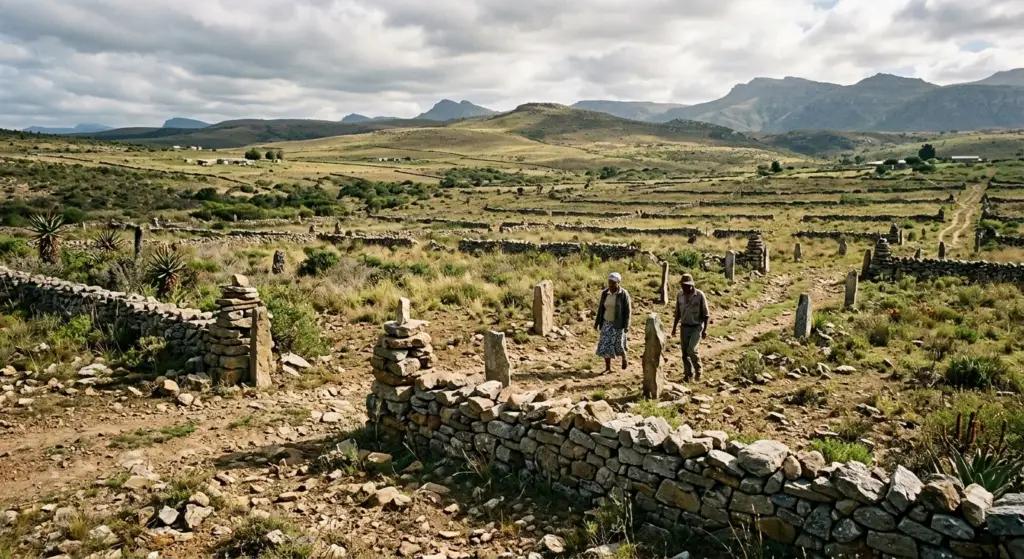
A recent survey of nineteen landholders in South Africa’s Eastern Cape Province found something researchers didn’t expect: nearly every one of them had listed wildlife-based income in their land-reform business plan, and 84 percent actually had wildlife on their land. Only 42 percent were earning anything from it (Shwababa et al., 2025). The deed had transferred. The infrastructure, stock, and market access needed to make the deed worth something had not.
A transfer of ownership is not the same event as a transfer of the conditions that make ownership meaningful. That gap raises a harder question than who receives the land: who decides how it is divided, and what makes a division just once the dividing itself is finished? Long before modern land reform, another text spent twelve chapters wrestling with exactly that question.
S2 — HISTORICAL CASE
An Old Problem, Not a New One
Solon’s reforms in sixth-century BCE Athens are remembered as an early act of economic justice. Their actual mechanism was narrower and more physical: the seisachtheia canceled debts and outlawed debt-bondage, and the horoi — stone markers recording what a farmer owed against his own land — were pulled out of Attic soil one by one (Aristotle, Constitution of the Athenians, c. 4th c. BCE). The law changed. Who could farm productively, and with what resources, did not change nearly as much.
Who Has the Right to a Common Resource
Rome’s Gracchan reforms two centuries later went further, but not in the way they are often summarized. The lex Sempronia agraria did not seize private estates; it capped how much of the ager publicus — public land technically owned by Rome but long occupied by wealthy families — any household could hold. The question underneath that cap was not simply who owned what, but who had a legitimate claim to a resource the whole community was understood to share. Both Gracchus brothers were killed by political opponents within a generation of raising it.1
S3 — BIBLICAL LENS
Joshua 13–19 divides the land among the tribes by casting lots at Shiloh. The lot does something specific: it limits the authority of the men doing the dividing — a distribution settled not by anyone’s preference but by procedural chance, a structure political theorists have since approached from other directions, most famously in arguments for choosing rules before anyone knows which side of them they’ll stand on.
“And Joshua cast lots for them in Shiloh before the LORD: and there Joshua divided the land unto the children of Israel according to their divisions.” (Joshua 18:10, KJV)
But the lot is not the whole system. Two cases run alongside it, and they are not the same kind of case. The daughters of Zelophehad had already secured a ruling under Moses that their father’s inheritance should pass to them — a legal precedent, applied rather than newly argued (Joshua 17:3–4; cf. Numbers 27:1–7). Caleb’s claim is different — not precedent but covenant, a promise made decades earlier and simply recalled:
“Now therefore give me this mountain, whereof the LORD spake in that day… if so be the LORD will be with me, then I shall be able to drive them out, as the LORD said.” (Joshua 14:12, KJV)
A just procedure does not erase a prior obligation. The lot governed what no one had already claimed. It was never asked to govern what had already been promised or already been ruled.
S4 — PATTERN INSIGHT
What the Map Cannot Measure
Land can accumulate across generations in ways income alone cannot — inherited, withheld, and consolidated without any single transaction ever being unjust in isolation. A one-time allotment corrects concentration on paper. It does not by itself supply the water, capital, or market access that turns a boundary line into a livelihood. The allotment is not the same event as the flourishing.
Joshua’s text carries its own version of this gap. The tribe of Levi received no allotted territory at all:
“But unto the tribe of Levi Moses gave not any inheritance: the LORD God of Israel was their inheritance, as he said unto them.” (Joshua 13:33, KJV)
Levi demonstrates that equality of treatment is not identical to equality of possession. What sustained the Levites was a separate provision — dedicated cities, a tithe from the other tribes’ harvest — built for a need the lot was never designed to address. Ownership, in the modern sense, was never the category the text was optimizing for. Something closer to stewardship was.
What does it mean to own something without becoming its master? The gap the Eastern Cape survey found — assets transferred, the conditions for using them left behind — is not unique to land. It shows up anywhere a share, a title, or a credential changes hands without the capacity to make use of it changing hands alongside it. Joshua 13–19 does not solve that gap by removing human judgment. It solves it by keeping an unrigged procedure and a legitimate prior claim inside the same authority.
S5 — CLOSING
The Land After the Lot
The dividing ends by chapter 19. What follows in chapter 24 is not a victory lap but a speech, and its subject is not the map but what the tribes will do with what the map gave them.
“Choose you this day whom ye will serve… but as for me and my house, we will serve the LORD.” (Joshua 24:15, KJV)
Read against the allotment that precedes it, this is not primarily one man’s private resolve. It is addressed to a people who had just finished dividing a shared inheritance, and it binds their households to the same covenant the land itself was distributed under. The text does not hand readers a land policy. It hands them a way of thinking about what allocation owes the people it touches, long after the boundary lines are drawn.
Justice did not end when the land was fairly divided. It began again the moment someone had to live with what they had been given — and an inheritance, in this account, was never merely something received. It was something its recipients became responsible for.
1. Plutarch, “Tiberius and Gaius Gracchus,” in Plutarch’s Lives, trans. Bernadotte Perrin, Loeb Classical Library (Cambridge, MA: Harvard University Press, 1921).
2. Siviwe Shwababa, Matthew F. Child, Alta de Vos, Naledi Mneno, and Hayley S. Clements, “Unlocking Opportunities for Meaningful Participation of Land Reform Beneficiaries in the Wildlife Economy,” Land Use Policy 154 (2025).