HOOK
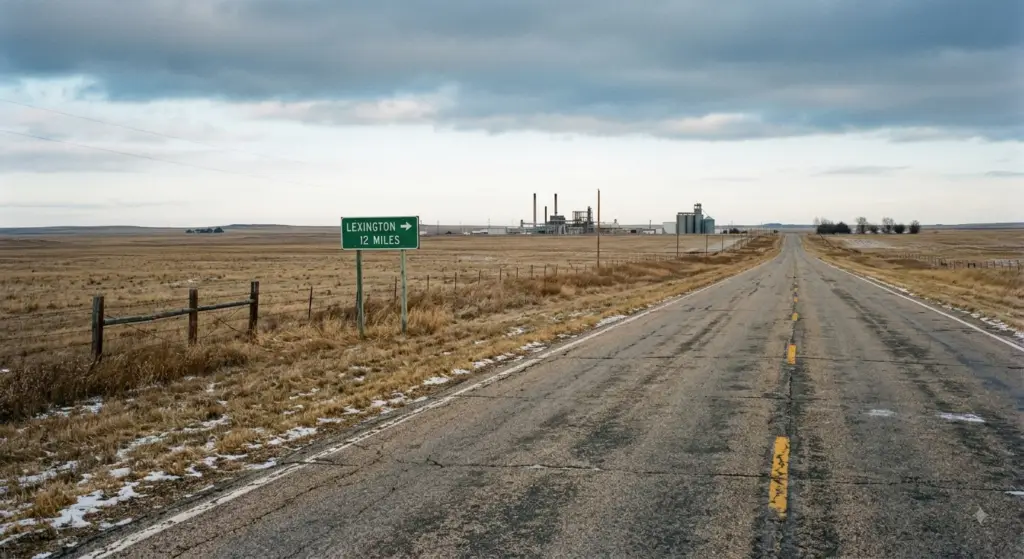
Last December, after Mass at St. Ann’s Catholic Church in Lexington, Nebraska, worshippers filed into the basement and sat on folding chairs, their faces barely masking a fear that had settled over the whole town.
Weeks earlier, Tyson Foods had announced it would permanently close the beef plant that employed nearly a third of the city’s residents — 3,212 positions eliminated, effective January 20. Alejandra Gutierrez, one of the workers, put it plainly: “Suddenly they tell us that there’s no more work. Your world closes in on you.”
That basement is not incidental to this story. In small American towns, church basements are where AA meetings happen, where funeral lunches are served, where the town quietly manages what it cannot manage in public. It was the right room for what Lexington needed to say to itself.
Nobody there needed the layoff notice explained. They needed to know what a town becomes when the one thing holding it together decides to leave.
What a Town Learns From a Company Town
Lexington did not become dependent on Tyson the way nineteenth-century mill towns became dependent on their founders. Lowell, Massachusetts, and Pullman, Illinois, were company towns in the literal sense — the corporation owned the houses, ran the churches, set the rent. When George Pullman cut wages during the depression of 1893 without cutting the rents his own company charged, workers had no other landlord to appeal to, because there was no other landlord. That is direct control. Tyson never owned a single home in Lexington.
What Lexington shows instead is a subtler, more contemporary captivity — not imposed by ownership, but assembled, unintentionally, out of two decades of ordinary choices. The plant opened in 1990 and Tyson bought it eleven years later, and workers came from as far as Los Angeles, many of them immigrants who arrived speaking little English and stayed to buy homes, learn a second language in adult school, and enroll children in a district that now teaches in more than twenty languages. Nobody forced them to stay. The town simply became, gradually and without anyone deciding it, the only place their particular American future was available. That is a different kind of dependency than Pullman’s — not a cage with a landlord’s name on the deed, but an entire town’s mortgage payments, tax base, and Little League schedule quietly organized around one employer’s continued goodwill. It is, in its way, a harder trap to see coming, because no one built it on purpose.
There is a particular irony worth sitting with. The workers who kept America’s beef supply running — who did the coldest, hardest, least visible work in the food chain — were disproportionately the same immigrant families who had the least cushion when that work disappeared. The people who fed the country left holding the fewest options when the country’s meat company decided the math no longer worked.
A Famine Made of Spreadsheets
Scripture opens one of its most tender stories with exactly this kind of departure.
“In the days when the judges ruled, there was a famine in the land, and a man from Bethlehem in Judah went to sojourn in the fields of Moab, he and his wife and his two sons” (Ruth 1:1, ESV).
Naomi’s family did not leave Bethlehem because they were unfaithful. They left because the ground beneath them stopped producing what it once had. The comparison has a real limit, and it is worth naming rather than smoothing over: Naomi’s famine was drought, a failure of nature no human hand had engineered. Lexington’s famine was a spreadsheet — a company’s calculated judgment about cattle supply and next year’s projected losses. One is providence in its harshest form; the other is a decision made in a boardroom. But the question forced on ordinary people turns out to be strangely similar in both cases: what does faithfulness look like when the thing you built your life around stops being reliable, whatever the reason?
Moses warned Israel about a related but distinct danger.
“Beware lest you say in your heart, ‘My power and the might of my hand have gotten me this wealth'” (Deuteronomy 8:17, ESV).
That warning is aimed at people grown comfortable in abundance, tempted to forget who supplied it. It does not quite fit Lexington’s workers, who were never comfortable and never claimed to have built their own security. But it points toward a quieter version of the same danger — not pride, but simple daily necessity, the kind that can make any of us mistake the instrument of our provision for its source, not because we worship it, but because it is what showed up, reliably, for twenty years, until it didn’t.
Scripture never demands that we read economic collapse as an automated verdict from heaven — but it does insist, without exception, that what a people have quietly organized their lives around eventually reveals itself, for better or worse. Losing the plant was not judgment on Lexington. Whatever comes after — recovery or further loss — will not be proof of God’s favor or God’s absence, either. Faith, if it means anything here, cannot be measured by whether the old economy returns.
What the Balance Sheet Doesn’t Count
An economic analysis released by the University of Nebraska–Lincoln, built on the same input-output modeling economists use to study natural disasters, projects the closure will cost the state more than 7,000 jobs once the ripple effects through supporting industries are counted, and Tyson workers alone stand to lose an estimated $241 million in annual pay and benefits.1 Those figures are precise, peer-reviewable, defensible. What they cannot measure is what happened in a church basement in December — a town discovering, all at once, that its sense of who it was had quietly depended on people who will never see that basement, let alone attend the funerals that follow a town’s slow decline.
This is not a case for treating Tyson as a villain. By the company’s own account, the closure followed an expected $600 million loss on beef production — a decision that was, from where the company sits, entirely rational. The harder question is the one this essay’s category exists to ask: can a decision be completely rational for a corporation and still be devastating for the community assembled around it — and if so, who ends up paying the difference the balance sheet doesn’t record? Not the shareholders in another state. The workers. The school district teaching in twenty languages. The church basement where, according to the same reporting, one worker’s daughter quietly decided college might no longer be within reach.
Scripture’s answer to that gap is not simply “trust God” offered as an abstraction. In Ruth, provision arrives through Boaz — a neighbor bound by covenant obligation to leave grain standing in his own fields for a family with nothing. The theological claim underneath the book is not that God provides instead of people, but that God provides through people who agree to absorb some cost on their neighbor’s behalf. If that is true, Lexington’s real question is not only what the town will do without Tyson. It is what the surrounding churches, the neighboring towns, and the wider community owe the families now deciding whether to stay or go.
What the Basement Remembers
Lizeth Yanes, another plant worker, had told a reporter it took her years to learn to love this small town — and that now that she finally did, she had to leave it. That single sentence carries more theology than most sermons manage. A town does not discover what it has actually trusted until the thing it trusted stops providing. Naomi walked back toward Bethlehem not knowing what waited there, only that the famine had taught her something about where her security had never really come from.
Lexington is learning a version of the same lesson, in a Nebraska church basement instead of a foreign field. The harder question left in that basement was never really whether the plant comes back. It’s whether anyone — a neighboring congregation, a state program, a family with room at the table — is willing to become, for a season, the field where someone else is allowed to glean.
1. Elliott Dennis and Eric Thompson, “Economic Impacts of the Tyson Beef Plant Closure in Lexington, Nebraska,” University of Nebraska–Lincoln, Department of Agricultural Economics, December 22, 2025.
New essays every week. Delivered quietly.