S1 — HOOK
Every negotiator eventually asks the same question before signing: who, exactly, is sitting across the table?
Modern contract law has a fairly clean answer for what happens when the answer turns out to be false: an agreement obtained through fraud is voidable — the deceived party can walk away, and the law will usually let them. That escape hatch feels obvious to a modern reader. It did not exist for the people who swore oaths in the ancient Near East. There, a promise was not backed by a court that could later void it. It was backed by whichever god had been named as witness — which meant the weight of what a man had said aloud to that god could outlast, and outrank, the weight of the lie that had gotten him to say it.
The Book of Joshua holds one of the oldest versions of that asymmetry in writing. A nation is tricked into an oath it could have voided by any modern standard. The trick is uncovered. And the oath is kept anyway — not because the deception stopped mattering, but because something else, harder to name, mattered more.
S2 — HISTORICAL CASE
An Agreement Signed on False Premises
A party lies about who it is, or what it can deliver, and secures a better bargain because of the lie. The discovery usually comes too late to undo the transaction cleanly — and the party that was deceived is left holding a promise it never would have made with full information.
Ancient treaties handled this differently than modern contracts do. They were rarely signed alone; they were sworn, often before a deity named as witness — the same suzerain-vassal form used across the ancient Near East, where a weaker party secured protection by binding itself, under oath, to a stronger one. A broken treaty was not only a private failure between two parties. It was a public one, made in front of whichever god had been asked to watch.
A Ruse Built Out of Dust and Mold
The inhabitants of Gibeon seem to have understood exactly this mechanism, and built their survival plan around it.
Israel had just leveled Jericho and Ai. Every kingdom west of the Jordan knew what was coming. Most formed a military coalition to fight it. Gibeon chose differently — not surrender, and not war, but disguise.
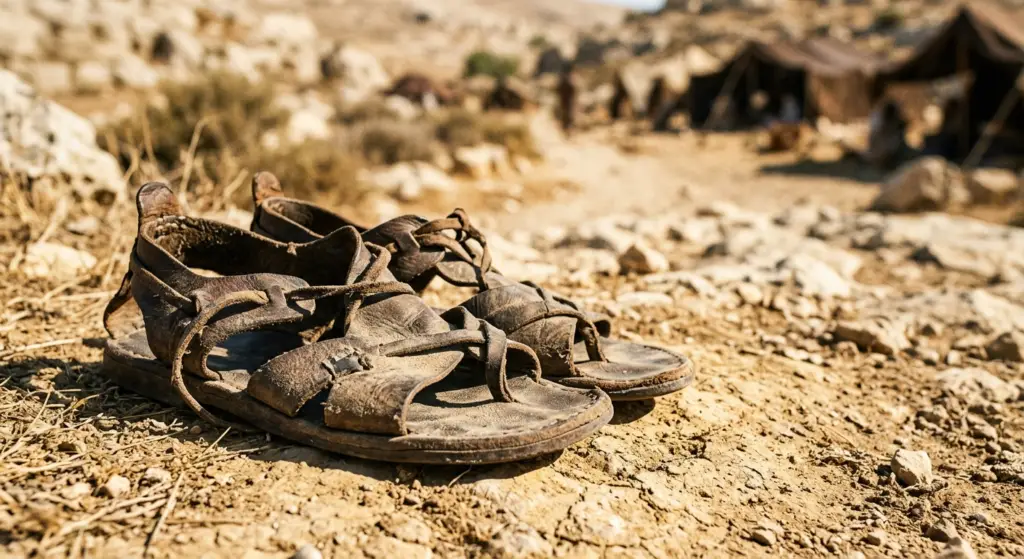
A delegation arrived at Israel’s camp dressed as travelers from a distant country: worn-out sacks on their donkeys, wineskins cracked and mended, sandals patched from the road, bread gone moldy and dry — every prop chosen to make three days of stale evidence look like months of real distance (Joshua 9:3–5). They asked for a treaty of peace, on the claim that they came from far enough away to pose no threat to the conquest.
S3 — BIBLICAL LENS
“And the men took of their victuals, and asked not counsel at the mouth of the LORD. And Joshua made peace with them, and made a league with them, to let them live: and the princes of the congregation sware unto them.” (Joshua 9:14–15, KJV)
That clause — asked not counsel at the mouth of the LORD — carries most of the weight in this story. Israel had a mechanism for exactly this kind of decision, and skipped it. The moldy bread was convincing enough that nobody thought to check.
Three days later, the ruse collapses. Scouts report that the Gibeonites live only a few days’ march away, well inside the land Israel had been instructed to take (Deuteronomy 20:16–18) — a command that makes this discovery graver than a broken business deal. The congregation’s response is not confusion but anger, aimed at their own leaders for a treaty that now looks like a costly, possibly disobedient mistake (Joshua 9:18). And here the text turns on a single sentence.
“But all the princes said unto all the congregation, We have sworn unto them by the LORD God of Israel: now therefore we may not touch them.” (Joshua 9:19, KJV)
The leaders do not argue that the Gibeonites deserve protection, or that the deception was somehow forgivable. Their case rests on something narrower: the deception was Gibeon’s. The oath, once sworn, became Israel’s. One party’s dishonesty did not transfer to the other party’s obligation. The treaty was flawed in its making. It is not, on that basis alone, dissolved in its keeping.
This is not a claim that every oath deserves that kind of loyalty. Scripture elsewhere treats rash vows and coerced promises with real suspicion — a promise built on wickedness does not become sacred by being spoken aloud. What makes Joshua 9 different is that Israel’s leaders do not defend the promise as flawless. They simply refuse to let Gibeon’s dishonesty become the occasion for their own.
The consequence Israel does impose is not annulment but reassignment — the Gibeonites become woodcutters and water-carriers for the community and the altar (Joshua 9:21–27). Equality does not follow from the kept oath; only survival does. The promise held. The relationship it produced was not the one either side had first imagined.
What follows in chapter 10 tests how far that promise reaches. Five Amorite kings, furious that Gibeon defected without a fight, march against the city to punish it. Israel — bound by an oath it never should have had to keep, owed to people who had lied to obtain it — marches all night in Gibeon’s defense (Joshua 10:6–9). In the middle of that unplanned battle, the text records its most famous line: the sun stands still over Gibeon until the fight is won (Joshua 10:12–14). The oath had not merely survived an inconvenience. It had carried Israel into the center of the chapter’s most extraordinary event.
Centuries later, a psalm tries to name the kind of person fit to stand in God’s presence, and gives that same instinct compressed, aphoristic form:
“He that sweareth to his own hurt, and changeth not.” (Psalm 15:4, KJV)
Not the one who is never deceived. The one who, having sworn, keeps the oath even after discovering what it will cost. Joshua 9–10 does not prove that principle historically first; it gives it narrative flesh — a single, costly, specific case of what the psalm states as a rule.
S4 — PATTERN INSIGHT
The Cost Was Not Hypothetical
It would be easy to read Joshua 9 as a story about gullibility with a happy ending. It isn’t. Keeping the oath cost Israel a military campaign it had not planned to fight, on behalf of people who had lied to secure the very protection now being defended with soldiers’ lives. The princes’ decision in verse 19 was made before chapter 10 existed. They committed to the hurt before they knew its price.
A promise that survives only while it remains convenient is not yet fidelity. The test Psalm 15 names only becomes visible after the swearing is finished and the bill has come due.
Where This Still Shows Up
Almost everyone eventually discovers that a commitment they made — to a partner, a family member, an institution — was entered into with information they didn’t have, offered by someone who wasn’t fully honest about what they wanted. Joshua 9 does not resolve every version of that discovery; some agreements genuinely should not survive the fraud that produced them. What it leaves instead is a harder question than one about blame: having given my word, what does keeping it — or breaking it — say about me, independent of what the other side deserved?
There are two ways to hold a promise. One treats fidelity as a transaction — my word is only as good as what the other person has earned. The other treats fidelity as identity — what I said defines me regardless of what the other person turns out to deserve. Joshua 9 does not argue for the second by ignoring the first. It simply shows a people who, having every transactional justification to walk away, chose the harder definition instead.
A Debt That Outlived the Century
The Gibeonites do not disappear from Israel’s story after chapter 10. Centuries later, in 2 Samuel 21, a famine strikes the land. David inquires of the LORD and is told the cause traces back to Saul, who had broken this very treaty and moved violently against the Gibeonites — the text attributes it to zeal, though whose zeal it truly served, Saul’s or Israel’s, the narrative leaves unsettled. What follows is not a comfortable resolution: the Gibeonites name their own terms for atonement, and David grants them. Scripture does not smooth this into something easier to admire.
What it does confirm is something the oath-takers in Joshua 9 could not have known. An oath sworn by one generation did not expire when that generation died. It became, without anyone voting on it, the obligation of every generation after — including one that had never met a Gibeonite and had no memory of the moldy bread. An oath has a memory longer than the people who swore it.
Read backward from 2 Samuel 21, Joshua 9 comes into sharper focus. Israel’s leaders were not moral heroes in that chapter — they had failed to seek counsel, and their failure nearly cost them a mistaken war against people under treaty protection. Israel failed in discernment, and only afterward succeeded in fidelity. Scripture does not require the second without the first ever happening; it simply records that the first did not disqualify Israel from the second.
S5 — CLOSING
The Bread That Never Stopped Being Stale
The Gibeonites’ bread was moldy the day they carried it into Israel’s camp, and it was moldy for a reason — they needed the deception to hold only as long as it took to get an oath sworn. It worked. The mold did its job in three days and was irrelevant by the fourth.
What outlasted the bread was the oath. Not because Israel’s leaders forgot they had been deceived — the grievance is recorded, not erased. It survived because the leaders drew a line between two questions, were we tricked and did we swear, and treated only the second as theirs to answer for.
Centuries of consequence followed from that one line held — a war nobody planned to fight, and a famine, generations later, that remembered what a king had chosen to forget. Scripture records what the oath cost. It never records that Israel tried to take it back.
A person’s character is not finally measured by the promises kept to those who deserved them. It is measured by what happens to the promises made to those who did not.
What, then, does it mean to keep a word to someone who no longer deserves it — and what does refusing to keep it say about the one still holding the promise?
1. Ian Brownlie, Principles of Public International Law, Oxford University Press, 2008.