Opening
A Command Is Held Together by the One Who Stays
The number I keep turning over is 264. It is how many days the USS Abraham Lincoln went without a port call, in a deployment that ran 301 days and, by the account of Military Times, wore heavily on morale aboard the flagship (Military Times, 2026). On Monday, September 28, the first ship of that strike group, the USS Frank E. Petersen Jr., tied up at Pearl Harbor. Its commanding officer said his crew had never abandoned the ship or one another.
I am not interested here in who drew up that calendar. What held me was the idea inside the sentence: a chain of command depends, in part, on the belief that the person at the top will still be there when things turn hard.
Crews can bear a surprising amount of salt, distance, and boredom. What they cannot bear for long is a deck that goes quiet where the captain should be.
Earlier this week we followed Crassus into the Syrian desert, where the weight a commander would not set down was gold (the road a rich man chose). The weight in this essay is lighter, harder to see, and harder to name. It sailed out of a Greek gulf on September 2, 31 BC, and a fleet of Roman ships watched it go.
Historical Case
Sixty Sails Rose Behind the Line
By the summer of 31 BC, Mark Antony and Cleopatra were boxed in at the mouth of the Ambracian Gulf in western Greece. Octavian’s admiral Agrippa had taken the supply points along the coast, and the army ashore, nineteen legions by Plutarch’s count, could be fed only for so long (Plutarch, Life of Antony 68). The choice was to fight, or to break out and run. The plan seems to have allowed for both: the war chest was loaded onto the fastest of Cleopatra’s ships, and sails were kept ready (Mark, 2019).
Near midday a wind came up, and Antony’s heavy ships went out against Agrippa’s lighter, quicker ones. Cleopatra’s sixty ships had been held at the rear. At some point in the fighting they raised their sails and passed through the gap in the line toward open sea.
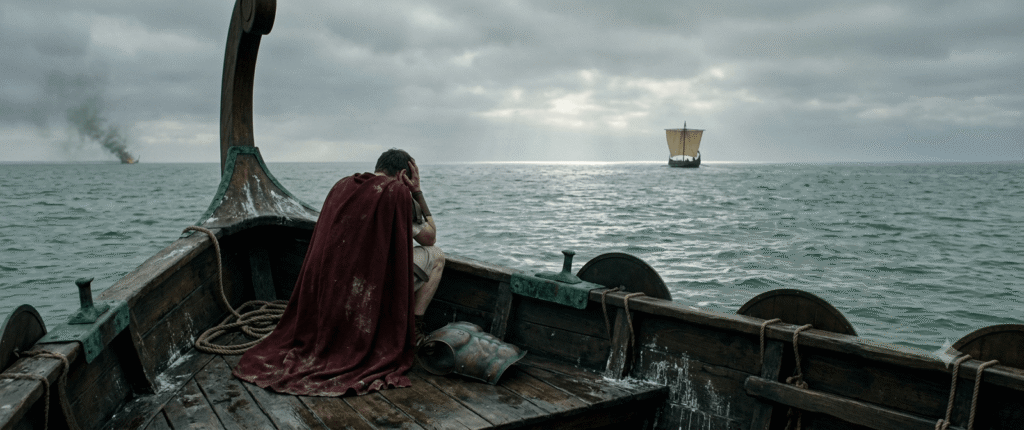
Antony’s flagship was caught in a tangle of hulls. According to Cassius Dio, he left it for a smaller vessel and followed her with about forty ships, climbing aboard Cleopatra’s flagship when he caught up (Cassius Dio, Roman History 50.33–35; Mark, 2019). Plutarch, writing more than a century later, adds the image that stays. Once aboard, Antony went forward alone, sat down in the prow in silence with his head in both hands, and remained there for three days. Plutarch offers two guesses for the silence, anger at Cleopatra or shame at facing her (Plutarch, Life of Antony 67).
Behind him the fight did not stop. Dio describes crews still pushing boarders back with hooks and axes even after Antony had fled, and Plutarch has the fleet holding out until the late afternoon before it gave up.
The army ashore is the part I cannot set down. From Taenarum, Antony sent word to his general Canidius to lead the legions out through Macedonia into Asia, and he gave a shipload of coin and plate to his friends, telling them to scatter and look to their own safety (Plutarch, Life of Antony 67). On the shore, meanwhile, hardly anyone yet believed he had gone. Plutarch says the soldiers found it incredible that a man would leave nineteen undefeated legions, expected him to appear from some quarter, and even after the truth was plain held together for seven days, ignoring the messages Octavian sent them (Plutarch, Life of Antony 68).
They did not yield to the enemy’s arms. By Plutarch’s telling, they yielded only after their general Canidius slipped away by night, leaving them destitute and betrayed by their commanders. The commander had left. The commanded stayed, and kept staying, for a week.
The ancient writers do not agree on what the flight meant. Plutarch reads it as a man’s devotion overriding his duty; Dio narrates the same sequence with more room for calculation. Modern historians have kept the argument alive, between a breakout planned from the start and a battle that became a flight once it turned. It matters, too, who told the story. Octavian had spent the previous year presenting the conflict as a Roman struggle against Cleopatra’s hold on Antony, and the version that reached us was shaped by the needs of the victor (Mark, 2019).
Biblical Lens
A King at Home, an Army in the Field
The books of Samuel contain a spring campaign that begins with a small, unremarked absence.
“And it came to pass, after the year was expired, at the time when kings go forth to battle, that David sent Joab, and his servants with him, and all Israel; and they destroyed the children of Ammon, and besieged Rabbah. But David tarried still at Jerusalem.” (2 Samuel 11:1, KJV)
The narrator does not comment on the verb. He simply sets the season, the army, and the king’s location side by side. Later in the chapter, David summons Uriah the Hittite home from the front, hoping to hide what he has done. Uriah, a soldier in Israel’s ranks, refuses to go down to his house.
“The ark, and Israel, and Judah, abide in tents; and my lord Joab, and the servants of my lord, are encamped in the open fields; shall I then go into mine house, to eat and to drink, and to lie with my wife? as thou livest, and as thy soul liveth, I will not do this thing.” (2 Samuel 11:11, KJV)
Set the two verbs side by side. The king, who belonged with the army, tarried; the soldier, who had every right to go home, would not. A few verses later, the plan to protect the king’s secret is carried out at the city wall.
“And the men of the city went out, and fought with Joab: and there fell some of the people of the servants of David; and Uriah the Hittite died also.” (2 Samuel 11:17, KJV)
Nothing in these pages asks us to hear every wreck as a sentence passed from above. What they do press on a reader, quietly, is that a people’s choices, tallied over enough time, spell out the conditions it was willing to live under.
Pattern Insight
Where the Command Went
A count of hulls and legions settles what was lost. Sixty sails left the line, roughly forty ships followed, and the legions waited ashore. But arithmetic is silent about the human decision at the center of the story: what a commander does when his own safety and the safety of those under him no longer point in the same direction.
Set the silent prow beside Uriah’s open field, and the pattern comes into view. Uriah had a house, a wife, and the king’s permission, and he chose the camp anyway, because his comrades were sleeping in the open. Loyalty in a command runs in two directions, and the downward half is tested only when the person at the top has somewhere else to be. In Samuel, the king has somewhere else to be. At Actium, the commander does.
The two stories are not equal, and it would be dishonest to pretend they are. David’s wrong was active and cruel; the text names it, and a prophet is sent to say so. Antony’s wrong, as far as we can tell, was a departure, with no prophet in sight and no one close enough to speak. The throne David left to his son would later give the same question a longer answer, in a king’s divided heart. What David and Antony share is where the cost lands. In Samuel the price is paid under a city wall by men who did not know why. At Actium it is paid by crews who went on fighting, for hours, on behalf of a commander who was already a sail on the horizon.
Both stories also invite a lazy reading in which a woman is the cause. Octavian’s camp pressed that reading about Cleopatra with great success, and readers of Samuel have done it to Bathsheba for centuries. The Hebrew narrator does not; the weight of the chapter falls on the man who held the power. A queen with her own ships and treasury need not be reduced to a temptation. The ancient sources themselves show her acting as a political and military decision-maker, and on one reading of them her post was her kingdom and its treasury, while his was the army. The one who left his post is the one who answers for the post.
Closing
What a Fleet Is Waiting For
The sequel was short. In the summer of 30 BC, Octavian’s forces entered Alexandria, and by the end of August both Antony and Cleopatra were dead. Within three years the Senate had given Octavian the name Augustus. Actium is often treated as the decisive turning point in Rome’s transition from Republic to imperial rule.
I find myself returning, though, to the week on the shore. Seven days is a long time to hold a line for someone who is not coming back. That kind of waiting is its own form of loyalty, and it is a different thing from the patience I wrote about in trusting God’s timing, because those soldiers had no one to wait on but a man already at sea.
The report from Pearl Harbor ends differently, with a gangway, a crew on the pier, and a captain saying his people stayed. A fleet can endure a great deal. What it cannot easily endure is uncertainty about whether the one in command is still on board.
- Military Times, “First elements of USS Abraham Lincoln strike group return home,” September 30, 2026. Source for the 301-day deployment, the 264 days without a port call, and the return of the USS Frank E. Petersen Jr.
- Plutarch, Life of Antony 66–68, trans. Bernadotte Perrin (Loeb Classical Library, 1920). Source for Antony in the prow, his orders to Canidius, the cargo given to his friends, and the legions’ seven days (67–68).
- Cassius Dio, Roman History 50.31–35. The account of the battle and the departure, including the fighting that continued afterward.
- Joshua J. Mark, “Battle of Actium,” World History Encyclopedia (2019), drawing on J.F.C. Fuller, A Military History of the Western World, vol. 1 (Da Capo, 1997), and M.P. Charlesworth on Octavian’s propaganda. The battle is dated September 2, 31 BC.
- EBSCO Research Starters, “Battle of Actium.” Summary of the scholarly debate over a planned breakout versus a flight.
New essays every week. Delivered quietly.