Opening
A Man Can Lose an Army to What He Refuses to Set Down
On Monday, September 28, gold slid to roughly $4,150 an ounce, its lowest level in nearly two months (Trading Economics, 2026). Less than four weeks earlier it had been trading above $4,490 (Fortune, 2026). A drop like that sends people back to their screens, refreshing the page and doing quiet arithmetic on what they hold.
I keep returning to one detail that never makes it into the market reports: nobody inside that arithmetic asks what the metal is for. It becomes a number to be guarded, and the guarding has a way of turning into the purpose.
Crassus did his own arithmetic, two thousand years ago, and what he concluded from the sum is the story. It is set on a dry plain in what is now southeastern Turkey, in the spring of 53 BC, where the richest man in Rome went looking for more. In the previous installment, we stayed with a grief that had lost its voice. Carrhae is the reverse case: a man whose wanting was never quiet.
Historical Case
The Road Through the Desert Was the Road He Wanted
Marcus Licinius Crassus did not begin as a soldier of fortune. He began as a buyer of burning houses. Plutarch reports that Crassus kept some five hundred builders and architects, and that he bought houses as they burned, along with the neighboring ones, from owners too frightened to bargain (Plutarch, Life of Crassus). Plutarch also ties part of his fortune to the property auctions of Sulla’s proscriptions, a story his rivals had reason to sharpen, so it deserves some caution.
The scale is not in doubt. By Plutarch’s count, an estate of about three hundred talents at the start of his public life had grown to roughly seven thousand one hundred before he marched east. He is said to have remarked that no man counts as rich who cannot keep an army on his own income.
Wealth alone no longer satisfied him. Pompey and Caesar had shown Crassus the other currency of Roman power: military glory, command, and the provinces that came with victory. Syria was his, and beyond Syria lay the Parthian empire, which Rome had barely tested.
The choice that mattered came before the first arrow. King Artavasdes of Armenia offered soldiers and proposed a route through his own hill country, where cavalry would struggle and provisions were near. Crassus preferred the straight line across the Mesopotamian plain, the faster road to the richer prize. Plutarch says he brushed the advice aside.
Some stories don’t need me to explain why they matter. They just need me to get out of the way. So here is what the plain did with seven legions. The Parthian commander, called Surena in the sources, fielded a far smaller force, mostly mounted archers, and kept a train of camels carrying arrows so that the volleys never thinned.
Roman infantry closed ranks and waited for an enemy that would not come close enough to fight. Crassus’s son Publius, chasing what looked like a retreat, was drawn away from the main body and lost with the cavalry he led.
By Plutarch’s count, some twenty thousand Romans died at Carrhae and ten thousand were taken. The survivors fell back toward the town, and a parley was arranged. Crassus went to it reluctantly, pushed by his own men, and did not return.
A later tradition, preserved by Cassius Dio, holds that the Parthians answered his famous appetite with the metal itself. Whether that happened, or was told afterward because the irony was too tidy to resist, the historians cannot settle (Cassius Dio, Roman History, 40.27).
There is one more detail, from the year before, and it comes with a caution. Josephus, writing well over a century later, reports that Crassus passed through Jerusalem in 54 BC and stripped the Temple treasury. According to Josephus, a priest handed over a solid beam of gold on an oath that Crassus would leave the rest alone, and Crassus took the beam and the rest anyway (Josephus, Antiquities 14.105–109).
Josephus had his own reasons to tell the story, and it should be weighed as one voice among several. Still, it shows how the Roman world remembered the man.
Biblical Lens
Two Old Accounts of a Weight Nobody Sees
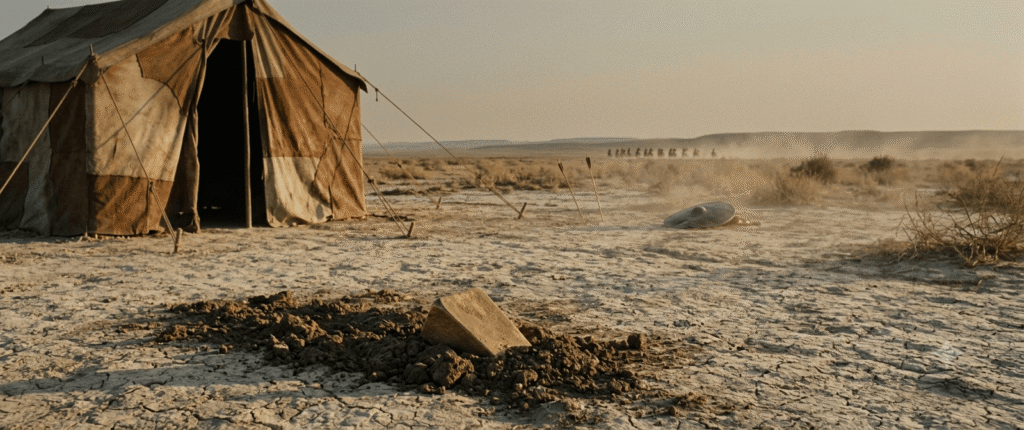
The book of Joshua contains a defeat that makes no military sense. Israel, fresh from Jericho, sends a modest force against the small town of Ai and is driven back, with thirty-six men dead (Joshua 7:5). Joshua falls on his face. The answer, when it comes, is not tactical. Something taken and hidden, in violation of a ban, lies in the earth beneath one man’s tent.
“When I saw among the spoils a goodly Babylonish garment, and two hundred shekels of silver, and a wedge of gold of fifty shekels weight, then I coveted them, and took them; and, behold, they are hid in the earth in the midst of my tent.” (Joshua 7:21, KJV)
The old English keeps the order of events plain: he coveted, and then he took. The verbs arrive in the sequence a conscience would have heard them.
The Gospel of Mark tells a different story from the other side of the ledger. A man runs up and kneels, and he has kept the commandments since youth. Mark adds a line that is easy to skim past, that Jesus, looking at him, loved him. Then comes the single thing lacking, and the man’s face falls.
“And he was sad at that saying, and went away grieved: for he had great possessions.” (Mark 10:22, KJV)
Jesus turns to his disciples and reaches for the most absurd image available.
“It is easier for a camel to go through the eye of a needle, than for a rich man to enter into the kingdom of God.” (Mark 10:25, KJV)
None of this licenses us to read every defeat as a verdict from heaven. The texts claim something smaller and harder to dodge: that a community, given enough time, shows in plain view the terms it agreed to live by.
Pattern Insight
The Weight Chooses the Road
The numbers invite a comfortable reading. Too little cavalry, too few scouts, too much sun, and military historians make that case well (Sampson, 2008). Those explanations are true as far as they go. But they describe how the disaster happened and stay quiet about why the march began on that road.
In the tent that night, the desert road would probably have sounded like strategy: speed, confidence in the legions, a decisive battle. The Armenian route asked for patience, a foreign king’s cooperation, and time. The desert asked for nothing except speed and nerve.
Plutarch attributes to Crassus dreams that reached past Parthia toward Bactria and India, which suggests an appetite that no single victory would have closed. That is an inference from the sources, not a confession from the man, and it should be held loosely.
Set beside the Bible’s two accounts, the pattern comes into focus. One man took what was forbidden; the other kept what was lawfully his. Scripture records both, and that is the unsettling part: an attachment does not have to be a crime to steer a life.
In Joshua the buried thing is hidden from the army and still governs its fate. In Mark the possessions are in plain sight, and the man walks away from a road he wanted to take. Crassus managed both at once. He kept his wealth in the open, yet his appetite for more seems to have helped decide the road he chose.
There is another echo, and it is the one that stays. At Ai, thirty-six men died in a defeat traced to what one man had hidden in his tent. At Carrhae, the price was paid by the men who had followed Crassus into the desert. The weight that a leader will not set down tends to be carried by someone else.
Closing
The Number Was Never the Question
Rome did recover something from Carrhae, though not by force. In 20 BC, under Augustus, the legionary standards lost on that plain came home through negotiation, thirty-three years after the battle (Sampson, 2008). They returned not through another Roman victory but through diplomacy, the slower and less spectacular instrument Crassus had never chosen for his own campaign.
Markets will steady, and the price that fell this week will rise again or fall further. The screen will go on reporting a figure, and the figure will say nothing about whose hands are underneath it.
The gold on that screen last Monday is only a number. What stays worth noticing is the corner of the tent where each of us keeps whatever we cannot afford to have found.
- Plutarch, Life of Crassus (Loeb Classical Library). Source for the fortune, the fires and proscription auctions, the Armenian route, and the casualty figures.
- Josephus, Antiquities of the Jews 14.105–109. The account of the Temple treasury.
- Cassius Dio, Roman History 40.27. The tradition of the molten gold.
- Gareth Sampson, The Defeat of Rome: Crassus, Carrhae and the Invasion of the East (Pen & Sword, 2008). The battle is dated to May or June of 53 BC, depending on the source; the standards were returned in 20 BC.
- Trading Economics, gold price data for September 28–29, 2026; Fortune, “Current price of gold,” September 3, 2026.
New essays every week. Delivered quietly.