Hook
Black letters on a black page
Douglas Seiler, an affiliate of Berkeley SETI, ordered papyrus from Egypt and lampblack ink from Japan, then had high school students copy passages onto the sheets, some of them from the Bible. He rolled the finished scrolls tight, sealed them in a steel container starved of oxygen, and heated them until they charred (Sanders, 2026).1 The aim was to stage in miniature what Vesuvius did to a Roman library in A.D. 79.
The real scrolls, roughly 1,800 whole and fragmentary rolls now held in Italy, France, and England, carry a stubborn problem. Their ink is carbon and so is the page beneath it, so an X-ray finds almost nothing to tell one from the other. Efforts to unroll them by hand, begun after the library’s discovery in 1752, frequently left only ash.
In a paper published September 16 in PLOS ONE, Seiler’s team reported that even trace amounts of lead in the ink can make letters stand out against the burned papyrus, with lead absorbing up to twenty-five times more X-rays than the material around it (Seiler et al., 2026).2 Whether the Herculaneum scrolls actually contain lead has not yet been tested across the collection; this was a proof of concept on modern replicas. What the experiment demonstrates is narrower and stranger: a text can sit entirely intact, letter by letter, and remain unreadable because nothing in it stands apart from its surroundings.
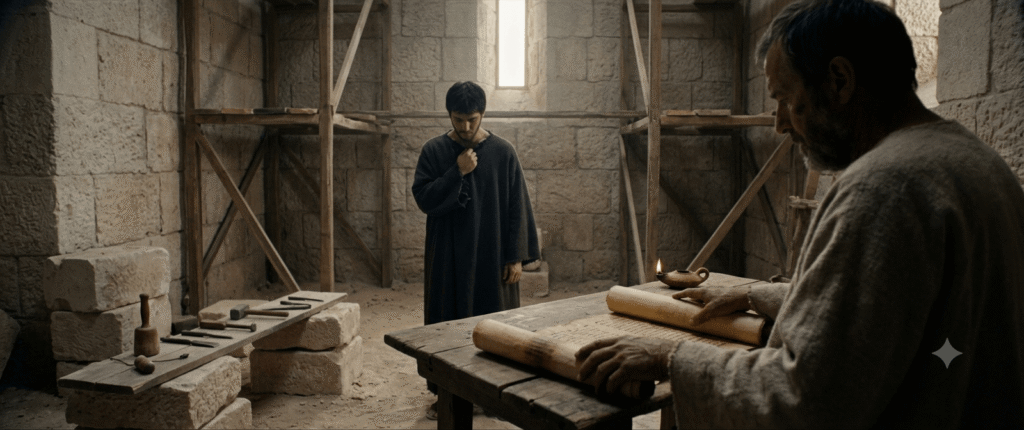
A comparable puzzle opens 2 Kings 22. In the eighteenth year of King Josiah, during repairs on the temple, the high priest Hilkiah tells the royal secretary that he has found the book of the law in the house of the LORD (2 Kings 22:8). A house used for worship had contained its own governing text, yet the text had somehow ceased to govern the life around it. Josiah’s own diagnosis, once the book is read to him, is that the generations before him had not acted on its words (2 Kings 22:13).
In the previous installment, King Ahab tore his clothes at Elijah’s word and bought himself a delay (1 Kings 21:27–29). Here another king tears his clothes at a reading, and what follows poses the harder question: when an old text is found, heard, and obeyed with unusual thoroughness, what exactly has been changed?
Historical Case
A small kingdom between two weather systems
For most of the seventh century B.C., Judah lived inside Assyria’s shadow. An inscription from the reign of Esarhaddon lists Manasseh of Judah among the western kings obliged to supply materials for the Assyrian court’s building works (Pritchard, 1969).3 Manasseh held the throne for fifty-five years, and the biblical writers remember those decades as a long season of altars to the heavenly host, set even in the temple courts (2 Kings 21:3–6).
By Josiah’s day the shadow was thinning. Assyria weakened after the death of Ashurbanipal around 630, and Nineveh fell to a Babylonian-Median coalition in 612. Josiah’s purge, which swept out the astral cults and the cult furniture of the earlier reign (2 Kings 23:4–12), leads some historians to read it as political as well as devotional, since it came as Assyrian power was visibly weakening (Sweeney, 2001).4 The biblical text does not divide conscience from calculation, and neither need we.
The timing, in the end, proved as exposed as the aims. In 609 Pharaoh Neco II marched north to support the remnant of the Assyrian army against Babylon (Grayson, 1975).5 Josiah went out to meet him at Megiddo and was killed there (2 Kings 23:29). The Chronicler preserves Neco’s claim that he had no quarrel with Judah (2 Chronicles 35:21), and what Josiah hoped to accomplish on that road remains unclear.
Renewal inside a small kingdom did not change the weather of empires. Within twenty-three years, four kings sat in Jerusalem. Egypt replaced one (2 Kings 23:33–34), Babylon carried off another (24:12), and in 586 the temple that had given up its scroll was burned (25:9).
Biblical Lens
Three verses, one unresolved question
The chapters on Josiah hold three statements that answer the same event at different levels. The first comes when the secretary Shaphan reads the found book aloud before the king.
Shaphan read from the book, and the king, listening, tore his own clothes.
2 Kings 22:10–11 (paraphrased)
The second is the narrator’s verdict on the reform that followed. It swept out the high places, restored the Passover, and bound the people to a renewed covenant. The assessment is as generous as any in the book, and it is followed at once by a qualification.
No king before him had turned back to the LORD with such completeness of heart, will, and strength, and none after him would match it. And yet the LORD’s long anger against Judah did not cool, kindled as it was by all that Manasseh had provoked.
2 Kings 23:25–26 (paraphrased)
Between the two stands the prophet Huldah, whom the king’s delegation consults. Her answer has two edges. The judgment announced in the book will come, but because Josiah’s heart was tender and he humbled himself, he will be gathered to his grave in peace and spared the sight of it (2 Kings 22:15–20). Megiddo makes “in peace” hard to hear as “quietly”; in context the phrase points to being spared the coming disaster, not to a painless death.
The third voice is a prophet’s. Jeremiah 3:6 places the oracle in Josiah’s days, though the dating of the passage is debated, and its judgment on Judah is blunt.
Even through all of this, Judah did not come back to me with her whole heart; she came back only in pretense.
Jeremiah 3:10 (paraphrased)
Scripture, here as elsewhere, stops short of calling every collapse a sentence; what it will not stop short of is the observation that a people’s long-kept loyalties end up written where anyone can read them, the people themselves included.
Pattern Insight
Thirteen years against fifty-five
Start with the arithmetic. Manasseh reigned fifty-five years, the longest of any king of Judah, and his son Amon added two (2 Kings 21:1, 19). Josiah then reigned thirty-one, but the scroll surfaced only in his eighteenth year, which leaves roughly thirteen years of reform before Megiddo. After him came four kings in twenty-three years, ruling three months, eleven years, three months, and eleven years.
Those figures are not an indictment of Josiah, whom the narrator ranks without rival. They measure how hard the board was. Max Weber, reflecting in 1919 on what political work demands, put it this way:
Politics is a strong and slow boring of hard boards.
Max Weber, Politik als Beruf (1919)
Weber added that it requires passion as well as perspective (Weber, 1919).6 Josiah’s passion is beyond dispute, and the text credits him with all of it. What passion could not supply was a reign longer than the habit it was working against.
The Bible’s own account lets us separate the work into three registers, and Josiah’s story gives a different answer in each. For the person, the response was real, and Huldah says as much. For the institution, it produced visible change: altars were cleared, and, according to the narrator, the Passover was kept on a scale not seen since the days of the judges (2 Kings 23:21–23). For the nation’s direction, an oracle that Jeremiah 3:6 dates to Josiah’s days suggests the change did not take hold. A decree can clear the altars in a season, but it cannot by itself change what a people loves.
Read the chapter’s verbs in order: found, read, torn, covenanted, purged, observed. None of them names something that continues on its own. The Berkeley experiment offers a small gloss on that list. Hilkiah’s book could still be read, and the survival of the letters was never the problem. In the laboratory, contrast comes from the chemistry of the ink; in Judah it came from attention, first Josiah’s and then, for a time, the people’s, and attention, unlike lead, has to be renewed by each generation that wants it.
Closing
Recovering a text is not the same as returning to it
Hilkiah’s discovery reads like a happy ending that the narrator declines to finish. The reform was real, and it was not enough. Kings holds both facts on the same page, and a reader who wants only one of them has to tear the other out.
A text can be intact and still cease to govern the life around it. The Berkeley scrolls show a cousin of the same problem: a text can lie intact inside its surroundings, matching them so closely that no one can read it, until something makes the letters stand apart. In Jerusalem, that something was attention. A king heard the words, tore his clothes, sought a prophet, renewed the covenant, and set the reforms of 2 Kings 23 in motion. A nation shows what it has chosen not by the books it finds, but by what it is still doing with them a generation later.
The last lines of 2 Kings record that Jehoiachin, thirty-seven years into his captivity, was released and given a seat at the Babylonian king’s table (2 Kings 25:27–30). The narrator explains nothing and promises nothing. A history that opened its final chapters with a recovered scroll closes with a smaller recovery: one door left open in a foreign palace.
In the laboratory, contrast made the letters visible. In Jerusalem, attention made the text visible again. Kings keeps the reform, the warning, and the thirteen years between discovery and Megiddo on the same page.
- Robert Sanders, “To read 2,000-year-old burned scrolls, scientists burn their own,” Berkeley News, Sept. 16, 2026.
- Seiler et al., “A model carbonized papyrus scroll opens a novel path to identifying readable scrolls of the Herculaneum Library,” PLOS ONE 21(9): e0353485 (2026).
- J. B. Pritchard, ed., Ancient Near Eastern Texts Relating to the Old Testament, 3rd ed. (Princeton University Press, 1969).
- Marvin A. Sweeney, King Josiah of Judah: The Lost Messiah of Israel (Oxford University Press, 2001).
- A. K. Grayson, Assyrian and Babylonian Chronicles (J. J. Augustin, 1975).
- Max Weber, “Politik als Beruf” (1919); English as rendered in Scott Horton, “Weber on the Political Vocation,” Harper’s Magazine, June 2008.
New essays every week. Delivered quietly.