The Watchtower Files
A Kidney Given Where No Debt Was Owed
In September 2026, Amanda Kulin gave a kidney to a man she knew only casually — a fact that would be unremarkable if he had been her brother, and remains striking because he was not.
For two years, Christos Panagiotidis of Kennett, Missouri had lived with kidney failure while his wife, Meli, worked through their circle of family and friends looking for a match. When that circle ran out, she posted an appeal video to her personal Facebook page and to the Facebook account of the boutique she runs — a video that went on to reach more than seventy thousand views and hundreds of shares across the region (KFVS12, 2026).
Amanda saw it once. She was not related to Christos, and by her own account not one of his close friends either — someone the couple knew the way people in a town of ten thousand tend to know each other. She called in anyway.
Living-donor kidney transplantation has a specific birthday: December 23, 1954, at Boston’s Peter Bent Brigham Hospital, when surgeon Joseph Murray transplanted a kidney from Ronald Herrick into his identical twin brother, Richard — the first successful human kidney transplant in medical history. It worked in large part because the brothers were genetically identical; Richard’s body had no biological reason to reject what his twin gave him. Murray received the Nobel Prize in Physiology or Medicine decades later.
The genetic advantage the Herrick brothers had is the exception that shaped an expectation, not a rule that has held absolutely. In the decades since, most living kidney donations in the United States have continued to travel along existing bonds — spouse to spouse, sibling to sibling, parent to child — closely enough that transplant-ethics guidance has had to build a separate framework specifically to address the rarer case of a donor with no prior tie to the recipient at all (HRSA, 2023).
Read one way, the history that runs from the Herricks to now is a history of overcoming immune rejection. Read another way, it is a slower history of an ethical boundary being redrawn — medicine deciding, case by case, who counts as close enough to receive a piece of someone else’s body. Amanda Kulin’s decision does not fall safely inside that boundary. It sits closer to its furthest edge yet drawn.
The oldest text most Americans still know about a debt owed to a near-stranger is not a modern one. A religious lawyer once asked Jesus to define the edge of the command to love one’s neighbor — “And who is my neighbor?” (Luke 10:29) — a question most commentators read as an attempt to find out how small that circle could reasonably be drawn.
Jesus answers with a story about a traveler beaten and left on the road, passed by a priest and then a Levite, until:
“But a Samaritan, as he journeyed, came to where he was, and when he saw him, he had compassion.” (Luke 10:33)
What gave the story its force to a first-century audience was not simply that the Samaritan was a stranger to the wounded man. Jews and Samaritans held each other at a distance shaped by centuries of religious and ethnic estrangement; the Samaritan had more reason than most travelers on that road to keep walking. He stopped anyway, bandaged the man’s wounds, and paid an innkeeper to continue the man’s care.
Jesus does not close the exchange by answering the lawyer’s original question. He reframes it:
“Which of these three, do you think, proved to be a neighbor…? He said, ‘The one who showed him mercy.’ And Jesus said to him, ‘Go and do likewise.’” (Luke 10:36–37)
The parable does not claim that every costly kindness is an appointment scheduled by heaven in advance, or that everyone unable to give this way has failed some test the story is administering. What it insists on is narrower: “neighbor” was never a category to be settled by definition. It is something a person becomes, by what they are willing to do once someone else’s need is in front of them.
There is a way to hear Amanda’s decision inside that same reframing. The lawyer’s question was a passive one — who already qualifies, so that I can stop looking there. What Amanda did looks closer to the active version the parable leaves its listener with instead: not who is close enough to require my help, but who I am willing to become a neighbor to.
Transplant literature generally sorts living donors into two broad categories — directed, where the donor names a specific recipient, and non-directed, where they do not — but directed donation itself spans a wide range, from a spouse or sibling at one end to, occasionally, someone who simply heard about the need at the other. Amanda’s gift sits at that far end of the directed category: she named her recipient, the way a family donor does, while carrying none of the biological tie or long-standing relationship that usually accompanies that kind of naming.
Even against that narrower comparison, the numbers make the exception visible. In 2019, non-directed donors — those who give without naming any recipient at all — accounted for just 387 of the 6,863 living-kidney donations performed in the United States that year, about one in eighteen (Jan et al., 2022). The overwhelming remainder followed the pattern transplant medicine was built around: a donor already bound to the recipient by family or established relationship. Amanda’s gift belongs comfortably to neither group. She named someone, but carried none of the history that ordinarily earns a name that kind of claim.
None of this should read as treating the decision as costless. Living kidney donation involves a full medical workup, informed consent, major surgery, and a permanent reduction in kidney reserve — considerations serious enough that transplant centers require every donor to weigh independently of the recipient’s need (HRSA, 2023). Many people who might want to give this kind of gift cannot, for reasons of health, family responsibility, or finances that have nothing to do with the size of their heart.
Amanda’s own account of the decision was not medical language at all. “I knew immediately that was the vessel that God had talked about,” she said of the moment she watched the video — and, more plainly elsewhere: “God told me to.” Whatever a reader makes of that framing, it is Amanda’s own description of what moved her, not a claim this essay is making on her behalf.
The Vessel
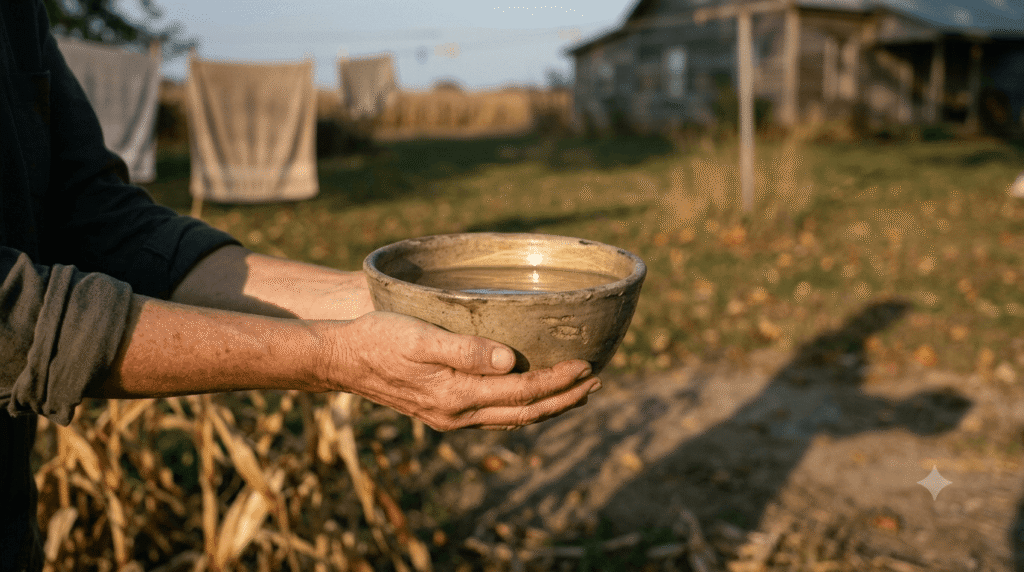
The word “vessel” is Amanda’s own, and it is worth sitting with. A vessel is not the gift itself. It is what carries a gift from one place to another — a shape willing to hold something it did not manufacture and will not keep.
It is also a word that runs against how most people are taught to think about their own bodies today — as property, fully theirs to allocate however their own judgment sees fit. “Vessel” suggests something nearer the opposite: not a possession to be managed, but a channel something else was permitted to move through. A reader does not have to share Amanda’s theology to notice how far that idea sits from the default one, or to wonder, briefly, what it would cost to actually live inside it.
In the previous installment, we examined what it cost a woman to forgive a debt she had every right to hold onto. This story asks a related question from the other direction: what a person is willing to give before any debt exists at all — before there is a wrong to repay or a bond to honor, only a stranger’s video and a decision not to keep scrolling.
Christos Panagiotidis is now home in Kennett, recovering. Somewhere behind that fact is a two-year search, a video his wife never expected to work, and a woman who, when she saw it, has said only that she knew immediately what she was supposed to do.
1 Jan, Muhammad Y., et al. “Nondirected Living Kidney Donation and Recipient Outcomes in the United States: A 20-Year Review.” Kidney International Reports, vol. 7, no. 6, 2022, pp. 1289–1305.
New essays every week. Delivered quietly.